Sensex, Nifty Gain, Defying Global Gloom Ahead Of Key US Jobs Data
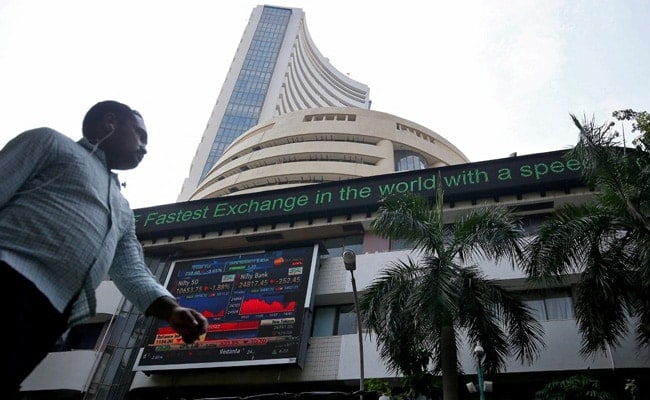
Equity benchmarks opened in the green, recouping some of the steep losses in the previous session even as the global economic gloom persists and investors eye the key US jobs data later on Friday.
The 30-share BSE Sensex index climbed 342.07 points to 59,108.66 in early trade, and the broader NSE Nifty-50 index gained 101.05 points to 17,643.85.
From the Sensex pack, NTPC, ITC, Bajaj Finance, Kotak Mahindra Bank, Larsen & Toubro, Titan, Mahindra & Mahindra and Asian Paints were among the gainers in early trade.
Tata Steel, IndusInd Bank, Reliance Industries, HDFC, UltraTech Cement and Bajaj Finserv were among the laggards.
After a report claimed that the Indian government had permitted public sector businesses to import goods for renewable energy projects from nations like China, the Nifty energy index rose 0.8 per cent, boosted by a 3 per cent gain in NTPC.
That comes after Indian equity benchmarks crashed over 1 per cent to start on a weak note in September, a month that is often poor for global stocks' returns, reversing two-straight months of bull run.
"Local benchmark indices are likely to log gains in early trades Friday amid mixed Asian market cues, and if global cues improve, then there is a bright chance that Nifty could scale higher," Prashanth Tapse, Senior Vice President for Research at Mehta Equities, had said ahead of the markets open.
"The effect of Jackson Hole is still revolving across financial markets with a soaring dollar and falling equities as the main themes," he added.
The effect of Jackson Hole is still revolving across financial markets, with a soaring dollar and falling equities as the main themes.
After US central bank officials made it plain they view the need for restrictive monetary conditions for some time, an indicator of global shares is poised for its worst week since June. This is due to waning bets on moderate Fed tightening.
"We don't have a lot of reasons to be bullish in this type of environment for the next couple of weeks and months," Meera Pandit, global market strategist at JPMorgan Asset Management, said on Bloomberg Television. "Yet when we think about the long-term perspective and the longer-term investor, these are the types of levels that can be fruitful in the long run."
Ahead of the key US jobs data that could fuel hopes for another quick Fed interest-rate hike, an Asian stock index declined on Friday, and a dollar gauge lingered close to a record high.
A regional equities index was hurt by declines in Hong Kong and Japan, while bourses in China experienced mixed results.
MSCI's broadest index of Asia-Pacific shares outside Japan remained largely unchanged in early Asia trade. Still, it was headed for its worst weekly performance in seven with a drop of 3 per cent, as rising expectations of hawkish global rate hikes hit risky assets.
Oil prices tumbled 3 per cent overnight before recovering some ground on Friday but were on track to post their worst weekly drop in four on fears COVID-19 curbs in China and weak global growth will hit demand.
"Markets broadly continue to absorb that central banks' 'whatever it takes to lower inflation message means much slower global economic growth," said Tobin Gorey, agriculture strategy director at the Commonwealth Bank, in a note. "And China's weakening economy is an amplifying special factor in that scenario."
In Europe, fears of a recession are on the rise. On Thursday, a survey showed that manufacturing activity across the euro zone declined again last month as consumers feeling the pinch from a deepening cost of living crisis cut spending.
US futures shook after Wall Street scraped out minor gains after a four-day losing streak.
Following stronger-than-expected US manufacturing data, Friday's payroll growth is anticipated to be high. Traders increasingly anticipate another large 75 basis points Fed rate rise to cool inflation.
The two-year Treasury yield was close to the highest since 2007 against that backdrop.
The Bloomberg Global Aggregate Total Return Index of government and investment-grade corporate bonds is down more than 20 per cent from a peak in 2021, signalling the first bear market in a generation for the entire world's bonds market.

-
Talking Points This Week: Tech Nerves, FII Buying, And A Faraway Banking Shock

The global markets are not shining this Diwali. The exception in the large markets is, India.
-
Midterm Rally Lasted A Day. The Hard Reality Of A Divided US May Last Two Years | Opinion
Between a contested AI boom, a debt ceiling that arrives in 2027 and a president with every incentive to act alone, the next two years may prove more volatile than the first day's rally suggests.
-
Blue Wave Will Derail the AI Trade but Won't Dismantle the AI Era | Unhedged Position
The Democrats' sweep of the US Congress will see politics collide with economic forces both over the long and short term.
-
It's Time To Take The GST Council's Bet On Trust Global
Payment records can prove India's services exports, and clear, proportionate rules can bring foreign digital sellers into the tax net.
-
Opinion | India at 38: From Innovation Overperformer to Innovation Powerhouse
India now has 453 VC-backed deep science startups, 18 of them late-stage, after 117 percent growth since 2020. Laurus Labs, at USD 9.3 billion, is the most valuable deep science company in any middle-income economy outside China.
-
Navigating Energy Crossroads: S Jaishankar's Call For Diversified Supply Chains At G20 Ministerial Meeting
As geopolitical fault lines continue to test maritime trade routes and commodity flows, Jaishankar's message remains pertinent: true economic resilience requires open markets, protected transit lines, and a genuine commitment to multilateral cooperation rather than coercion.
-
Indians Are Travelling, But Not Every Journey Is A Holiday | The Week In Whys
Pilgrims, patients and working women are the real travellers, and the system hasn't quite caught up with them.
-
Getting To Work Costs Women More | The Reason Why
It is not just about women paying more than men. It is about women paying much more in cities than in villages.
-
AI Bias In Investing Cannot Be Eliminated, But It Can Be Governed
Framing is a particularly important example as identical financial information presented in terms of gains rather than losses can lead an LLM to reach a different assessment.









