Sensex Falls Over 300 Points, Extending Losses For Second Straight Session
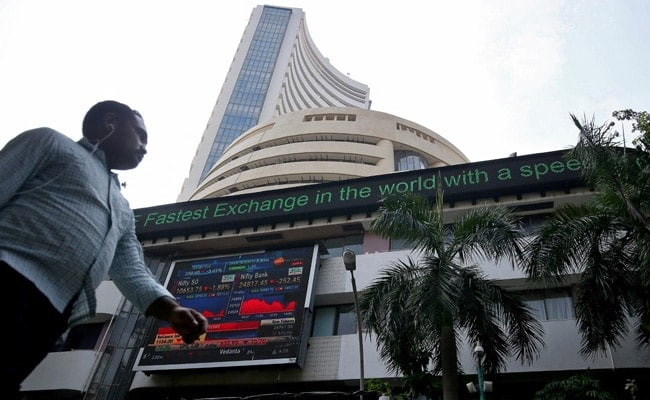
Indian equity benchmarks extended losses for the second straight session on Thursday as rising Covid cases in China alarmed investors who had anticipated the world's second-largest economy to pick up steam following the easing of strict restrictions.
After closing marginally lower in the previous session, the BSE Sensex index fell 300.33 points to 60,609.95 in early trade on Thursday, and the broader NSE Nifty index opened in the red, reflecting a fall in wider Asian share markets along with oil prices.
As traders try to settle their futures and options (F&)) contracts for the December derivatives, the last series of 2022, the expiry on Thursday could cause a spike in volatility.
"Markets are likely to see a bearish opening on Thursday in view of weak global cues after US markets slumped overnight amidst rising bond yields over fears that inflation could pick up on China's reopening," said Prashanth Tapse, Senior Vice President For Research at Mehta Equities.
"Volatility is likely to be the hallmark for the day as traders roll-over December F&O contracts to January," he added.
The broader MSCI index of Asia-Pacific shares, barring Japan, was down over 1 per cent and on track to post losses for the third consecutive week.
Markets have remained muted due to worries that measures by central banks to manage inflation could cause an economic downturn and the uncertainty around how China's economy will perform after the easing of Covid restrictions have also weighed on risk assets, with Wall Street shares ending in the red overnight.
Since Beijing began dismantling its zero-COVID policy at the beginning of the month, its healthcare sector has been under much strain.
On a light trading day, equity indexes in South Korea, Australia, Hong Kong, and Japan fell by more than 1 per cent.
After the S&P 500 index dropped 1.2 per cent to its lowest level in more than a month, futures contracts for European equities declined while those for the S&P 500 see-sawed between gains and losses.
After a terrible year for the financial markets, optimism was dampened in the final trading week of 2022 by the possibility of additional pandemic damage to weak supply chains as central banks struggle to manage inflation.
A worldwide bond index has fallen 16 per cent, while global equities have lost a fifth of their value, the biggest annual loss since 2008. The US 10-year yield has risen from 1.5 per cent at the end of 2021 to above 3.8 per cent due to the dollar's 7 per cent increase.
China's reopening "complicates the Fed's job with respect to putting a little bit of a bid under oil prices, putting a little bit of a bid under inflation globally, to aggregate demand," said Sameer Samana, Senior Global Market Strategist for Wells Fargo Investment Institute, on Bloomberg TV.
"That's going to be one of the biggest things that we'll be watching in the first half," he added.
As the number of COVID-19 cases in China increased, there was less optimism for a rebound in fuel demand in the second-largest oil consumer in the world, pushing crude prices lower.
That crude price fall could cap the domestic shares losses as India depends on imports for over 85 per cent of its oil needs.

-
Navigating Friction And Energy Realities: An Analysis Of Marco Rubio's October Visit To India

Occurring at a critical juncture marked by stalled trade negotiations and escalating geopolitical pressures over global energy supplies, the visit offers a profound window into modern US-India relations.
-
India Exports Capital. Why Not Export Trusteeship?
The big question, then, is whether India can build an institution that global borrowers, investors, banks, and lawyers can trust, even without an Indian connection.
-
France's Economy & Politics Are In Crisis | The Reason Why
Let's look at how the French economy and politics evolved under Nicolas Sarkozy, Franois Hollande and Emmanuel Macron.
-
You May Inherit The Business. You Must Earn Its Credibility.
Succession tests the founder's ability to share authority as much as it tests the next generation's readiness to assume it.
-
Signing Deals Is One Thing; Making Them Work Is Another | The Week In Whys
Sometimes, things don't turn out as planned. Indian companies have lost some bids to rivals, some projects won't produce until 2030.
-
FOMC Wall, PERM Suspension, Hospital Stocks | Talking Points This Week
A PERM suspension would directly affect green-card sponsorship rather than H-1B visas, so the near-term earnings impact could remain relatively limited. The key question is whether this marks a new phase in US scrutiny of Indian IT.
-
Everything, Everywhere, All At Once: Dalal Street's Week To Forget | Joining The Dots
Visa curbs, a Starlink spat and cancer drug caps: what connects this week's shocks for Indian markets
-
India Is Going Abroad For Critical Minerals. But It May Take Years To Pay Off | The Reason Why
Although India's steps are in the right direction, they remain modest compared with India's growing dependence.
-
When Everyone Has AI, What Gives You An Edge?
India's young workforce is entering an uncertain world of work where powerful AI tools are becoming widely accessible. The advantage will belong to those who combine deep expertise with digital fluency, and the distinctly human capabilities that technology cannot manufacture.
-
Wrong Labels, High Pesticide Residues Holding Back Agri Exports | The Reason Why
India needs stronger domestic food-safety and labelling standards, with best practices becoming part of everyday business for farmers, traders and food companies.