Sensex Ends Higher, But Pares Some Gains To Close Below 60,000 Level
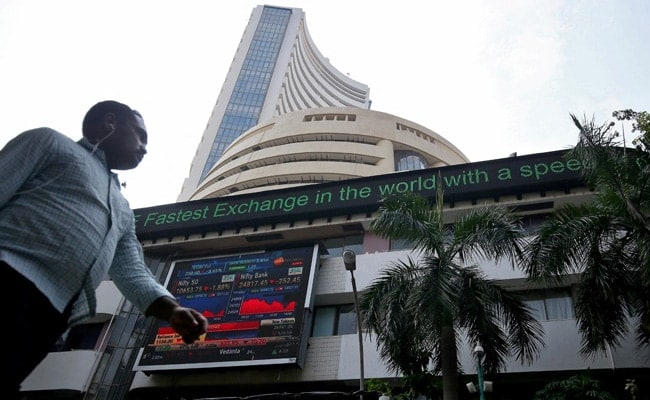
Equity benchmarks end higher but pare some gains earlier in the session, with the Sensex index closing below 60,000 points after hitting that level earlier in the day, driven by a broader risk assets rally.
Assets considered the market's improved sentiment helped risky bets at the conclusion of the week, which was reflected in broad gains in global stocks, especially European equities, and a softening dollar.
Even bruised cryptocurrencies rose at the dollar's expense, with bitcoin back above $20,000 and up 7 per cent.
The 30-share BSE Sensex index hit an intra-day high of 60,119.80 earlier in the session but ended Friday below that mark with gains of 104.92 points, or 0.18 per cent to 59,793.14 and the broader NSE Nifty-50 index climbed 34.60 points, or 0.19 per cent to 17,833.35.
With gains on Friday, equity benchmarks ended higher for the second straight session. Indian shares ended at a three-week high, logging their first weekly climb in three, led by strong buying in technology stocks. For the year, the Nifty 50 is up nearly 3 per cent.
With heavyweight Infosys rising 2.4 per cent, the Nifty IT index gained 2.2 per cent to close at its highest level in over two weeks, making it the best-performing sub-index on Friday.
To increase supplies and lower local costs, India, the world's largest exporter of rice, restricted the export of broken rice and levied a 20 per cent export tax on the sale of specific grades abroad.
Rain Industries saw its worst day since June 20 and closed 7.7 per cent lower, after the carbon and advanced materials manufacturer said that a European plant would temporarily close in anticipation of anticipated natural gas shortages and price hikes.
Markets are now eyeing data due Monday which will likely show that retail inflation ended a three-month downward trend to rise back up to nearly 7 per cent in August as food costs rose, according to a Reuter survey of economists.
Foreign investors are putting money heavily once more in the domestic market because they believe that the Indian economy will grow faster than its peers globally, despite warnings from analysts about inflated values.
"Both the Sensex and Nifty Indexes gained 1.7 per cent each over the past week. The Indian markets were buoyed by falling crude prices and a decline in domestic bond yields. Autos were the top losers in the week, while banks, capital goods and healthcare were the top gainers among major sectors," said Shrikant Chouhan, Head of Equity Research for Retail at Kotak Securities.
A broad rally in risk assets pushed the dollar lower, with the US currency heading for its first weekly decline in four weeks as investors eyed the US inflation data early next week.
Indeed, the dollar index, which compares the greenback's performance against six major counterparts, fell 1 per cent on Friday and traded at 108.400. The currency lost territory overall and was set for a weekly decline of 1.1 per cent, the first fall in a month or so.
Global equities were on track to post their first weekly gain in four weeks, providing some relief from the bear-market warning signs circling the markets due to monetary tightening, energy problems, and China's slowing economy on COVID-19 shutdowns.
That even as Federal Reserve Chair, Jerome Powell, confirmed an aggressive policy path.
"The markets have finally digested the fact that rates are almost certain to go up by 75 basis points when the Fed moves next," JoAnne Feeney, partner and portfolio manager for Advisors Capital Management, said on Bloomberg TV.
"What we are seeing, though, is some recognition that perhaps the sell-off that we saw in the second half of August was a bit overdone," she said.
On the other hand, Bank of America strategists warned that investors are fleeing US stocks as the chance of an economic slowdown rises amid various dangers, in contrast to the upbeat mood in equity markets on Friday, according to Bloomberg.
According to EPFR Global data published by the bank, US stock funds experienced outflows of $10.9 billion in the week ending Sept. 7. This was the largest outflow in 11 weeks and was driven by technology stocks.
Still, Wall Street's major indexes made minor gains overnight, which left the S&P 500 above 4,000 points for the first time since late August.
In Asia, the MSCI index of Asia-Pacific shares outside Japan rose to the highest in two weeks, and the strongest suggestion yet from Japanese officials about potential direct market intervention in reaction to the yen's weakness sent the currency on its way to its best day in a month.
Among the big gainers was the euro, which leapt 1.1 per cent to a three-week high of $1.01105, a day after the European Central Bank hiked its key rate by a record 75 basis points (bps) and hinted at more to come.
"This is clearly an interest rate differential story," Samy Chaar, chief economist at Lombard Odier, told Reuters. "We have yields in Europe that continue to be well supported following the ECB, that was – as expected - hawkish through all the policy instruments. And on the other hand, US yields are backing down a bit.
"Putting the two together, that's probably what is behind the retreat of the dollar," he added.
Still, the death of Queen Elizabeth II, which provoked an outpouring of sympathy from all across the world, was overshadowing the market gyrations on Friday.
On the other hand, the rupee gained sharply on Friday to hold its ground firmly and extended its weekly winning streak for the second week in a row.
The Indian currency hit a one-month high of 79.57 earlier in the day and closed out the week with gains of about 0.2 per cent, which was its best performance in seven weeks.

-
Navigating Energy Crossroads: S Jaishankar's Call For Diversified Supply Chains At G20 Ministerial Meeting

As geopolitical fault lines continue to test maritime trade routes and commodity flows, Jaishankar's message remains pertinent: true economic resilience requires open markets, protected transit lines, and a genuine commitment to multilateral cooperation rather than coercion.
-
Indians Are Travelling, But Not Every Journey Is A Holiday | The Week In Whys
Pilgrims, patients and working women are the real travellers, and the system hasn't quite caught up with them.
-
Getting To Work Costs Women More | The Reason Why
It is not just about women paying more than men. It is about women paying much more in cities than in villages.
-
AI Bias In Investing Cannot Be Eliminated, But It Can Be Governed
Framing is a particularly important example as identical financial information presented in terms of gains rather than losses can lead an LLM to reach a different assessment.
-
Joining The Dots | Dark Skies, Steady Diya: Why Hope Holds This Diwali
With war, a weak rupee and foreign outflows weighing on sentiment, policymakers at the NDTV World Summit and market veterans at NDTV Profit Ignite: Diwali Edition offered the same advice: stay invested and filter out the noise.
-
The Curious Case of Equitas Small Finance Bank And A CEO Who Quit For Stock
PN Vasudevan believes persistent investor concerns over a perceived conflict of interest had become a governance overhang on Equitas Small Finance Bank's stock, even as the lender improved profitability and asset quality.
-
Talking Points This Week: AI Cash Burn, A Tiger Comeback And An India That Still Finds Its Own Path
India is not immune to higher oil or tighter global liquidity, yet its earnings base is broader, its domestic policy levers are still available.
-
Foreign Investors Own Half Of HDFC Bank and ICICI Bank. An LTCG Cut Could Matter Most Here
Foreign portfolio investors have US$115 billion parked in HDFC Bank, ICICI Bank. If the government cuts long-term capital gains tax, Jefferies says returning foreign money could land here first.
-
'Never Seen This Level Of Negativity': Sandeep Tandon Says The Next Rally May Be Closer Than You Think
Veteran investor Sandeep Tandon says foreign selling is easing, large-caps are due a comeback and mid-caps are crowded, while he turns positive on gold, power and pharma this Diwali.
-
Indians Stay With Family, Not In Hotels | The Reason Why
India still lacks enough clean, reliable and affordable hotels for budget-conscious travellers.










