Steel Prices May Fall To Rs 60,000 Per Tonne By March: Report
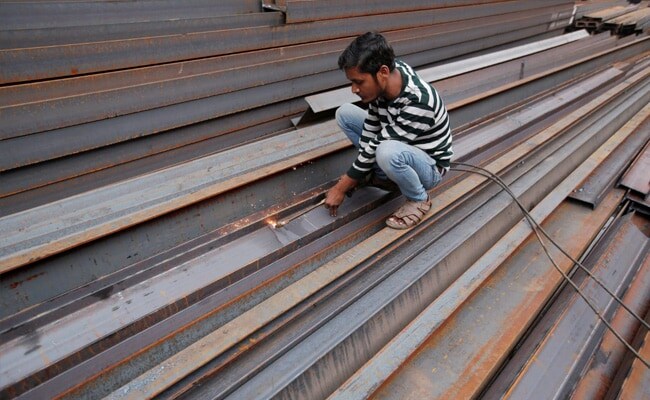
Steel prices, which have been on a song for the past two years, are finally set to correct on weak seasonality, and may trade at around Rs 60,000/tonne by the end of the current fiscal year, down from the Rs 76,000/tonne peak it scaled last month, says a report.
Prices are still holding high because of the continuing uncertainty over supply disruptions, decarbonization measures globally, especially in China and geopolitical risks stemming from the Russia-Ukraine war, which has driven up raw material costs, Crisil said in a report on Monday.
Price corrections are likely due to the onset of monsoon next month which will pull down demand as constructions will be on hold along with the likely lower premium realisation that domestic mills may get from exports, the report said.
According to Koustav Mazumdar, an associate director with the agency, the onset of the weak demand season because of the monsoon and less-lucrative exports mean domestic steel prices should begin easing and ultimately move towards Rs 60,000/tonne by March 2023, down from the Rs 76,000/tonne peak it scaled in just last month, which will still be well above the pre-pandemic levels.
Flat steel prices could rise 3-5 per cent this fiscal year after surging over 50 per cent in 2021-22. Hetal Gandhi, a director at the agency, reasoned that despite a moderation in demand in January-March, steel prices inched up owing to higher input costs and buoyant exports.
Also, domestic supply stayed tight, eliminating the differential between global landed and domestic prices, which was once nearly Rs 15,000/tonne.
On the other hand, export realization premia surged to $75/tonne in early May. While steel mills made the best use of elevated global prices, domestic demand began to waver. Soaring construction costs, and multiple price hikes by companies in the auto, consumer appliances and durables space drove down demand in Q4FY22.
In Q1FY23, domestic demand could see an optical recovery due to low-base, but consumer sentiment remains sluggish with higher input costs leading to postponement of purchases and construction decisions.
Similarly, elevated prices and the resultant inflationary pressure impacted sentiment across the globe, eventually leading to a price correction. Since April, hot-rolled coil prices declined over 25 per cent in Europe and the US to $1,150-1,200/tonne from a peak of $1,600 in mid-March.
While domestic exports to these markets will remain high in Q1, retreating prices will narrow the arbitrage for domestic mills. To sum up, exports will remain range bound at 13-14 million tonne this fiscal on the back of revised quota to Europe and supply constraints in Southeast Asia.
However, the agency does not see a free fall as a myriad of uncertainties will limit a freefall in domestic prices, which though are showing signs of fatigue after a relentless rally over the past two years as the monsoon season sets in.
The report attributes the still firm prices to the heightened geopolitical risks that have limited the price corrections, which started moderating early this year.
However, the Russian invasion of Ukraine in late February, cranked the prices up again on supply-disruption fears. In Europe and the US, where the impact was greater, prices crossed the $1,600/tonne-mark.
Then rising input costs added to the pain. Prices of international coking coal rose 47 per cent to $670/ tonne in three weeks from $455/tonne in late February, due to the flooding of mines amid high demand from countries that traditionally imported from Russia.
While coking coal prices have eased from their peaks, they continue to get support from strong demand at $500/tonne. All this has kept domestic steel prices elevated. In April, they hit an all-time high of over Rs 76,000/tonne, which is 95 per cent over March 2020 levels, when Covid-19 was declared a pandemic. PTI BEN ANU ANU

-
Navigating Friction And Energy Realities: An Analysis Of Marco Rubio's October Visit To India

Occurring at a critical juncture marked by stalled trade negotiations and escalating geopolitical pressures over global energy supplies, the visit offers a profound window into modern US-India relations.
-
India Exports Capital. Why Not Export Trusteeship?
The big question, then, is whether India can build an institution that global borrowers, investors, banks, and lawyers can trust, even without an Indian connection.
-
France's Economy & Politics Are In Crisis | The Reason Why
Let's look at how the French economy and politics evolved under Nicolas Sarkozy, Franois Hollande and Emmanuel Macron.
-
You May Inherit The Business. You Must Earn Its Credibility.
Succession tests the founder's ability to share authority as much as it tests the next generation's readiness to assume it.
-
Signing Deals Is One Thing; Making Them Work Is Another | The Week In Whys
Sometimes, things don't turn out as planned. Indian companies have lost some bids to rivals, some projects won't produce until 2030.
-
FOMC Wall, PERM Suspension, Hospital Stocks | Talking Points This Week
A PERM suspension would directly affect green-card sponsorship rather than H-1B visas, so the near-term earnings impact could remain relatively limited. The key question is whether this marks a new phase in US scrutiny of Indian IT.
-
Everything, Everywhere, All At Once: Dalal Street's Week To Forget | Joining The Dots
Visa curbs, a Starlink spat and cancer drug caps: what connects this week's shocks for Indian markets
-
India Is Going Abroad For Critical Minerals. But It May Take Years To Pay Off | The Reason Why
Although India's steps are in the right direction, they remain modest compared with India's growing dependence.
-
When Everyone Has AI, What Gives You An Edge?
India's young workforce is entering an uncertain world of work where powerful AI tools are becoming widely accessible. The advantage will belong to those who combine deep expertise with digital fluency, and the distinctly human capabilities that technology cannot manufacture.
-
Wrong Labels, High Pesticide Residues Holding Back Agri Exports | The Reason Why
India needs stronger domestic food-safety and labelling standards, with best practices becoming part of everyday business for farmers, traders and food companies.










