Steel Prices Fall Over 10%, Coal Crisis Havocs Secondary Steelmakers
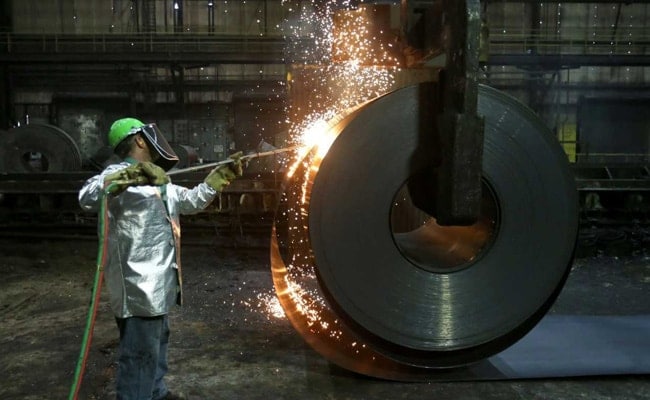
Steel sector players are facing some heat owing to high input commodity prices as finished steel products have begun to decline since April after the Russia-Ukraine war broke out.
Prices in the long products segment have declined on an average of 10-15 per cent to Rs 57,000 per tonne in Kolkata market from a high of Rs 65,000 a tonne. Coal which is a key raw material for the secondary steel producers has turned out to be the major pain point, officials said.
Steel prices from leading players were higher at Rs 75,000-76,000 per tonne at its peak.
"Steel products, be it construction like TMT bars and structurals have come down between 10 and 15 per cent due to sluggish demand and are expected to ease a little more before it settles. While our costs have soared," Steel Rolling Mills Association chairman Vivek Adukia told PTI.
"Our costs have increased by 50 per cent despite a compromise on quality of inputs, secondary steel producers using Direct Reduced Iron (DRI) require high quality thermal coal to make sponge iron. The imported coal price which was USD 120 per tonne had shot up to USD 300 per tonne after the war broke out. The price is not sustainable unless passed through," he said.
"Steel prices, which have been on a song for the past two years, are finally set to correct on weak seasonality, and may trade at around Rs 60,000 per tonne by the end of the current fiscal year, down from the Rs 76,000 per tonne peak it scaled last month", rating agency Crisil said in its latest report.
A PSU steel maker without divulging details said there had been some easing in the price of steel.
"Demand has gone up post-Covid because of a lot of spending by various governments. At the same time, supply had not caught up. So there is a reason why we have seen a very big increase in steel prices. Now we are seeing a slight correction in steel prices," JSW Steel joint MD Seshagiri Rao had commented recently at the ET Awards ceremony.
He, however, said it was anybody's guess whether steel prices had peaked out.
Tata Steel MD & CEO T V Narendran, however, have a contrarian view and had said recently that as far as “first quarter” of this year (FY'23) is concerned, "we expect in India the prices to be Rs 8,000-8,500 per tonne higher than fourth quarter which will cover the cost increases that we are facing due to high coal prices."
According to Koustav Mazumdar, an associate director with the agency, the onset of the weak demand season because of the monsoon and less-lucrative exports mean domestic steel prices should begin easing and ultimately move towards Rs 60,000/tonne by March 2023, down from the Rs 76,000/tonne peak it scaled in just last month, which will still be well above the pre-pandemic levels.
Mr Adukia said steel companies are now forced to import coal for survival as Coal India is not lending its ears to their demand.
"As Coal India is not listening to our plea that coal is “not” for fuel but a key raw material and so we should be treated as a priority sector. We have approached the state government to speak to the city headquartered miner on our behalf," Mr Adukia said.
"If coal prices in the international market do not decline then 30-40 per cent of the secondary steel units will have to scale down production or close down. There are about 65 secondary units in West Bengal and about one lakh employment is associated," he said.

-
Midterm Rally Lasted A Day. The Hard Reality Of A Divided US May Last Two Years | Opinion

Between a contested AI boom, a debt ceiling that arrives in 2027 and a president with every incentive to act alone, the next two years may prove more volatile than the first day's rally suggests.
-
Blue Wave Will Derail the AI Trade but Won't Dismantle the AI Era | Unhedged Position
The Democrats' sweep of the US Congress will see politics collide with economic forces both over the long and short term.
-
It's Time To Take The GST Council's Bet On Trust Global
Payment records can prove India's services exports, and clear, proportionate rules can bring foreign digital sellers into the tax net.
-
Opinion | India at 38: From Innovation Overperformer to Innovation Powerhouse
India now has 453 VC-backed deep science startups, 18 of them late-stage, after 117 percent growth since 2020. Laurus Labs, at USD 9.3 billion, is the most valuable deep science company in any middle-income economy outside China.
-
Navigating Energy Crossroads: S Jaishankar's Call For Diversified Supply Chains At G20 Ministerial Meeting
As geopolitical fault lines continue to test maritime trade routes and commodity flows, Jaishankar's message remains pertinent: true economic resilience requires open markets, protected transit lines, and a genuine commitment to multilateral cooperation rather than coercion.
-
Indians Are Travelling, But Not Every Journey Is A Holiday | The Week In Whys
Pilgrims, patients and working women are the real travellers, and the system hasn't quite caught up with them.
-
Getting To Work Costs Women More | The Reason Why
It is not just about women paying more than men. It is about women paying much more in cities than in villages.
-
AI Bias In Investing Cannot Be Eliminated, But It Can Be Governed
Framing is a particularly important example as identical financial information presented in terms of gains rather than losses can lead an LLM to reach a different assessment.
-
Joining The Dots | Dark Skies, Steady Diya: Why Hope Holds This Diwali
With war, a weak rupee and foreign outflows weighing on sentiment, policymakers at the NDTV World Summit and market veterans at NDTV Profit Ignite: Diwali Edition offered the same advice: stay invested and filter out the noise.









