Steel Demand Growth in India Seen Resilient Against Inflation

(Bloomberg) -- Indian steel demand looks set for another strong year as government plans to upgrade the country's creaky infrastructure and an easing of prices boost the outlook for consumption.
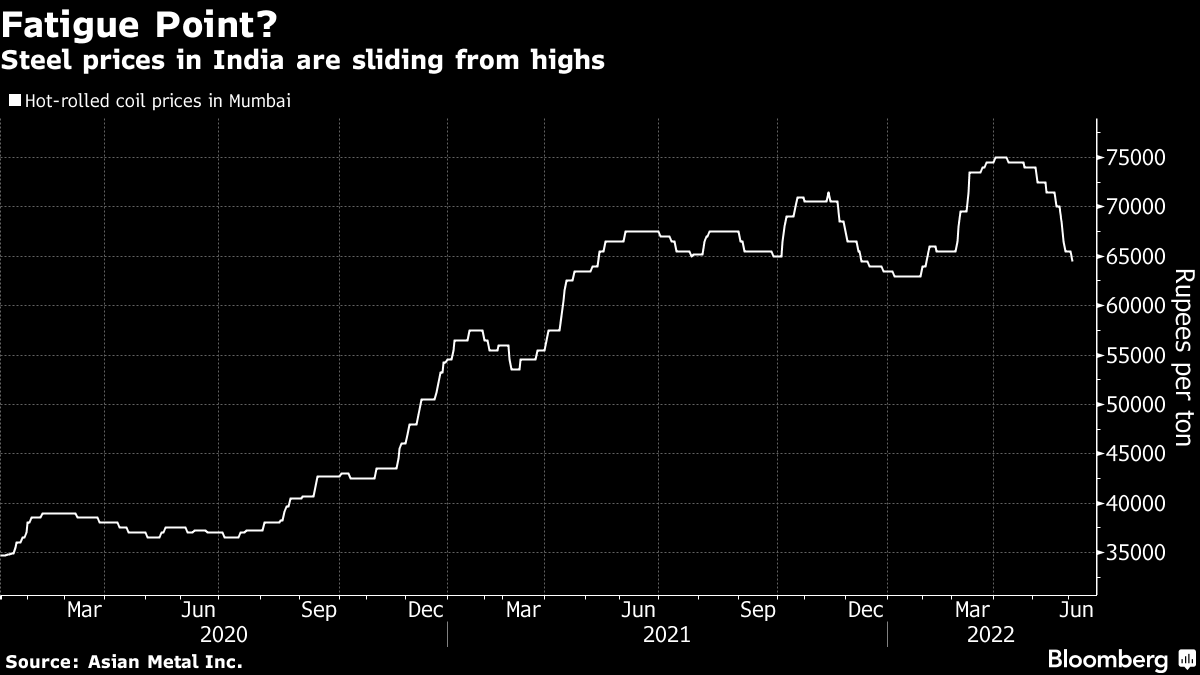
Domestic steel prices have surged almost 75% over the past two years as the economy rebounded from the depths of the pandemic. That's increasing the allure of even rusted metal in the country, which is the world's biggest steel-maker after China.
In April, a group of men dismantled a dilapidated bridge over an irrigation canal in Bihar's Rohtas region to sell the metal as scrap, Ashish Bharti, a police officer in the district, said. That was the third such incident in a month, according to media reports.
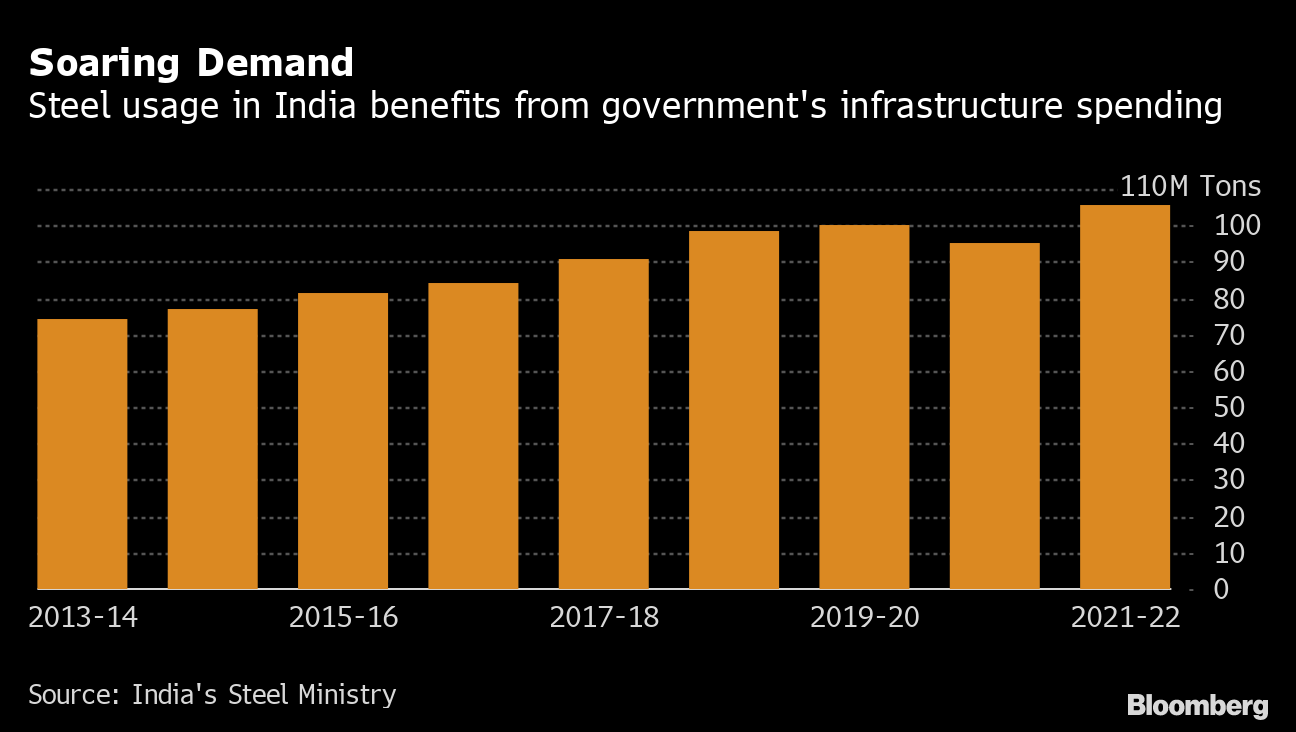
India's demand for steel is set to outpace the rest of the world, supported by government capital expenditure that will increase by more than a third in the year through March 2023, with hefty increases for rail and roads, according to Bloomberg Intelligence. Consumption is likely to rise even more as prices cool after the country imposed a tax on steel exports and scrapped import duties on key input materials to tackle surging prices and rein in inflation.
While prices have eased about 14% from a record 75,000 rupees a ton in April, they remain well above the five-year average for this time of the year. That's forcing some smaller consumers in India to think twice about making purchases as prices at these levels impact their working capital, Tata Steel Ltd. warned last month.
After the recent tax changes, “the case for good demand growth becomes even stronger because of the price correction,” said Jayanta Roy, senior vice president at ICRA Ltd., the local arm of Moody's Investors Service. While higher output will check any increase in domestic steel prices in the near term, “they will remain at buoyant levels despite the correction,” said Roy.
Demand will rise 7.5% in the year through March 2023 as Modi continues to spend heavily on building up the nation's infrastructure, according to JSW Steel Ltd. Steel consumption surged 11% to 105.4 million tons in the last fiscal year and the latest data for April showed that demand was the highest for the month in at least four years.
Mills, including some small- and medium-sized ones like Shyam Steel Industries Ltd., are producing more steel to meet growing demand even as costs escalate. The Kolkata-based producer has maintained output although expenses have doubled, according to director Lalit Beriwala.
“It is very important for the prices of raw materials to go down to help the industry,” Beriwala said. “Prices of iron ore and pellets will become soft in the next two-to-three months and it will come to a more affordable level for the Indian industry.”
Raw materials, including coal costs, have soared driven by massive stimulus spending and widespread bottlenecks across supply chains, further exacerbated by Russia's invasion of Ukraine. That has fueled high inflationary pressures, prompting central banks to raise interest rates.
“While there exist risks of high input costs, the growth of the Indian steel industry is likely to remain stable as domestic demand is expected to remain robust and global supply-demand dynamics may present export opportunities,” Tata Steel chairman N. Chandrasekaran said in the mill's annual report this month.
More stories like this are available on bloomberg.com
©2022 Bloomberg L.P.

-
Talking Points This Week: Tech Nerves, FII Buying, And A Faraway Banking Shock

The global markets are not shining this Diwali. The exception in the large markets is, India.
-
Midterm Rally Lasted A Day. The Hard Reality Of A Divided US May Last Two Years | Opinion
Between a contested AI boom, a debt ceiling that arrives in 2027 and a president with every incentive to act alone, the next two years may prove more volatile than the first day's rally suggests.
-
Blue Wave Will Derail the AI Trade but Won't Dismantle the AI Era | Unhedged Position
The Democrats' sweep of the US Congress will see politics collide with economic forces both over the long and short term.
-
It's Time To Take The GST Council's Bet On Trust Global
Payment records can prove India's services exports, and clear, proportionate rules can bring foreign digital sellers into the tax net.
-
Opinion | India at 38: From Innovation Overperformer to Innovation Powerhouse
India now has 453 VC-backed deep science startups, 18 of them late-stage, after 117 percent growth since 2020. Laurus Labs, at USD 9.3 billion, is the most valuable deep science company in any middle-income economy outside China.
-
Navigating Energy Crossroads: S Jaishankar's Call For Diversified Supply Chains At G20 Ministerial Meeting
As geopolitical fault lines continue to test maritime trade routes and commodity flows, Jaishankar's message remains pertinent: true economic resilience requires open markets, protected transit lines, and a genuine commitment to multilateral cooperation rather than coercion.
-
Indians Are Travelling, But Not Every Journey Is A Holiday | The Week In Whys
Pilgrims, patients and working women are the real travellers, and the system hasn't quite caught up with them.
-
Getting To Work Costs Women More | The Reason Why
It is not just about women paying more than men. It is about women paying much more in cities than in villages.
-
AI Bias In Investing Cannot Be Eliminated, But It Can Be Governed
Framing is a particularly important example as identical financial information presented in terms of gains rather than losses can lead an LLM to reach a different assessment.









