Statue Of Unity Also A Tribute To Indian Engineering Skills, Says L&T
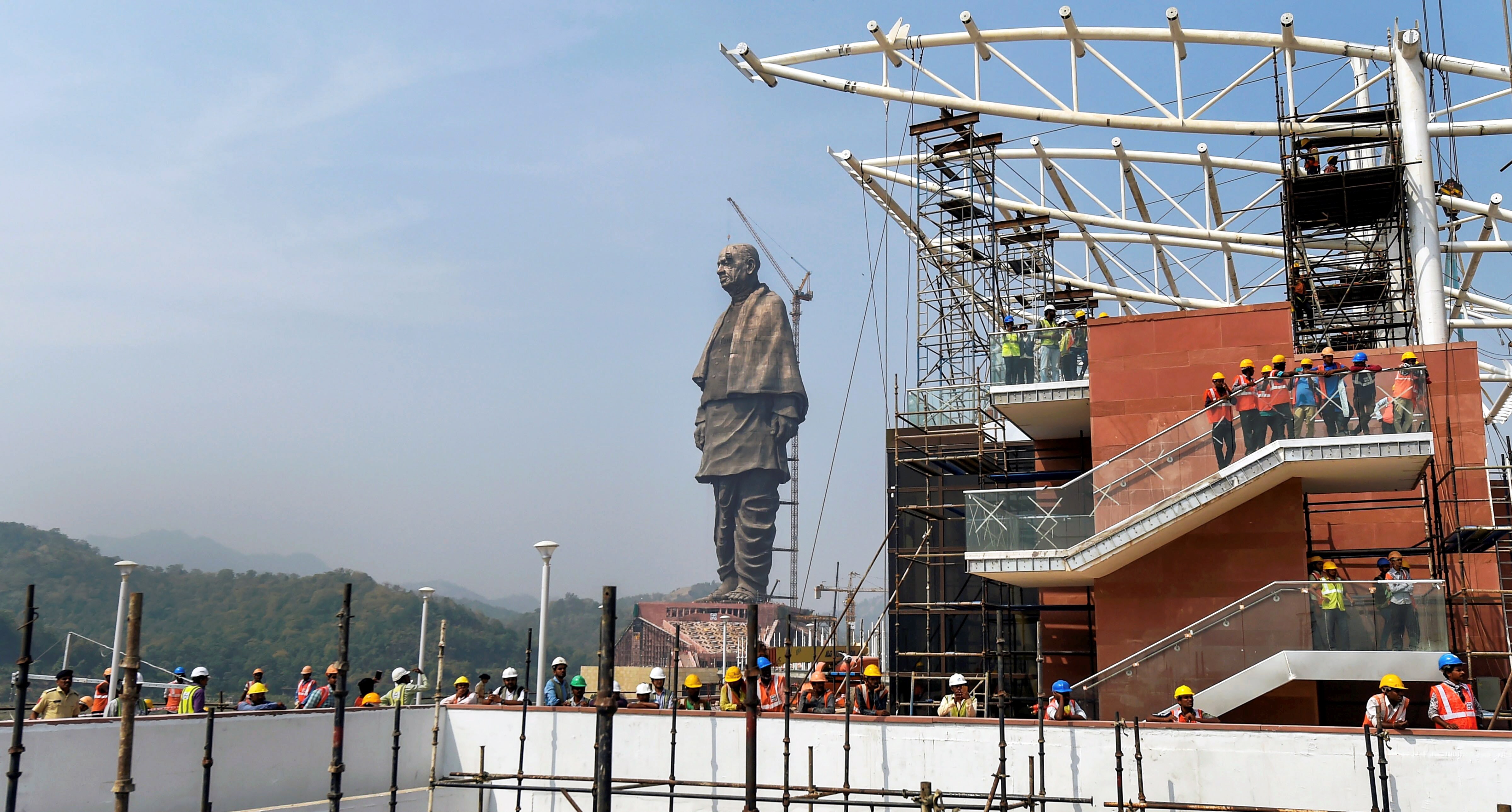
The Statue of Unity, built as a tribute to Sardar Vallabhbhai Patel, known as Iron Man of India, would be the tallest in the world and the quickest to be completed in just 33 months unlike China's Spring Temple Buddha which took 11 years to complete, infrastructure giant Larsen & Toubro Ltd. claimed.
At 182 metres from the road entry and 208.5 metres from the river entry, the iconic statue is taller than the 153m Spring Temple Buddha in China and almost twice the height of the world-famous Statue of Liberty in New York.
The giant statue is set for inauguration by Prime Minister Narendra Modi on Oct. 31.
Built at a cost of Rs 2,989 crore, the Statue of Unity project, barring bronze cladding which is a fragment of the mammoth work, has been done indigenously, L&T told PTI. The statue is located approximately 3.5 km downstream from the Sardar Sarovar Dam, on Sadhu Hill on the bed of the river Narmada.
The raft construction of the structure began on Dec. 19, 2015, and took 33 months construction time for completion. It devoured 180,000 cu. m. of cement concrete, 18,500 tonnes of reinforced steel, 6,500 tonnes of structured steel, 1,700 tonnes of bronze and 1,850 tonnes of bronze cladding, the conglomerate said.
The statue is conceived as a naturalistic depiction of Sardar Patel in characteristic garb in a walking pose and it rises out of a star-shaped, geometric base that covers the entire Sadhu Hill.

Also, the statue is slender at the base, which goes against the norms of what other tall statues have followed. The walking pose also opened up a gap of 6.4 metres between the two feet which then had to be tested to withstand wind velocity, the company mentioned.
The company said that the statue structure was to be designed for 180 km per hour wind speed. “And if you have seen all the huge statues in the world they have a wide base on which they stand. In case of this statue, the standing leader's two legs were to be shown separately, which resulted in a narrow base for the structure. This was the biggest challenge, as one has to make the structure withstand the high wind speed at the same time, it should meet the sculptors' aesthetic requirements,” said L&T.
Another challenge was the statue is of a living legend and not an imaginary persona.
We evolved the design of the statue by using various techniques. We collected around 2,000 photographs from archives and zeroed in on one photograph, after consulting multiple stakeholders like historians and people who had seen Sardar. We used technology to convert the 2-dimensional photograph into a 3-dimensional modelLarsen and Toubro.
The shape of the shawl, its fall and texture are unique considering the peasant background and the sculptor Ram Suttar had to work hard and diligently to come as close to reality as possible, L&T said.
L&T Chief Executive Officer and Managing Director SN Subrahmanyan said, “The Statue of Unity, apart from being a symbol of national pride, and integration is also a tribute to India's engineering skills and project management abilities.”
“Our engineering and construction teams along with the architects, the sculptor, and reputed global consultants, have realised this dream of Prime Minister to reality in a record period. Our commitment to scale, speed and quality in engineering has yielded this desired outcome, which is not only structurally superior but also aesthetically appealing,” he said.
On project challenges Mukesh S Raval, project director for the Statue of Unity of L&T, told PTI: "Mr Ram Suthar, the sculptor, made a few replicas and the final bronze replica, measuring 30 feet, was handed over to us. That replica was scanned into electronic data, which was finally converted into a data grid for around 597-feet (182 meters) statue design.”
“There were corrections as in any photography enlargement some details get lost. Then we took this data to the foundry for casting the final bronze claddings. It was like arranging thousands of parts to complete a three-dimensional jigsaw puzzle,” Raval added.
The engineering giant said the structure has two vertical cores supporting the steel frames to which about 6,500 bronze panels are clad.
L&T said it has been engineered to withstand wind speeds of up to 50 m per second (almost 180 km). The Statue of Unity can also survive earthquakes measuring up to 6.5 on the Richter Scale, at a depth of 10 km and within a radius of 12 km of the statue.
Altogether, the statue is divided into five zones. Up to its shin is the first zone, comprising three levels, including an exhibit floor, mezzanine and roof. It will contain a Memorial Garden and a large museum.
Zone 2 extends up to the statue's thighs at 149 metres, while Zone 3 goes up to the viewing gallery at 153 metres. Zone 4 comprises the maintenance area and Zone 5 the head and shoulders.
The viewing gallery with space to accommodate up to 200 people at a time, will have a view of the Satpura and Vindhyachal mountain ranges, which also form the point where Madhya Pradesh, Gujarat and Maharashtra meet.
Visitors can also get a distant view of the Sardar Sarovar Reservoir and the 12-km-long Garudeshwar Reservoir.
In the lobby area at the entrance of the statue, a museum and audio visual gallery will feature 15-minute presentations on the life of Patel and the tribal culture of Gujarat on the pattern of Burj Khalifa where visitors are shown audio-visual presentations on its construction.
On Dec. 15, 2013, then Gujarat CM Narendra Modi had flagged off the campaign to 1.69 lakh villages, carrying about three lakh empty kit boxes and subsequently, by 2016, 135 metric tonnes of iron was collected for the statue, L&T said.

-
Why Amazon And Flipkart Are Struggling To Beat Meesho In India's Smaller Cities

With 274 million users and lowest-cost logistics, Meesho is defending its value commerce crown against giants like Amazon and Flipkart.
-
High US Salaries, No Green Card Certainty: The Financial Calculation Facing Indian H-1B Families
The suspension of PERM processing at eight technology employers does not cancel existing H-1B visas. What it does is force a question many Indian families have been avoiding: is the US salary worth tying your career and family plans to one employer?
-
Swiggy vs Eternal: Food Delivery's Two Rivals Are No Longer In The Same Race
Eternal is building a private AI assistant, dark.ai. Swiggy is still working out how to make Instamart pay, with an operating loss of Rs 895 crore in the July-September quarter while Blinkit stayed profitable.
-
Where You Live Shapes How You Get To Work | The Reason Why
Two-wheelers are the most popular way to get to work in India, accounting for nearly 43% of workplace commutes.
-
Unhedged Position: Can India See An Indonesia-Style Time Correction?
The Nifty is trading below levels it first clocked in 2024. Is there, then, as I have suggested in the headline, potential that the current time correction drags on painfully for the next three-five, even ten years?
-
Navigating Friction And Energy Realities: An Analysis Of Marco Rubio's October Visit To India
Occurring at a critical juncture marked by stalled trade negotiations and escalating geopolitical pressures over global energy supplies, the visit offers a profound window into modern US-India relations.
-
India Exports Capital. Why Not Export Trusteeship?
The big question, then, is whether India can build an institution that global borrowers, investors, banks, and lawyers can trust, even without an Indian connection.
-
France's Economy & Politics Are In Crisis | The Reason Why
Let's look at how the French economy and politics evolved under Nicolas Sarkozy, Franois Hollande and Emmanuel Macron.
-
You May Inherit The Business. You Must Earn Its Credibility.
Succession tests the founder's ability to share authority as much as it tests the next generation's readiness to assume it.
-
Signing Deals Is One Thing; Making Them Work Is Another | The Week In Whys
Sometimes, things don't turn out as planned. Indian companies have lost some bids to rivals, some projects won't produce until 2030.










