Sona Comstar Banking On EV Parts-Led Order Book To Weather Global Slump
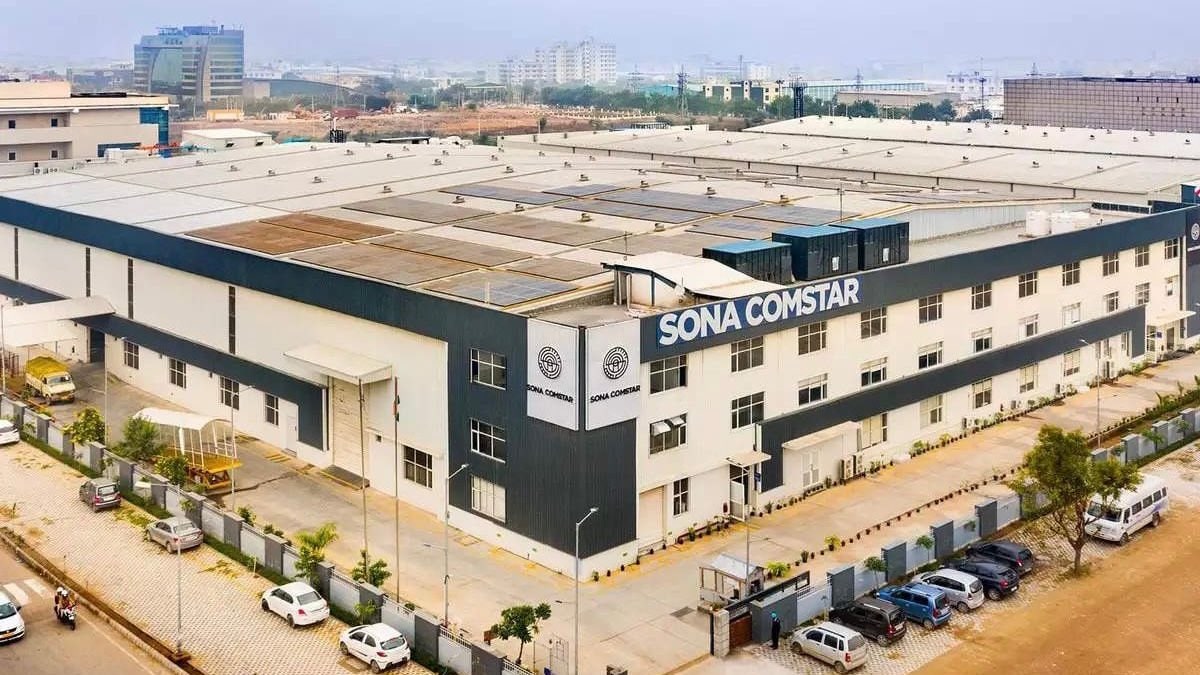
The automotive technology firm Sona Comstar, or Sona BLW Precision Forgings Ltd., expects its robust order book to protect it from the impact of a looming global economic recession.
The company has a significant order book worth Rs 20,500 crore, 68% of which is in the electric vehicle segment, making it a favourite among investors since its listing last year.
The Gurugram-based company, which manufactures driveline and motors for global automakers, counts North America and Europe as crucial markets along with India.
The company reported its highest-ever quarterly revenue, net profit and Ebitda margin in the quarter ended September. Its revenue rose 13% to Rs 653 crore year-on-year, with profit rising 5% to Rs 92.5 crore, according to an exchange filing. Ebitda margin remained flat at 25%.
Rohit Nanda, chief financial officer at Sona Comstar, spoke to BQ Prime on the risk from recession and the need for capacity expansion.

Rohit Nanda, CFO of Sona Comstar. (Source: Company)
Edited excerpts from the interview:
What impact do you see on your business from the looming recession in the West?
Rohit Nanda: Our growth is leveraged to the electrification theme, which is probably the biggest theme right now in the automotive industry. See, over the last 100 years, this is probably the biggest change for the automotive industry.
Our order book currently is at Rs 20,500 crore and 68% of it consists (of) EV orders only. While there are discussions around a potential slowdown globally, if we look at our key markets, North America and India especially, we've seen robust growth so far in both these markets.
Our third-largest market Europe had been struggling lately because of the war and other factors. Last quarter, we've seen some growth come back in Europe as well.
While I understand that there are concerns around growth slowing down as the interest costs go up globally, our growth model is more leveraged to execution of our order book, which means rolling out of new programmes as we go along and less about the underlying growth in our industry. In the last two-three years globally, the automotive industry has degrown.
Our sense is unless there's any major economic event, we see our growth to continue. The pace can be higher or lower depending upon how intense the so-called global slowdown or economic contraction happens.
But, even then, we are relying less on the underlying industry growth and more on programmes that we've won. We should be able to withstand it relatively better than other industry players.
But do you think in the short-term, the looming recession might slow down your trend of reporting record numbers every other quarter?
Rohit Nanda: What we look at is the immediate customer schedules that come to us, which are generally for the next three months, depending on the customers.
At this moment, we do not see any major stress based on the customer schedules except for the seasonality. For example, December is generally a little slower in western markets. If we take that out, so far, we're not seeing any major downward shift in the schedules.
But, yes, there are talks of an impending economic slowdown. If that happens, we're also part of the market. Eventually, it will affect everyone, but given the business model that we have, we may probably be on a spectrum that is less affected by the slowdown.
Do you think new order wins will also be affected?
Rohit Nanda: I think that probably will be a function of the intensity of the slowdown because the way our business works is there is a gap of 18-24 months between the product development negotiations and the production.
If the slowdown is not so intense, for the original equipment manufacturers, it is the medium-term outlook of 3-5 years horizon which matters more. So, unless people become negative about the market demand over 3–5 year horizon, that shouldn't affect the order cycle because OEMs tend to look through the shorter-term pressures.
So, you will continue with the Rs 900-1,000 crore capex announced for the next 2-3 years?
Rohit Nanda: We're expecting Rs 900-1,000 crore, but the fact is our capex is quite modular, it is not very specific. So, if we do see a slowdown of the nature we're discussing, we will calibrate our capex also. But right now, we're on track to meet the target.
As indicated by the company earlier, the revenue from the EV segment may account for 50% of the top line by 2027. How will this affect your margins, given the EV segment is considered more profitable?
Rohit Nanda: I think margins in both EVs and non-EVs are largely similar. For the two-wheeler market in India, the motor business' margin may even be slightly lower because of the current nature of the business. So, I don't think that impression would be correct. I think margin reaching 30% would be a function of how the material prices play out. But our margin range historically has been 25-27.5% and our expectation is that's where we will be in the medium term.
What kind of growth do you expect from the battery electric vehicle segment revenue in the coming years?
Rohit Nanda: A large part of our EV revenues come from the international markets. The global EV sales in 2019 were about less than 2% of the overall market, which is expected to touch more than 10% this year. Within three years, it has grown five times. We expect this trend to continue as every OEM is announcing EV models and investing in this segment.
By 2030, most of the global OEMs may be working on electrified vehicles only. In the Indian context, the trend is largely observed in the two-wheeler market. It is a price sensitive market and government's support may continue till EVs touch a competitive price without that support. By 2030, we expect EVs to be 50% of the overall two-wheeler market.
Tell us about the pace of orders from the domestic electric two- and three-wheeler manufacturers.
Rohit Nanda: We are getting very good traction in the two-wheeler segment. Based on the market numbers, (we are) one of the largest EV motor suppliers to the Indian two-wheeler market. We already have eight programmes with seven customers in our order book.
The company has moved its plant from Bhosari to a bigger facility in Chakan, Pune. Is this enough to take care of your long-term production needs?
Rohit Nanda: For the next 3-5 years, it should be enough. The earlier plant was very small and the new 10-acre facility was needed to expand our gear manufacturing capacity.
In Gurugram, for example, our capacities are totally full and we don't have room to expand in terms of land availability. For the differential assembly, we're setting up a new plant, which will be separate.
How much will the Gurugram plant increase your differential assembly manufacturing capacity?
Rohit Nanda: We make differential assemblies in Manesar. We had set up a 5-acre facility there. The demand has been very good for the last 2-3 years. We need to expand, for which we have taken another complex here in Manesar. The idea is to go up to 20 lakh assemblies annually over time. But that will happen over a period of time as it is modular and we calibrate it depending upon the customer demand.

-
It's Time To Take The GST Council's Bet On Trust Global

Payment records can prove India's services exports, and clear, proportionate rules can bring foreign digital sellers into the tax net.
-
Opinion | India at 38: From Innovation Overperformer to Innovation Powerhouse
India now has 453 VC-backed deep science startups, 18 of them late-stage, after 117 percent growth since 2020. Laurus Labs, at USD 9.3 billion, is the most valuable deep science company in any middle-income economy outside China.
-
Navigating Energy Crossroads: S Jaishankar's Call For Diversified Supply Chains At G20 Ministerial Meeting
As geopolitical fault lines continue to test maritime trade routes and commodity flows, Jaishankar's message remains pertinent: true economic resilience requires open markets, protected transit lines, and a genuine commitment to multilateral cooperation rather than coercion.
-
Indians Are Travelling, But Not Every Journey Is A Holiday | The Week In Whys
Pilgrims, patients and working women are the real travellers, and the system hasn't quite caught up with them.
-
Getting To Work Costs Women More | The Reason Why
It is not just about women paying more than men. It is about women paying much more in cities than in villages.
-
AI Bias In Investing Cannot Be Eliminated, But It Can Be Governed
Framing is a particularly important example as identical financial information presented in terms of gains rather than losses can lead an LLM to reach a different assessment.
-
Joining The Dots | Dark Skies, Steady Diya: Why Hope Holds This Diwali
With war, a weak rupee and foreign outflows weighing on sentiment, policymakers at the NDTV World Summit and market veterans at NDTV Profit Ignite: Diwali Edition offered the same advice: stay invested and filter out the noise.
-
The Curious Case of Equitas Small Finance Bank And A CEO Who Quit For Stock
PN Vasudevan believes persistent investor concerns over a perceived conflict of interest had become a governance overhang on Equitas Small Finance Bank's stock, even as the lender improved profitability and asset quality.
-
Talking Points This Week: AI Cash Burn, A Tiger Comeback And An India That Still Finds Its Own Path
India is not immune to higher oil or tighter global liquidity, yet its earnings base is broader, its domestic policy levers are still available.










