Solar Power Developers Say Safeguard Duty Has Put Projects At Risk
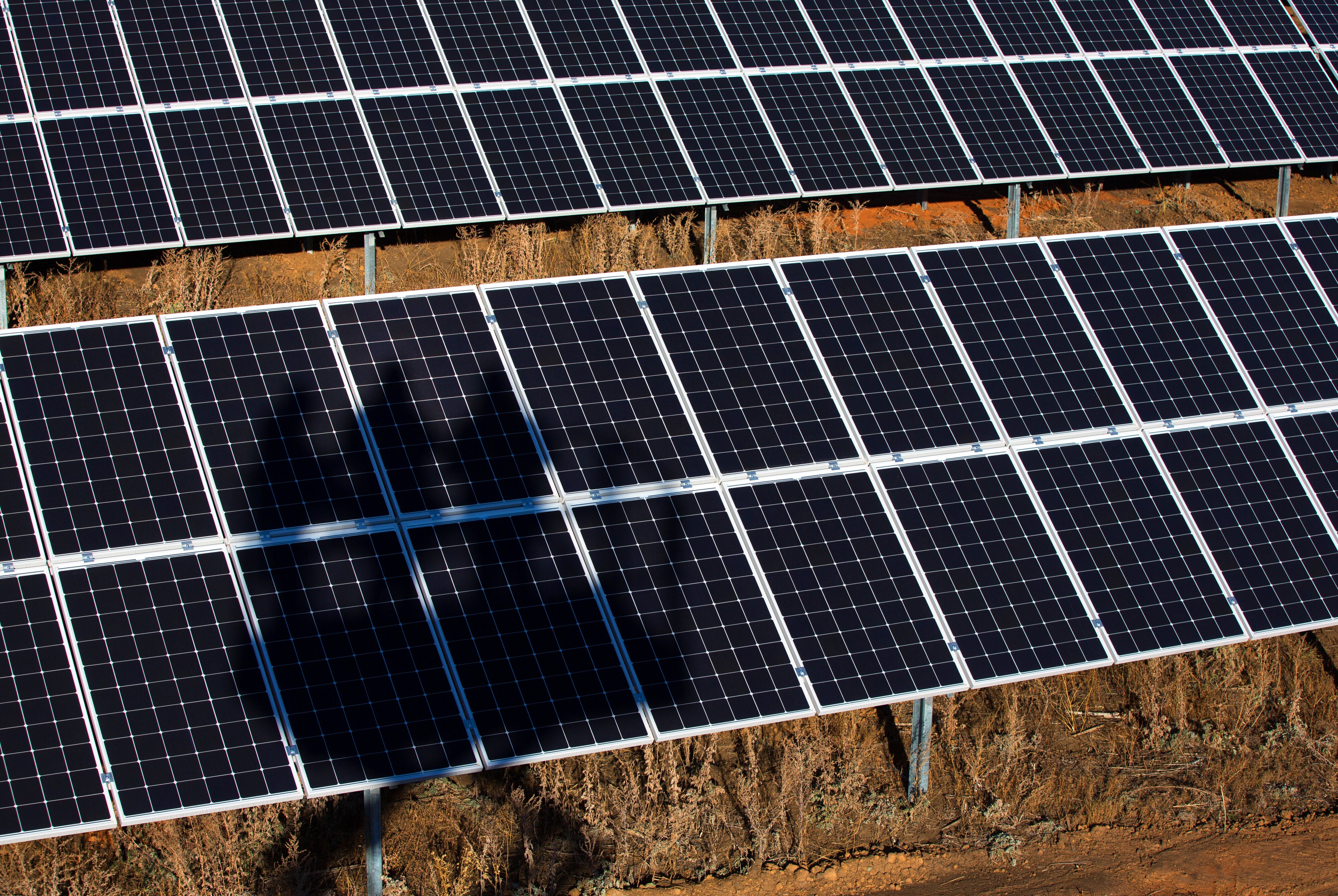
Solar power developers warned that projects could turn unviable as they can't pass on additional levy on imported panels to distribution companies despite the central regulator allowing it.
Generation companies want to pass on the additional cost to consumers to offset the impact of 25 percent safeguard duty imposed by the government on July 30 to protect local manufacturing. While the Central Electricity Regulatory Commission allows a pass-through, developers said state-level regulators have still not asked distribution companies to do so.
A developer has to increase power tariff to set off the increase in cost due to the duty, said Shashi Shekhar, vice chairman at Acme Solar. “But utilities are not willing to buy power at a higher tariff.”
India imports roughly 90 percent of the solar panels from Malaysia and China, which had helped developers quote record-low tariffs. Higher costs now threaten Prime Minister Narendra Modi's target of reaching 100 gigawatts of solar energy by 2022.
The Ministry of Power in August asked the power regulator to allow pass-through of higher costs due to any change in levies. The central regulator, however, is yet ask state regulators to allow that, Amit Gupta, director, legal and corporate affairs, at Vikram Solar, told BloombergQuint over the phone. Without states issuing directions to increase tariff, developers face a time-consuming and complex regulatory process to pass on additional costs under change in law in power purchase agreement, he said.
Already, 1,750 megawatts of solar bids out of 6,750 megawatts issued in 2017-18 have been scrapped so far, a company executive told BloombergQuint.
Future Unsure
The imposition of safeguard duty has delayed financial closure for solar projects. “Unless we get a certainty for a pass-through from the state governments, how will we approach banks for financing the project,” Shekhar said. “Therefore, developers are not participating in solar tenders.”
The Solar Energy Corporation of India had to scrap a 750 megawatts tender in Rajasthan after the utilities weren't willing to agree for a tariff beyond Rs 2.44 per unit, Shekhar said, adding that two tenders were also cancelled because of a higher tariff in Gujarat.
Acme Solar approached the power regulator to seek a pass-through for Reva and Bhadla solar tenders. “We had filed the petition on Nov. 2 and are yet to get a date for a hearing,” said Shekhar.
The company won the contract for developing 200 megawatts at the Bhadla solar project at Rs 2.44 a unit and it has so far invested Rs 980 crore in setting up the plant, according to Shekhar.
Tariff Cap
The Ministry of New and Renewable Energy, according to reports by the Economic Times and Mint, asked the Solar Energy Corporation of India cap the tariff at Rs 2.5 and Rs 2.68 a unit for developers using locally made and imported solar panels, respectively. The higher cap was to factor in the impact of safeguard duty. The ministry reportedly arrived at the limits after the recent 2,000-megawatt NTPC Ltd. got bids for Rs 2.59-2.60 a unit, the Economic Times reported.
A ceiling of Rs 2.68 a unit is unviable, said Sunil Jain, the chief executive officer of Hero Future Energies. “Keeping in view factors like rupee depreciation, interest rates going up and safeguard duty, the impact on tariff is around 38-39 paise a unit,” he said. “A tariff below Rs 2.95 a unit is unviable for a developer.”

-
Where You Live Shapes How You Get To Work | The Reason Why

Two-wheelers are the most popular way to get to work in India, accounting for nearly 43% of workplace commutes.
-
High US Salaries, No Green Card Certainty: The Financial Calculation Facing Indian H-1B Families
The suspension of PERM processing at eight technology employers does not cancel existing H-1B visas. What it does is force a question many Indian families have been avoiding: is the US salary worth tying your career and family plans to one employer?
-
Unhedged Position: Can India See An Indonesia-Style Time Correction?
The Nifty is trading below levels it first clocked in 2024. Is there, then, as I have suggested in the headline, potential that the current time correction drags on painfully for the next three-five, even ten years?
-
Navigating Friction And Energy Realities: An Analysis Of Marco Rubio's October Visit To India
Occurring at a critical juncture marked by stalled trade negotiations and escalating geopolitical pressures over global energy supplies, the visit offers a profound window into modern US-India relations.
-
India Exports Capital. Why Not Export Trusteeship?
The big question, then, is whether India can build an institution that global borrowers, investors, banks, and lawyers can trust, even without an Indian connection.
-
France's Economy & Politics Are In Crisis | The Reason Why
Let's look at how the French economy and politics evolved under Nicolas Sarkozy, Franois Hollande and Emmanuel Macron.
-
You May Inherit The Business. You Must Earn Its Credibility.
Succession tests the founder's ability to share authority as much as it tests the next generation's readiness to assume it.
-
Signing Deals Is One Thing; Making Them Work Is Another | The Week In Whys
Sometimes, things don't turn out as planned. Indian companies have lost some bids to rivals, some projects won't produce until 2030.
-
FOMC Wall, PERM Suspension, Hospital Stocks | Talking Points This Week
A PERM suspension would directly affect green-card sponsorship rather than H-1B visas, so the near-term earnings impact could remain relatively limited. The key question is whether this marks a new phase in US scrutiny of Indian IT.
-
Everything, Everywhere, All At Once: Dalal Street's Week To Forget | Joining The Dots
Visa curbs, a Starlink spat and cancer drug caps: what connects this week's shocks for Indian markets









