London's FTSE 100 Is About To Lose Another Big Name

(Bloomberg) -- A $20 billion merger in the packaging industry spells one thing for the UK stock market: the prospect of losing yet another of its top companies.
A planned tie-up between paper and packaging giant Smurfit Kappa Group Plc and WestRock Co. of the US would result in the cancellation of the Dublin-based company's premium listing on the London Stock Exchange. Smurfit Kappa has been a member of the exchange's benchmark FTSE 100 Index since 2016.
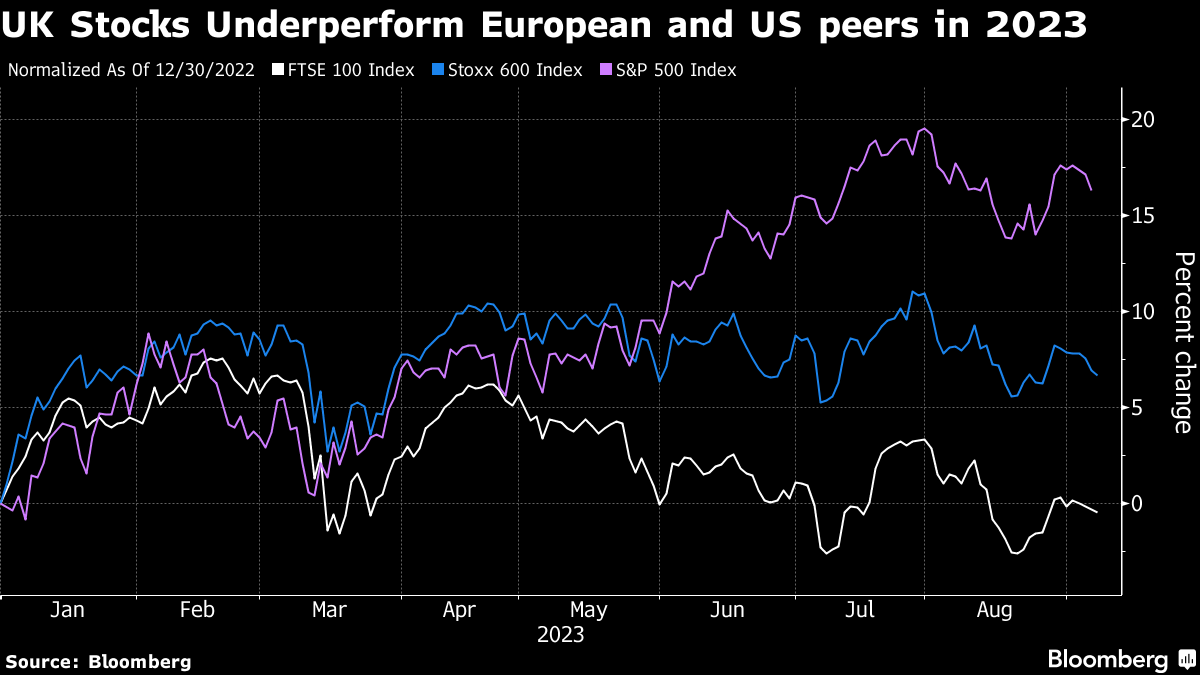
Aside from being a tough year for UK stocks with the FTSE's dismal performance compared with US and continental European markets, the country's attractiveness as a home for companies is being increasingly called into question.
“UK is seemingly not an attractive destination to raise capital due to the stark outperformance of US equities and their elevated valuations making capital raising look cheaper,” James Athey, investment director at Abrdn in London, said by phone. “It can become a self-fulfilling prophecy.”
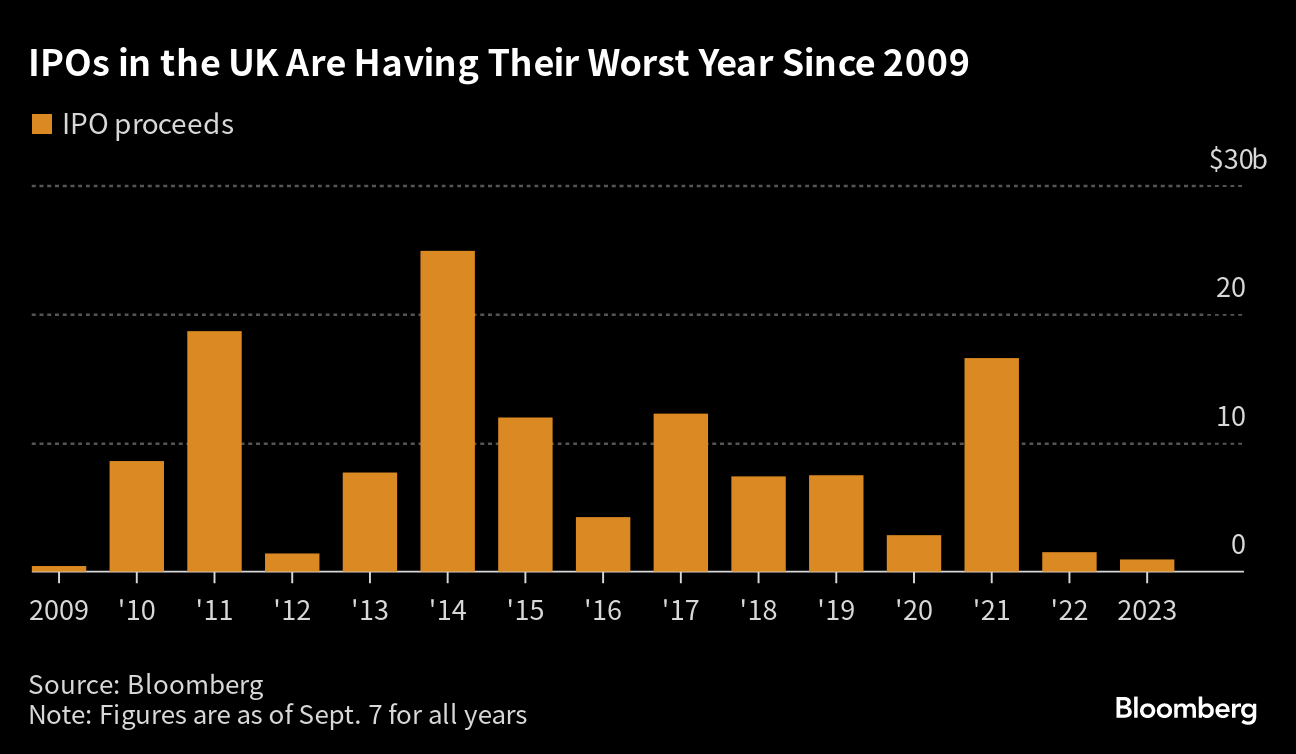
London missed out on the hottest initial public offering of the year, with chip designer Arm Holdings Ltd. shunning its home market for a New York listing. In fact, this year is shaping up to be the slowest year for IPOs in the UK since 2009.
Meanwhile, building materials company CRH Plc is due to move its main listing from London to New York this month and gambling firm Flutter Entertainment Plc is planning a secondary US listing in early 2024.
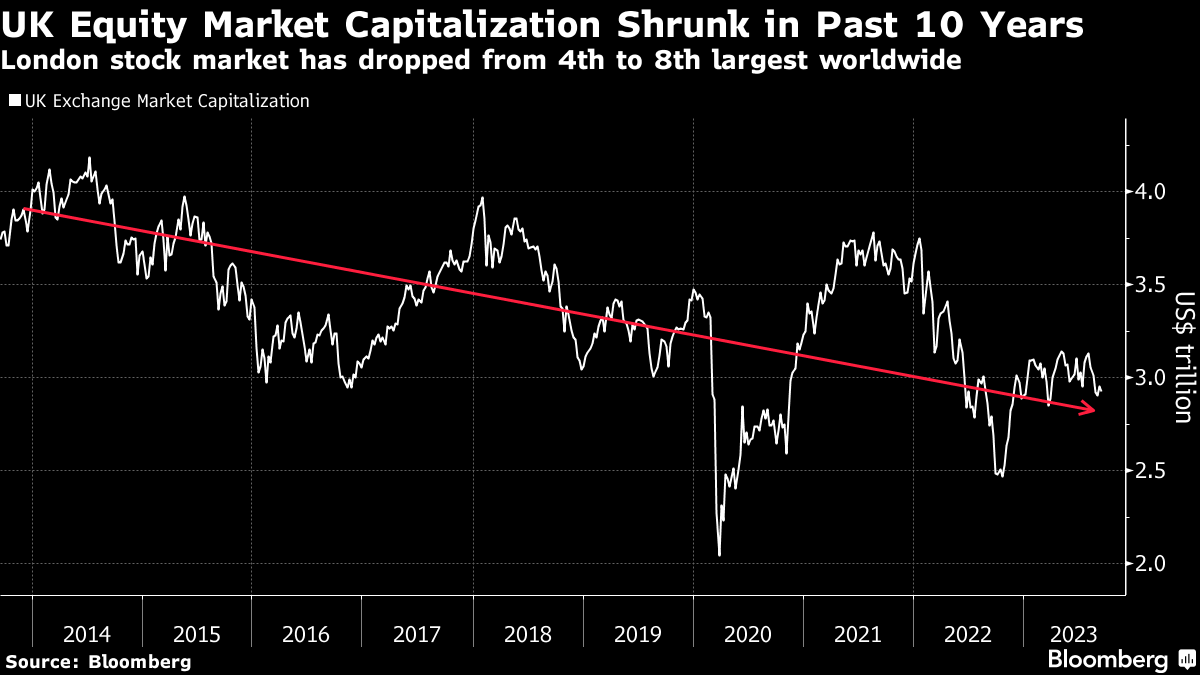
London's recent losses include Just Eat Takeaway.com NV in 2021 after it was reclassified as a Dutch company post-merger, while last year saw the exit of mining behemoth BHP Group Plc. Also in 2022, Abcam Plc, a Cambridge-based biotechnology company, moved its primary listing from London to the US. Paris last year overtook London as Europe's biggest stock market.
The low valuation of the UK stock market has hastened the exodus by encouraging foreign companies and private equity firms to buy and delist British companies. It's also pushing UK businesses to consider listing elsewhere in hopes of securing a richer value for their shares. And the UK's slumping economy has pushed investor dollars into other markets.
“All of these factors should in time lead to a re-rating of the UK market, but in the short term they have been hindered by asset allocation outflows from the UK,” Simon Gergel, chief investment officer for UK equities at Allianz Global Investors, said in written comments. “But the drivers for these outflows should be abating too, as many of the risks in the last few years – Brexit, political risk, levels of UK economic growth and inflation – are much less obvious today than previously.”
An LSE spokesperson didn't immediately respond to a request for comment.
In some cases, as with BHP and Smurfit, companies that give up their listing on the LSE's premium segment are still quoted on the exchange's second-tier standard segment. That makes them ineligible for inclusion in the FTSE indexes.
The UK market watchdog has taken steps to boost initial public offerings, proposing to eliminate the distinction between the premium and standard listings and allowing founders to retain control of companies post-listing. It's also studying changes to make secondary stock offerings easier.
--With assistance from Michael Msika, Thyagaraju Adinarayan, Julia Fioretti and Swetha Gopinath.
(Updates to add quote, charts on UK IPOs and on UK market size.)
More stories like this are available on bloomberg.com
©2023 Bloomberg L.P.

-
Talking Points This Week: Tech Nerves, FII Buying, And A Faraway Banking Shock

The global markets are not shining this Diwali. The exception in the large markets is, India.
-
Midterm Rally Lasted A Day. The Hard Reality Of A Divided US May Last Two Years | Opinion
Between a contested AI boom, a debt ceiling that arrives in 2027 and a president with every incentive to act alone, the next two years may prove more volatile than the first day's rally suggests.
-
Blue Wave Will Derail the AI Trade but Won't Dismantle the AI Era | Unhedged Position
The Democrats' sweep of the US Congress will see politics collide with economic forces both over the long and short term.
-
It's Time To Take The GST Council's Bet On Trust Global
Payment records can prove India's services exports, and clear, proportionate rules can bring foreign digital sellers into the tax net.
-
Opinion | India at 38: From Innovation Overperformer to Innovation Powerhouse
India now has 453 VC-backed deep science startups, 18 of them late-stage, after 117 percent growth since 2020. Laurus Labs, at USD 9.3 billion, is the most valuable deep science company in any middle-income economy outside China.
-
Navigating Energy Crossroads: S Jaishankar's Call For Diversified Supply Chains At G20 Ministerial Meeting
As geopolitical fault lines continue to test maritime trade routes and commodity flows, Jaishankar's message remains pertinent: true economic resilience requires open markets, protected transit lines, and a genuine commitment to multilateral cooperation rather than coercion.
-
Indians Are Travelling, But Not Every Journey Is A Holiday | The Week In Whys
Pilgrims, patients and working women are the real travellers, and the system hasn't quite caught up with them.
-
Getting To Work Costs Women More | The Reason Why
It is not just about women paying more than men. It is about women paying much more in cities than in villages.
-
AI Bias In Investing Cannot Be Eliminated, But It Can Be Governed
Framing is a particularly important example as identical financial information presented in terms of gains rather than losses can lead an LLM to reach a different assessment.









