‘Sizzling’ U.S. Jobs Data Make Case For Bigger Fed Rate Increases
(Bloomberg) -- A blowout US jobs report for July means the Federal Reserve will need to keep going with the most aggressive rate hikes in decades to curb demand and inflation.
US employers added 528,000 jobs last month, more than all estimates, the unemployment rate fell to a five-decade low of 3.5%, and wage growth accelerated, the Labor Department said.
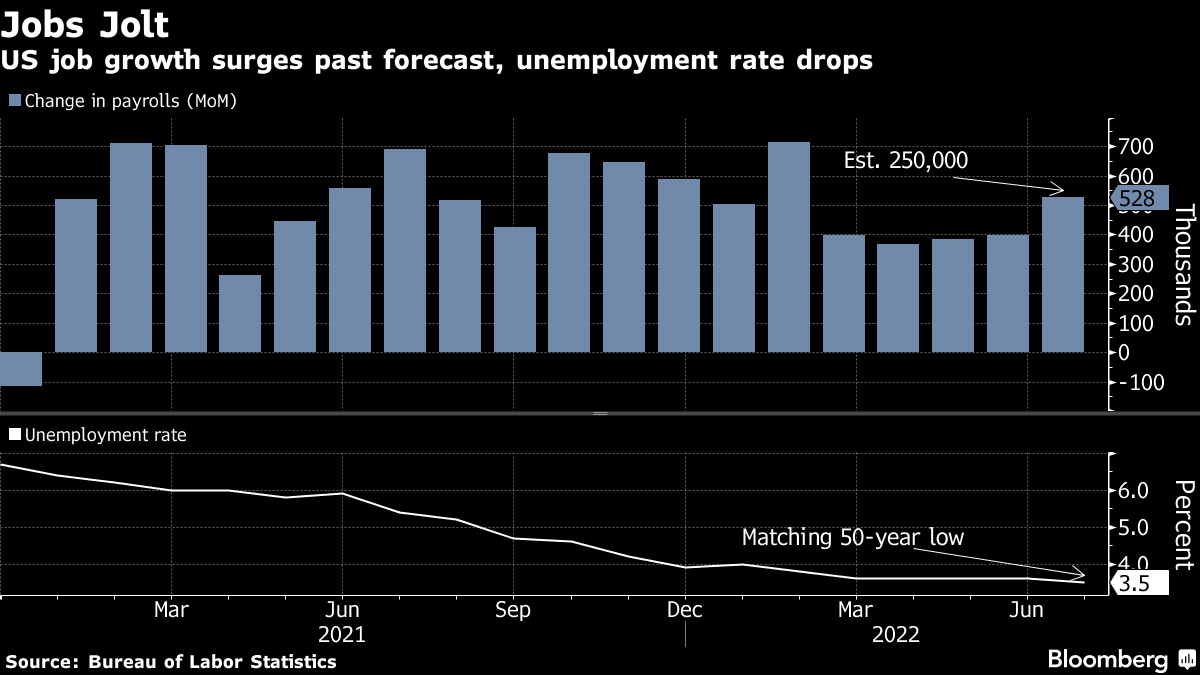
The data add impetus for the Federal Open Market Committee to raise interest rates by 75 basis points when it meets in September, matching the moves it made in June and July as it works to cool an inflation rate that's running at a 40-year high. The strong momentum could also suggest the central bank will need to keep rates higher for longer, contrary to market expectations for rate cuts in 2023.
The labor market is “still sizzling” and that can feed into inflation, said Diane Swonk, the chief economist at KPMG LLP. “This argues for another 75 basis point hike by the Fed.”
At a press conference last week, Fed Chair Jerome Powell said another large rate hike at the September meeting was possible, but he gave no specific forward guidance and said future increases would depend on data. Investors interpreted the remarks as a pivot to a less aggressive posture and markets rallied in response.
Fed presidents this week have strongly countered that impression, arguing the central bank wasn't intending a pivot away from aggressive hikes and that it would take significant news to alter their posture.
Friday's jobs data, while important, was just one of four key reports that will shape the FOMC decision next month. There will be one more employment print and two consumer-price index readouts, with the July data out on Aug. 10. That report should show slowing inflation because of plunging gas and commodities prices.
“If we get to September with things being where they are today -- and that's a big if -- 75 basis points and signals of the risk of another 75 basis points, that's what you'll see,” said Mohamed El-Erian, chief economic adviser to Allianz SE and a Bloomberg Opinion contributor.
Ultimately, it's the inflation data, which could also be affected by falling commodity prices and supply-chain improvements, that will decide the September move, said Julia Coronado, co-founder of MacroPolicy Perspectives LLC and a former Fed economist.
All else equal, the jobs data “would lean in favor of either a 75 basis-point hike or a longer hiking cycle, because we are not seeing moderating job growth,” she said.
What Bloomberg Economics Says...
“The July jobs report settles it -- we are not in a recession. More importantly, it also means the Fed will likely have to hike by another 75 basis points in September. Hiring was broad-based across sectors, and there was no evidence of widespread layoffs. The labor market has tightened even further from a high starting point. If there was any question of a dovish Fed pivot, this report has quashed it.”
--Anna Wong, Yelena Shulyatyeva, Andrew Husby and Eliza Winger, US economists
--To read the full report, click here
Yields on two-year Treasuries surged in response to the jobs report, a reflection of the expected Fed rates over that period. Market pricing indicated a 75 basis-point increase to the Fed's key rate is now seen as a more likely outcome in at the central bank's September meeting than 50 basis points.
Powell has described the labor market as “tight to an unhealthy level,” and has been seeking a moderation to help bring demand for products and services more in line with supplies that have been constrained by Covid-19 disruptions. He and other Fed leaders are worried about the potential for a wage-price spiral, with higher wages feeding into inflation in a cycle that is hard to break.
“This number is so comprehensively strong with a pretty significant uptick in wages,” said Mark Spindel, chief investment officer at MBB Capital Partners LLC in Chicago. “Companies are paying up for labor. Income matters most. When you look at the breadth of the employment report, and the earnings, this is an enormous tailwind for income.”
The upper bound of the Fed's benchmark is now at 2.5%. Policy makers will have to get the target rate to the region of 4% and hold it there for some time to quell inflation and price expectations, said Randall Kroszner, a former governor at the central bank.
“You've really got to make sure that inflation and inflation expectations have come down and are out of the system,” Kroszner, an economics professor at the University of Chicago Booth School of Business, said on Bloomberg Television. After the jobs report, he said that a 75 basis-point increase “will be on the table for the next meeting.”
(Updates with comment from El-Erian in eighth paragraph.)
More stories like this are available on bloomberg.com
©2022 Bloomberg L.P.

-
Blue Wave Will Derail the AI Trade but Won't Dismantle the AI Era | Unhedged Position

The Democrats' sweep of the US Congress will see politics collide with economic forces both over the long and short term.
-
It's Time To Take The GST Council's Bet On Trust Global
Payment records can prove India's services exports, and clear, proportionate rules can bring foreign digital sellers into the tax net.
-
Opinion | India at 38: From Innovation Overperformer to Innovation Powerhouse
India now has 453 VC-backed deep science startups, 18 of them late-stage, after 117 percent growth since 2020. Laurus Labs, at USD 9.3 billion, is the most valuable deep science company in any middle-income economy outside China.
-
Navigating Energy Crossroads: S Jaishankar's Call For Diversified Supply Chains At G20 Ministerial Meeting
As geopolitical fault lines continue to test maritime trade routes and commodity flows, Jaishankar's message remains pertinent: true economic resilience requires open markets, protected transit lines, and a genuine commitment to multilateral cooperation rather than coercion.
-
Indians Are Travelling, But Not Every Journey Is A Holiday | The Week In Whys
Pilgrims, patients and working women are the real travellers, and the system hasn't quite caught up with them.
-
Getting To Work Costs Women More | The Reason Why
It is not just about women paying more than men. It is about women paying much more in cities than in villages.
-
AI Bias In Investing Cannot Be Eliminated, But It Can Be Governed
Framing is a particularly important example as identical financial information presented in terms of gains rather than losses can lead an LLM to reach a different assessment.
-
Joining The Dots | Dark Skies, Steady Diya: Why Hope Holds This Diwali
With war, a weak rupee and foreign outflows weighing on sentiment, policymakers at the NDTV World Summit and market veterans at NDTV Profit Ignite: Diwali Edition offered the same advice: stay invested and filter out the noise.
-
The Curious Case of Equitas Small Finance Bank And A CEO Who Quit For Stock
PN Vasudevan believes persistent investor concerns over a perceived conflict of interest had become a governance overhang on Equitas Small Finance Bank's stock, even as the lender improved profitability and asset quality.










