Singapore Q2 GDP Shows Economy Still Under Stress, May Need More Stimulus
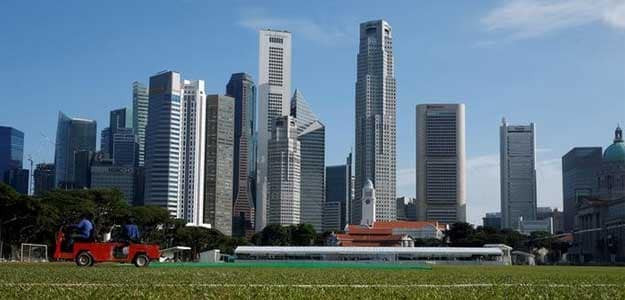
Singapore: Singapore's economy grew slower-than-expected in the second quarter on softer manufacturing and construction, keeping pressure on the central bank to further ease policy in the face of sluggish global demand and concerns over Brexit.
The trade-reliant economy expanded 0.8 percent in the April-June period from the previous three months on an annualised and seasonally adjusted basis, the Ministry of Trade and Industry said on Thursday in a statement.
That compared with a 0.9 percent rise forecast in a Reuters poll and 0.2 percent growth in the first quarter, suggesting only a modest bounce that could unravel on the Brexit fallout.
Manufacturers remained under stress, with the sector growing 0.3 percent in the second quarter from the previous three months, sharply down from an 18.4 percent expansion in the first quarter.
"The sequential slowdown of the economy, especially in the manufacturing sector, means that the MAS must choose between a weaker currency or lower interest rates," said Trinh Nguyen, senior emerging Asia economist for Natixis in Hong Kong, referring to the Monetary Authority of Singapore.
Nguyen expects further monetary policy easing in October through a re-centering of the S$NEER policy band lower.
The MAS manages policy by letting the Singapore dollar rise or fall against the currencies of its main trading partners based on its nominal effective exchange rate (NEER).
In April, in an effort to weather a slowdown in Singapore's biggest export market China and falling consumer prices, the central bank unexpected eased policy by setting the rate of appreciation of the policy band at zero percent.
The Singapore dollar has strengthened on safe-haven demand in emerging Asia, exacerbating both deflationary pressures and faltering exports - a development that is doubly worrying given fallout on global growth from Britain's shock vote to leave the European Union.
BREXIT WOES
Indeed, the anaemic economic activity and the strong local currency have already prompted some economists to tip the central bank to ease again in October.
On Tuesday, the Brexit worries prompted Malaysia's central bank to unexpectedly cut interest rates for the first time in seven years. Other global central banks are also expected to offer more stimulus or maintain their ultra-low rates to stoke demand.
"What will cause the MAS to think twice... is that Brexit risks are not reflected in these numbers," said Vishnu Varathan, senior economist for Mizuho Bank in Singapore.
Singapore expects the economy to grow 1-3 percent this year, though economists have trimmed their projections to 1.8 percent, a central bank survey showed.
Signs that the economy is faltering are ample, with vacant floors in some central shopping malls and other businesses also suffering a labour shortage due to immigration curbs.
"We expect economic growth and core inflationary pressures in Singapore to slow in the second half of this year," said Roy Teo, senior FX strategist for ABN AMRO in a note to clients.
"Hence there is a case for the MAS to lower the centre of the policy band later this year in October."
(This story has not been edited by NDTV staff and is auto-generated from a syndicated feed.)

-
High US Salaries, No Green Card Certainty: The Financial Calculation Facing Indian H-1B Families

The suspension of PERM processing at eight technology employers does not cancel existing H-1B visas. What it does is force a question many Indian families have been avoiding: is the US salary worth tying your career and family plans to one employer?
-
Unhedged Position: Can India See An Indonesia-Style Time Correction?
The Nifty is trading below levels it first clocked in 2024. Is there, then, as I have suggested in the headline, potential that the current time correction drags on painfully for the next three-five, even ten years?
-
Navigating Friction And Energy Realities: An Analysis Of Marco Rubio's October Visit To India
Occurring at a critical juncture marked by stalled trade negotiations and escalating geopolitical pressures over global energy supplies, the visit offers a profound window into modern US-India relations.
-
India Exports Capital. Why Not Export Trusteeship?
The big question, then, is whether India can build an institution that global borrowers, investors, banks, and lawyers can trust, even without an Indian connection.
-
France's Economy & Politics Are In Crisis | The Reason Why
Let's look at how the French economy and politics evolved under Nicolas Sarkozy, Franois Hollande and Emmanuel Macron.
-
You May Inherit The Business. You Must Earn Its Credibility.
Succession tests the founder's ability to share authority as much as it tests the next generation's readiness to assume it.
-
Signing Deals Is One Thing; Making Them Work Is Another | The Week In Whys
Sometimes, things don't turn out as planned. Indian companies have lost some bids to rivals, some projects won't produce until 2030.
-
FOMC Wall, PERM Suspension, Hospital Stocks | Talking Points This Week
A PERM suspension would directly affect green-card sponsorship rather than H-1B visas, so the near-term earnings impact could remain relatively limited. The key question is whether this marks a new phase in US scrutiny of Indian IT.
-
Everything, Everywhere, All At Once: Dalal Street's Week To Forget | Joining The Dots
Visa curbs, a Starlink spat and cancer drug caps: what connects this week's shocks for Indian markets
-
India Is Going Abroad For Critical Minerals. But It May Take Years To Pay Off | The Reason Why
Although India's steps are in the right direction, they remain modest compared with India's growing dependence.









