"Silly" To Compare Sri Lanka's Economic Crisis With India: Former NITI Aayog Vice-Chairman
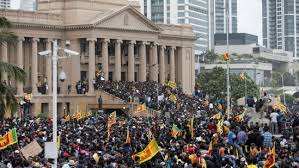
Former NITI Aayog Vice-Chairman Arvind Panagariya on Sunday said it would be 'silly' to compare the economic situation of Sri Lanka with India.
However, lessons can be learnt from the economic crisis in the island nation.
Mr Panagariya, in an interview with PTI, further said since the 1991 balance of payments crisis, successive governments have managed the macroeconomy conservatively.
He pointed out that in the case of India, fiscal deficits have not been allowed to get out of hand, the exchange rate has been allowed to depreciate to keep the current-account deficit low, monetary policy has been restrained to keep inflation low, and the opening of financial capital flows has been done in a calibrated fashion.
"This is a silly comparison...suggestions of any parallels between India and Sri Lanka currently are laughable," Panagariya said, adding that India has rarely borrowed abroad to finance its fiscal deficit.
The eminent economist was asked to comment on former Congress president Rahul Gandhi's statement in which Gandhi hit out at the Modi government over rising inflation and unemployment and said India looks a "lot like Sri Lanka" and the Centre should not distract people.
Sri Lanka is grappling with a severe economic crisis, and India has been at the forefront of extending economic assistance to Sri Lanka.
He said, "we must surely take lessons from the Sri Lankan experience for our future macroeconomic management. That is the main relevance of the events there for India."
Mr Panagariya, a professor of economics at Columbia University, replied to a question on unemployment and asserted that India's problem is not unemployment; instead, it is under-employment or low-productivity employment.
"We need to work on creating well-paid jobs for the masses," he said, adding that the unemployment rate even in the Covid year of 2020-21 had been down to 4.2 per cent compared with 6.1 per cent in 2017-18.
The eminent economist noted that those who had raised a hue and cry at the 6.1 per cent rate in 2017-18 have now gone completely quiet on the unemployment rates reported by the Periodic Labour Force Survey (PLFS).
On questions raised by some experts on India's official data on various subjects, he said the country's GDP, PLFS and vital statistics collection fare well in international comparisons.
"There are some genuine criticisms that need to be addressed. We certainly need to invest a lot more in revamping our data collection," he noted.
Having said this, Mr Panagariya said, 'we must also call out and reject many motivated criticisms'.
For instance, according to him, those such as the Economist and New York Times providing the alternative estimates of Covid deaths in India need to apply higher standards to evaluate their own (highly flawed) methodologies.
Asked whether he thinks the Indian economy is in a better position than it was eight years ago, he said, "you can look at any indicator you like: per-capita income, poverty, life expectancy, nutrition, and infant mortality. You will see improvement in each of these indicators."
Responding to a question on the Indian rupee weakening to a record low, Mr Panagariya said the rise in the interest rates in the United States had led capital to move out of emerging markets and Europe into the United States.
"That has led to a depreciation of nearly all major currencies against the dollar. The rupee is not unique in this regard," he said, adding that if anything, the rupee has depreciated less than most other currencies partially due to heavy intervention by the RBI.
Mr Panagariya pointed out that while during 2022, the rupee has depreciated 7 per cent against the dollar, in comparison, the Euro is down by 13 per cent, the British pound by 11 per cent and the Japanese yen by 16 per cent.
In Asia also, the South Korean won, Philippines peso, Thai baht and Taiwanese dollar have all fallen more than the rupee against the US dollar.
"The net result is an appreciation of the rupee against all of these currencies," he argued.
On fears of economic recession, Panagariya observed that persistent inflation at rates not witnessed in four decades and entrenchment of inflationary expectations, especially in the United States, have meant that the only way for the central banks to break the back of inflation is through the recession.
"That is, the central banks must keep raising the interest rates until economic activity sees a decline and forces a break in the high inflation-high wage-high inflation cycle.
"In India, we do not face the same problem," he opined.
Replying to a question on high inflation, the eminent economist said the source of India's inflation problem is largely external-- unprecedented sudden rise in oil and cereal prices triggered by the Russia-Ukraine war.
With RBI raising interest rates, oil prices seeing some thaw and the latest fruits and vegetable crops around the corner, he said, "We will see inflation return to below 6 per cent by the second half of FY23, as pointed out; by the RBI Governor."
Mr Pangariya noted that India's inflation at 7 per cent exceeds its tolerance limit of 6 per cent under inflation targeting by only one percentage point.

-
Swiggy vs Eternal: Food Delivery's Two Rivals Are No Longer In The Same Race

Eternal is building a private AI assistant, dark.ai. Swiggy is still working out how to make Instamart pay, with an operating loss of Rs 895 crore in the July-September quarter while Blinkit stayed profitable.
-
Where You Live Shapes How You Get To Work | The Reason Why
Two-wheelers are the most popular way to get to work in India, accounting for nearly 43% of workplace commutes.
-
High US Salaries, No Green Card Certainty: The Financial Calculation Facing Indian H-1B Families
The suspension of PERM processing at eight technology employers does not cancel existing H-1B visas. What it does is force a question many Indian families have been avoiding: is the US salary worth tying your career and family plans to one employer?
-
Unhedged Position: Can India See An Indonesia-Style Time Correction?
The Nifty is trading below levels it first clocked in 2024. Is there, then, as I have suggested in the headline, potential that the current time correction drags on painfully for the next three-five, even ten years?
-
Navigating Friction And Energy Realities: An Analysis Of Marco Rubio's October Visit To India
Occurring at a critical juncture marked by stalled trade negotiations and escalating geopolitical pressures over global energy supplies, the visit offers a profound window into modern US-India relations.
-
India Exports Capital. Why Not Export Trusteeship?
The big question, then, is whether India can build an institution that global borrowers, investors, banks, and lawyers can trust, even without an Indian connection.
-
France's Economy & Politics Are In Crisis | The Reason Why
Let's look at how the French economy and politics evolved under Nicolas Sarkozy, Franois Hollande and Emmanuel Macron.
-
You May Inherit The Business. You Must Earn Its Credibility.
Succession tests the founder's ability to share authority as much as it tests the next generation's readiness to assume it.
-
Signing Deals Is One Thing; Making Them Work Is Another | The Week In Whys
Sometimes, things don't turn out as planned. Indian companies have lost some bids to rivals, some projects won't produce until 2030.
-
FOMC Wall, PERM Suspension, Hospital Stocks | Talking Points This Week
A PERM suspension would directly affect green-card sponsorship rather than H-1B visas, so the near-term earnings impact could remain relatively limited. The key question is whether this marks a new phase in US scrutiny of Indian IT.









