Subhash Chandra, Punit Goenka Barred From Company Boards By Regulator
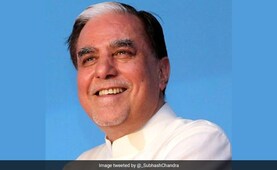
Markets regulator Sebi on Monday barred Essel Group chairman Subhash Chandra and Zee Entertainment Enterprises Ltd (ZEEL) MD and CEO Punit Goenka from holding the position of a director or key managerial personnel in any listed company for siphoning off funds of the media firm.
The case pertains to Chandra, who was also the chairman of ZEEL during the alleged violation, and Goenka having abused their position as directors or KMPs of a listed company for siphoning off funds for their own benefit.
In its interim order, Sebi noted that Chandra and Goenka alienated the assets of ZEEL and other listed companies of Essel Group for the benefit of associate entities, which are owned and controlled by them.
The siphoning of funds appears to be a well-planned scheme since, in some instances, the layering of transactions involved using as many as 13 entities as pass-through entities within a short period of two days only, it added.
Sebi noted that the share price of ZEEL has come down from a high of close to Rs 600 per share to the current price of less than Rs 200 per share during the period FY 2018-19 to FY 2022-23. This erosion of wealth despite the company being so profitable and generating profit after tax consistently would lead to a conclusion that "all was not well with the company".
During this period, the promoter shareholding dropped from 41.62 per cent to the current level of 3.99 per cent.
Although the promoter family is only holding 3.99 per cent shares in ZEEL, Chandra and Goenka continue to be at the helm of affairs of ZEEL, the order noted.
"Noticees (Chandra and Goneka) created a façade through sham entries to misrepresent to the investors as well as the regulator that money had been returned by associate entities, whereas in reality, it was ZEEL's own funds which were rotated through multiple layers to finally end in ZEEL's account.
The noticees have attempted to ride piggyback on the success of ZEEL, the flagship company of Essel Group, to bankroll the associate entities, which are owned and controlled by them," Sebi said in its 17-page order.
The order came after Sebi conducted an examination in the wake of the resignation of two independent directors -- Sunil Kumar and Neharika Vohra -- of ZEEL in November 2019.
They had raised concerns over several issues, including the appropriation of certain Fixed Deposit (FD) of ZEEL by Yes Bank for squaring off loans of related entities of Essel Group. Vohra alleged that bank guarantees were given to a subsidiary without approval from ZEEL's board.
Sebi's investigation found that Chandra had provided a “Letter of Comfort” or LoC in September 2018, that was towards a Rs 200 crore loan outstanding from Essel Group Mobility.
Going by the letter, the Rs 200 crore FD available with Yes Bank from any of the Essel Group companies, including ZEEL, could be taken to settle it. Accordingly, Yes Bank had adjusted the loans of seven associate entities with this Rs 200 crore of ZEEL.
Later, it was found that these seven entities were owned or controlled by family members of Chandra and Goenka, Sebi noted.
When Sebi investigated further, ZEEL submitted that Rs 200 crore had been returned by the associate entities to ZEEL. Since Chandra and Goenka had signed the LoCs without consulting or informing the Board, both were found to have violated provisions of LODR (Listing Obligations and Disclosure Requirements) rules.
Accordingly, Sebi said, "Noticees shall cease to hold the position of a director or a Key Managerial Personnel in any listed company or its subsidiaries until further orders". PTI SP MR
(Except for the headline, this story has not been edited by NDTV staff and is published from a syndicated feed.)

-
Unhedged Position: Can India See An Indonesia-Style Time Correction?

The Nifty is trading below levels it first clocked in 2024. Is there, then, as I have suggested in the headline, potential that the current time correction drags on painfully for the next three-five, even ten years?
-
Navigating Friction And Energy Realities: An Analysis Of Marco Rubio's October Visit To India
Occurring at a critical juncture marked by stalled trade negotiations and escalating geopolitical pressures over global energy supplies, the visit offers a profound window into modern US-India relations.
-
India Exports Capital. Why Not Export Trusteeship?
The big question, then, is whether India can build an institution that global borrowers, investors, banks, and lawyers can trust, even without an Indian connection.
-
France's Economy & Politics Are In Crisis | The Reason Why
Let's look at how the French economy and politics evolved under Nicolas Sarkozy, Franois Hollande and Emmanuel Macron.
-
You May Inherit The Business. You Must Earn Its Credibility.
Succession tests the founder's ability to share authority as much as it tests the next generation's readiness to assume it.
-
Signing Deals Is One Thing; Making Them Work Is Another | The Week In Whys
Sometimes, things don't turn out as planned. Indian companies have lost some bids to rivals, some projects won't produce until 2030.
-
FOMC Wall, PERM Suspension, Hospital Stocks | Talking Points This Week
A PERM suspension would directly affect green-card sponsorship rather than H-1B visas, so the near-term earnings impact could remain relatively limited. The key question is whether this marks a new phase in US scrutiny of Indian IT.
-
Everything, Everywhere, All At Once: Dalal Street's Week To Forget | Joining The Dots
Visa curbs, a Starlink spat and cancer drug caps: what connects this week's shocks for Indian markets
-
India Is Going Abroad For Critical Minerals. But It May Take Years To Pay Off | The Reason Why
Although India's steps are in the right direction, they remain modest compared with India's growing dependence.
-
When Everyone Has AI, What Gives You An Edge?
India's young workforce is entering an uncertain world of work where powerful AI tools are becoming widely accessible. The advantage will belong to those who combine deep expertise with digital fluency, and the distinctly human capabilities that technology cannot manufacture.









