SBI Pushes Associate Banks Merger To Next Fiscal Year
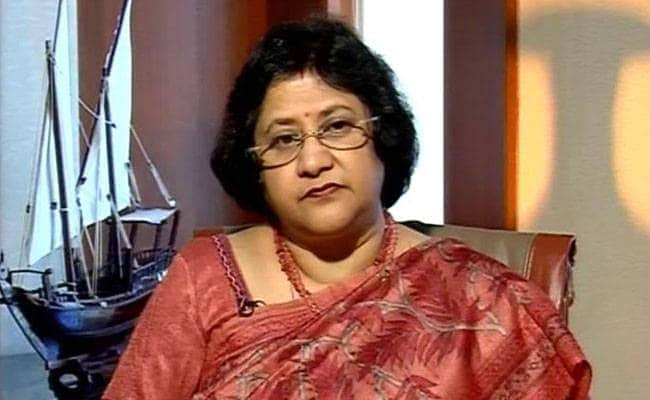
Mumbai: State Bank of India (SBI) chairperson Arundhati Bhattacharya on Monday hinted that the mega merger of its five associate banks and Bharatiya Mahila Bank (BMB) could be pushed to the next financial year as it is still awaiting the government notification on the move.
"Probably, by a quarter or so (the merger could be delayed). The reason is we still have to get the government approval and even if we get it now, doing things like merger in the last quarter is never a very wise thing because there would be lot of IT system changes," she told reporters when asked whether the merger could be delayed due to the disruptions caused by the demonetisation drive.
The merger would make SBI a global-sized bank and would be amongst the top 50 lenders in the world, with an asset base of Rs 37 trillion or over $555 billion, with 22,500 branches and over 58,000 ATMs and more than 50 crore customers.
Ms Bhattacharya said normally the banks close down all the IT system changes by mid-February.
"Sometimes IT system can impact something else quite unknowingly. So we don't want to take any risks at the annual closing time. So we may want to do the annual closing and then look at it," she added.
When asked whether she has a new time in mind for the merger process to be completed, the chairperson said "no yet. Let me first get the government approval only then we will know."
When specifically asked what sort of government approval is pending, the chairperson said the government has "to notify the merger scheme."
It can be noted that the bank had announced the merger in May and its central board of directors had in August approved the process along with the share swap ratio for three of the listed associate banks and Bharatiya Mahila Bank.
At that time it was announced that the merger would be completed by end March 2017.
"The (merger) process will start by October-end. The grievance committee will come to us hopefully by September end, after that we have to send it to RBI and then to the government, which may probably take a little time of about month; and then it will come to us. After that we will have to make an offer to employees and then give them four weeks time and then the merger can take place," Ms Bhattacharya had told PTI in an interview in September.
SBI has three listed associate banks - State Bank of Bikaner & Jaipur (SBBJ), State Bank of Mysore (SBM), State Bank of Travancore (SBT) and two unlisted associate bank - State Bank of Patiala and State Bank of Hyderabad.
As per the swap ratio, SBBJ shareholders would get 28 shares of SBI (Rs 1 each) for every 10 shares (Rs 10 each).
Similarly, SBM and SBT shareholders would get 22 shares of SBI for every 10 shares.
In case of Bharatiya Mahila Bank, 4,42,31,510 shares of SBI would be swapped for every 100 crore of Rs 10 each.
The lender had put in place a grievance redressal mechanism to provide an opportunity to its shareholders to file their objections with regard to the share swap ratios. It had given 21 calendar days of time for shareholders to register their complaints.
The grievance committee was headed by a High Court judge and two chartered accountants.
Ms Bhattacharya said post the merger of five associate banks and Bharatiya Mahila Bank, the government's stake in the bank would stand at around 59 per cent.
SBI has around 16,500 branches, including 191 foreign offices spread across 36 countries. Globally, SBI will come at the 45th position in terms of asset size after the merger.
SBI first merged State Bank of Saurashtra with itself in 2008. Two years later, State Bank of Indore was merged.
(This story has not been edited by NDTV staff and is auto-generated from a syndicated feed.)

-
A New Samvat Wishlist: Inclusive Prosperity And Human Development

India has strengthened its economic foundations through infrastructure, digital access and enterprise. Its next growth chapter must deepen productivity, create better livelihoods and widen participation in prosperity.
-
Love, Sex Aur Dhokha: The Audacious Plot To Spy On Jensen Huang
A Taipei dinner, a Singapore chip buyer and a suspected Chinese asset: inside the alleged spy operation that got close to NVIDIA's Jensen Huang.
-
Ten Things I Learnt This Samvat
Patience can be a trap. Cheap stocks can stay cheap. Leverage can wipe you out. What did Samvat 2082 teach us? Niraj Shah writes on 10 lessons from the year gone by.
-
Talking Points This Week: Tech Nerves, FII Buying, And A Faraway Banking Shock
The global markets are not shining this Diwali. The exception in the large markets is, India.
-
Midterm Rally Lasted A Day. The Hard Reality Of A Divided US May Last Two Years | Opinion
Between a contested AI boom, a debt ceiling that arrives in 2027 and a president with every incentive to act alone, the next two years may prove more volatile than the first day's rally suggests.
-
Blue Wave Will Derail the AI Trade but Won't Dismantle the AI Era | Unhedged Position
The Democrats' sweep of the US Congress will see politics collide with economic forces both over the long and short term.
-
It's Time To Take The GST Council's Bet On Trust Global
Payment records can prove India's services exports, and clear, proportionate rules can bring foreign digital sellers into the tax net.
-
Opinion | India at 38: From Innovation Overperformer to Innovation Powerhouse
India now has 453 VC-backed deep science startups, 18 of them late-stage, after 117 percent growth since 2020. Laurus Labs, at USD 9.3 billion, is the most valuable deep science company in any middle-income economy outside China.
-
Navigating Energy Crossroads: S Jaishankar's Call For Diversified Supply Chains At G20 Ministerial Meeting
As geopolitical fault lines continue to test maritime trade routes and commodity flows, Jaishankar's message remains pertinent: true economic resilience requires open markets, protected transit lines, and a genuine commitment to multilateral cooperation rather than coercion.









