Sensex, Nifty At Over 1-Week Closing Lows As Financial Stocks Tumble
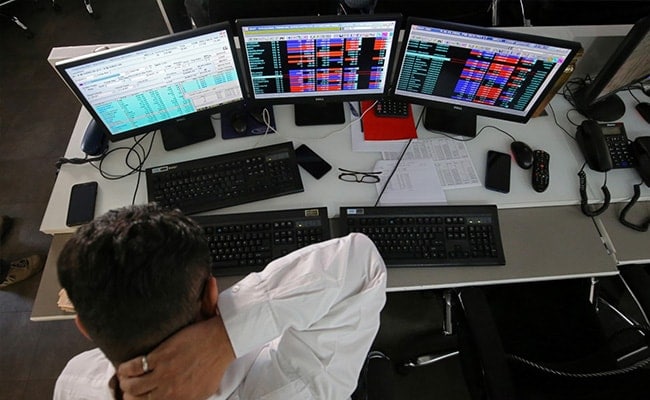
Domestic stock markets tumbled more than 2 per cent on Thursday amid a selloff across sectors led by financial stocks. The S&P BSE Sensex index hit 33,480.42 at the weakest level recorded during the session, shedding 766.63 points from its previous close. The broader NSE Nifty 50 benchmark declined to as low as 9,885.05 compared to its previous close of 10,116.15. A selloff in banking and financial services stocks deepened in late afternoon deals, while selling pressure also emerged in sectors such as automobiles, metals and pharmaceuticals.
The Sensex ended 708.68 points - or 2.07 per cent - lower at 33,538.37, and the Nifty settled at 9,902.00, down 214.15 points - or 2.12 per cent - from its previous close. Both benchmark indices logged their worst closing levels since June 1.
The markets extended losses after the Supreme Court extended a hearing on telecom companies' outstanding dues related to AGR or adjusted gross revenue, without providing any relief. The top court asked telecom operators to file replies on a roadmap for payment.
“Negative global cues and postponement of the decision on the AGR case sent the market tumbling," said Shrikant Chouhan, executive vice president-equity technical research at Kotak Securities.
Analysts awaited macroeconomic data due this week for more clarity on monetary policy going forward.
Official data on consumer inflation will be released at 5:30 pm on Friday. Consumer inflation - or the rate of increase in retail prices determined by the Consumer Price Index (CPI) - is likely to have moderated to a six-month low of 5.50 per cent in May, according to a poll of 35 economists by news agency Reuters.
Equities in other Asian markets eased after a downbeat economic outlook from the Federal Reserve stoked speculation the US central bank would have to add to already historic levels of stimulus to safeguard recovery.
The Federal Reserve hinted at years of extraordinary support for an economy facing a torturous slog back from the coronavirus pandemic, with policymakers projecting the economy to shrink 6.5 per cent in 2020 and the unemployment rate to be 9.3 per cent at the end of the year.
While MSCI's broadest index of Asia-Pacific shares outside Japan fell 1.40 per cent, following 10 sessions of gain, Japan's Nikkei 225 benchmark declined 2.82 per cent. China's Shanghai Composite, Hong Kong's Hang Seng and South Korea's KOSPI indices dropped 0.78 per cent, 2.27 per cent and 0.86 per cent respectively.
The E-Mini S&P 500 futures were last seen trading 1.93 per cent lower, indicating a negative start for the US markets on Thursday.
"The US and Asian markets plunged mainly due to the Fed signaling that the path to economic recovery will be long even as worries over the second wave of coronavirus infections grew," said Mr Chouhan.
European markets started the day with heavy losses. The United Kingdom's FTSE benchmark was last seen trading 2.44 per cent lower, while France's CAC and Germany's DAX barometers were down 2.73 per cent and 2.63 per cent respectively.

-
A New Samvat Wishlist: Inclusive Prosperity And Human Development

India has strengthened its economic foundations through infrastructure, digital access and enterprise. Its next growth chapter must deepen productivity, create better livelihoods and widen participation in prosperity.
-
Love, Sex Aur Dhokha: The Audacious Plot To Spy On Jensen Huang
A Taipei dinner, a Singapore chip buyer and a suspected Chinese asset: inside the alleged spy operation that got close to NVIDIA's Jensen Huang.
-
Ten Things I Learnt This Samvat
Patience can be a trap. Cheap stocks can stay cheap. Leverage can wipe you out. What did Samvat 2082 teach us? Niraj Shah writes on 10 lessons from the year gone by.
-
Talking Points This Week: Tech Nerves, FII Buying, And A Faraway Banking Shock
The global markets are not shining this Diwali. The exception in the large markets is, India.
-
Midterm Rally Lasted A Day. The Hard Reality Of A Divided US May Last Two Years | Opinion
Between a contested AI boom, a debt ceiling that arrives in 2027 and a president with every incentive to act alone, the next two years may prove more volatile than the first day's rally suggests.
-
Blue Wave Will Derail the AI Trade but Won't Dismantle the AI Era | Unhedged Position
The Democrats' sweep of the US Congress will see politics collide with economic forces both over the long and short term.
-
It's Time To Take The GST Council's Bet On Trust Global
Payment records can prove India's services exports, and clear, proportionate rules can bring foreign digital sellers into the tax net.
-
Opinion | India at 38: From Innovation Overperformer to Innovation Powerhouse
India now has 453 VC-backed deep science startups, 18 of them late-stage, after 117 percent growth since 2020. Laurus Labs, at USD 9.3 billion, is the most valuable deep science company in any middle-income economy outside China.
-
Navigating Energy Crossroads: S Jaishankar's Call For Diversified Supply Chains At G20 Ministerial Meeting
As geopolitical fault lines continue to test maritime trade routes and commodity flows, Jaishankar's message remains pertinent: true economic resilience requires open markets, protected transit lines, and a genuine commitment to multilateral cooperation rather than coercion.









