Russia Muscles In on Indian Oil Market at Expense of OPEC Titans
(Bloomberg) -- Watch out Iraq and Saudi Arabia, Russia is making huge inroads into the Indian oil market and has quite possibly become the largest supplier to the giant Asian buyer.
Deprived of many of its traditional European buyers, Moscow is on course to deliver somewhere between 1 million and 1.2 million barrels a day to the world's third-largest oil importer this month, according to tanker tracking figures compiled by Bloomberg and two oil analytics firms.
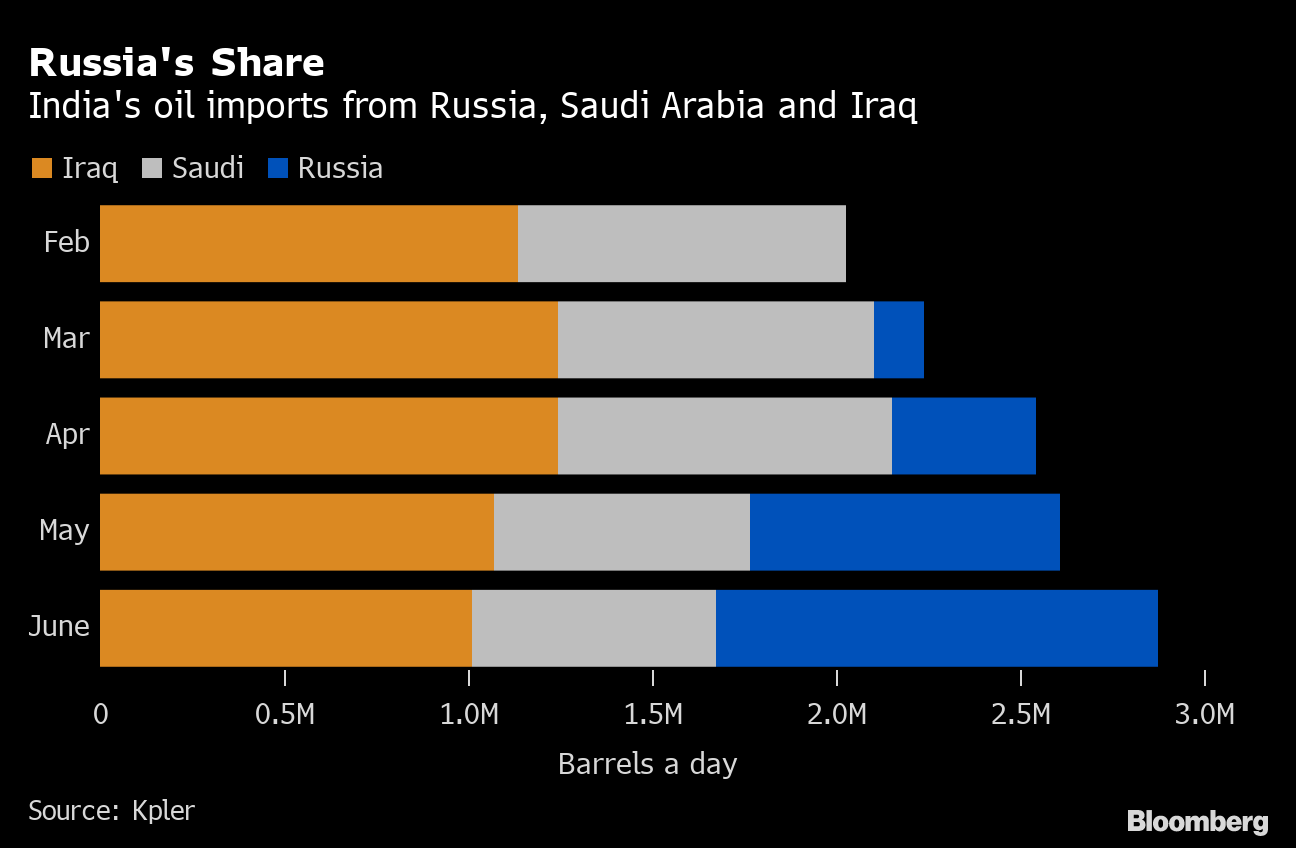
That would place it neck-and-neck with, or a little above, Iraq, and far ahead of Saudi Arabia. The surge in flows will be viewed with unease by Baghdad in particular, since Iraq's oil has increasingly had to discount to compete for market share in Asia.
Refiners in India have been gorging on cheap Russian barrels in a way they never did before the invasion of Ukraine, making it noticeable even to Vladimir Putin, Russia's president.
Europe Out
Flows to Asia rose because some European companies stopped buying, putting an onus on Russia to find alternative markets.
Vessel tracking figures vary from provider to provider, depending on different assumptions and underlying information about cargoes. But figures from Kpler, Vortexa and Bloomberg all underscore the dominant position Russia has assumed in India.
Kpler's data show that arrivals of Russian oil into India averaged 1.2 million barrels a day so far in June, a quarter of all crude flowing into the country. Iraq's daily supplies will be around 1.01 million barrels, while Saudi Arabia's are on course for 662,000 a day.
Vortexa figures suggest Russian deliveries of 1.16 million barrels a day, more than Iraq's 1.131 million. Tanker tracking compiled by Bloomberg indicates that 988,000 barrels a day will arrive from Russia this month, slightly below a figure of 1.003 million a day from Iraq.
“We think this new trade pattern between Russia and India should continue and could even intensify by the end of the year” following the implementation of new European Union sanctions, according to Homayoun Falakshahi, a senior commodity analyst at Kpler. “The whole situation is leading to a reshuffle of flows, with more Middle Eastern crudes going westwards toward Europe.”
India has defended the Russian purchases, citing its national interest to source cheaper crude. The buying has delivered one part of a trove of cash that Russia garnered from commodity markets, funding its war.
Russia's muscling into the Indian and Chinese markets has been eating into share of Iraq and Saudi Arabia in the world's biggest oil consuming region.
The two nations' combined deliveries to India have dropped by about 500,000 barrels a day since April, as Russian flows ramped up, according to tracking data.
“When the price goes up and you are left with no option, you will buy from anywhere,” Oil Minister Hardeep Singh Puri told reporters last week. “We have a very well defined understanding of what India's interests are.”
(Updates with analyst comment in ninth paragraph.)
More stories like this are available on bloomberg.com
©2022 Bloomberg L.P.

-
A New Samvat Wishlist: Inclusive Prosperity And Human Development

India has strengthened its economic foundations through infrastructure, digital access and enterprise. Its next growth chapter must deepen productivity, create better livelihoods and widen participation in prosperity.
-
Love, Sex Aur Dhokha: The Audacious Plot To Spy On Jensen Huang
A Taipei dinner, a Singapore chip buyer and a suspected Chinese asset: inside the alleged spy operation that got close to NVIDIA's Jensen Huang.
-
Ten Things I Learnt This Samvat
Patience can be a trap. Cheap stocks can stay cheap. Leverage can wipe you out. What did Samvat 2082 teach us? Niraj Shah writes on 10 lessons from the year gone by.
-
Talking Points This Week: Tech Nerves, FII Buying, And A Faraway Banking Shock
The global markets are not shining this Diwali. The exception in the large markets is, India.
-
Midterm Rally Lasted A Day. The Hard Reality Of A Divided US May Last Two Years | Opinion
Between a contested AI boom, a debt ceiling that arrives in 2027 and a president with every incentive to act alone, the next two years may prove more volatile than the first day's rally suggests.
-
Blue Wave Will Derail the AI Trade but Won't Dismantle the AI Era | Unhedged Position
The Democrats' sweep of the US Congress will see politics collide with economic forces both over the long and short term.
-
It's Time To Take The GST Council's Bet On Trust Global
Payment records can prove India's services exports, and clear, proportionate rules can bring foreign digital sellers into the tax net.
-
Opinion | India at 38: From Innovation Overperformer to Innovation Powerhouse
India now has 453 VC-backed deep science startups, 18 of them late-stage, after 117 percent growth since 2020. Laurus Labs, at USD 9.3 billion, is the most valuable deep science company in any middle-income economy outside China.
-
Navigating Energy Crossroads: S Jaishankar's Call For Diversified Supply Chains At G20 Ministerial Meeting
As geopolitical fault lines continue to test maritime trade routes and commodity flows, Jaishankar's message remains pertinent: true economic resilience requires open markets, protected transit lines, and a genuine commitment to multilateral cooperation rather than coercion.









