Rupee At New Record Low, Inches Towards 82 Per Dollar
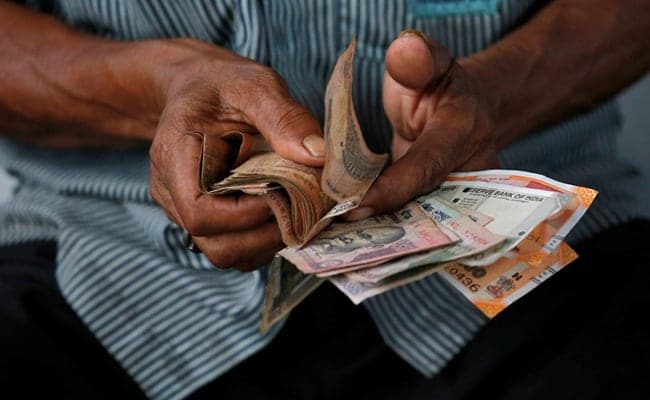
The rupee hit a new record low as the dollar soared to fresh highs on Wednesday after the White House downplayed the possibility of a currency deal to weaken the dollar, and hawkish remarks from Federal Reserve policymakers added more fuel to the skyrocketing greenback.
PTI reported that the domestic currency fell 40 paise to an all-time low of 81.93 against the US dollar in early trade.
Bloomberg showed the rupee last at 81.9050 per dollar, after hitting 81.9350, its weakest level ever, compared to its previous close of 81.5788.
In the previous session, the rupee had clawed back from record lows to end with modest gains.
But what has not helped the domestic currency is India ruling out any changes to tax policies that would have made it easier for the nation's bonds to be included in global indexes and roll in billions of dollars.
"With no exception or deviation to its FX peers and due to USD at a two-decade high, the rupee is expected to open near 81.80 levels. Yesterday, it was seen easing pressure to trade near the 81.30s level, but the setback of India's bond inclusion in 2022 news spurred demand for USD and the rupee weakened past the 81.60 mark," said Amit Pabari, Managing Director of CR Forex Advisors.
The rising US bond yields and dollar's pressure on developing market currencies raises the likelihood that those nations would have to raise interest rates further, which, in turn, would hurt economic growth there.
Indian investors await the Reserve Bank of India's monetary policy announcement as it kicks off its three-day policy meeting on Wednesday.
On Wednesday, the dollar surpassed a previous two-decade high versus a basket of currencies thanks to rising Treasury yields.
In Asian trading, the US dollar index reached a new high of 114.68 and was last up over 0.4 per cent at around 114.60.
For the first time since 2010, the US 10-year Treasury bond yield reached 4 per cent.
"It's a combination of the spillover from the UK... where the gilt yields have gone ballistic. And that has spilled over into other DM bond markets, so there's a bit of a ricochet effect," Moh Siong Sim, a Currency Strategist at Bank of Singapore, told Reuters.
"And of course...this is against the backdrop of a very determined message by the Fed to do whatever it takes to bring inflation down."
Sterling lost about 1 per cent of its value, or $1.0634, reversing a modest 0.4 per cent gain from the previous session and continuing its steep decline from its all-time low of $1.0327 at the beginning of the week.
As a result of the Fed's tightening stance, the dollar index reached a new record high, the euro and the pound both declined, and the offshore yuan plunged to its lowest level ever vs the dollar. The crucial 145-point level against the dollar, where Japan has intervened, was still in the yen's vicinity.
"The fact we have such a strong increase in US yields is attracting flows into the US dollar," Nanette Hechler-Fayd'herbe, Chief Investment Officer of International Wealth Management for Credit Suisse Group AG, told Bloomberg. "As long as monetary and fiscal policy worldwide are really not coming to strengthen their own currencies, we should be anticipating a very strong dollar."
On Wednesday, the strengthening dollar drove other currencies to multi-year lows, with the Australian dollar reaching a low of $0.6389, its lowest level since May 2020. To $0.55645, the kiwi fell by almost 1 per cent, matching its lowest level from March 2020.

-
Navigating Friction And Energy Realities: An Analysis Of Marco Rubio's October Visit To India

Occurring at a critical juncture marked by stalled trade negotiations and escalating geopolitical pressures over global energy supplies, the visit offers a profound window into modern US-India relations.
-
India Exports Capital. Why Not Export Trusteeship?
The big question, then, is whether India can build an institution that global borrowers, investors, banks, and lawyers can trust, even without an Indian connection.
-
France's Economy & Politics Are In Crisis | The Reason Why
Let's look at how the French economy and politics evolved under Nicolas Sarkozy, Franois Hollande and Emmanuel Macron.
-
You May Inherit The Business. You Must Earn Its Credibility.
Succession tests the founder's ability to share authority as much as it tests the next generation's readiness to assume it.
-
Signing Deals Is One Thing; Making Them Work Is Another | The Week In Whys
Sometimes, things don't turn out as planned. Indian companies have lost some bids to rivals, some projects won't produce until 2030.
-
FOMC Wall, PERM Suspension, Hospital Stocks | Talking Points This Week
A PERM suspension would directly affect green-card sponsorship rather than H-1B visas, so the near-term earnings impact could remain relatively limited. The key question is whether this marks a new phase in US scrutiny of Indian IT.
-
Everything, Everywhere, All At Once: Dalal Street's Week To Forget | Joining The Dots
Visa curbs, a Starlink spat and cancer drug caps: what connects this week's shocks for Indian markets
-
India Is Going Abroad For Critical Minerals. But It May Take Years To Pay Off | The Reason Why
Although India's steps are in the right direction, they remain modest compared with India's growing dependence.
-
When Everyone Has AI, What Gives You An Edge?
India's young workforce is entering an uncertain world of work where powerful AI tools are becoming widely accessible. The advantage will belong to those who combine deep expertise with digital fluency, and the distinctly human capabilities that technology cannot manufacture.
-
Wrong Labels, High Pesticide Residues Holding Back Agri Exports | The Reason Why
India needs stronger domestic food-safety and labelling standards, with best practices becoming part of everyday business for farmers, traders and food companies.










