Rupee Set For Worst Monthly Loss In 6 Years
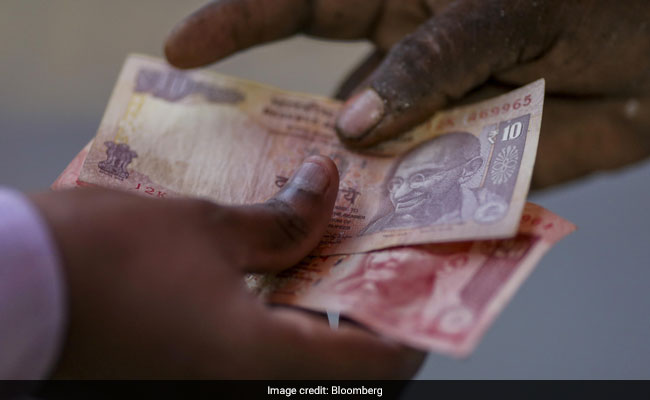
The rupee's resilience in the face of economic headwinds has come to an end, with the currency losing its year-to-date gains in the space of just one month.
The country's massive domestic market is now dragging on the rupee as growth at home slows, foreigners pull cash from local equities and the currency increasingly tracks moves in the yuan as the trade war heats up.
"Even though India is directly less vulnerable to US-China tensions, it can't remain completely insulated to the wider risk aversion," said Dushyant Padmanabhan, a forex strategist at Nomura Holdings Inc. in Singapore. The economic slowdown and capital outflows don't bode well for the rupee, he said.
The rupee is set for its worst monthly loss in six years and some analysts warn of more pain to come. JPMorgan Chase & Co. expects it to approach the record low hit last October by year-end, while Nomura forecasts the currency to finish 2019 at 72.5 per dollar. That's weaker than the median estimate of 71 in a Bloomberg survey.
Here are some of the reasons behind the currency's rapid reversal:
Growth Slowdown
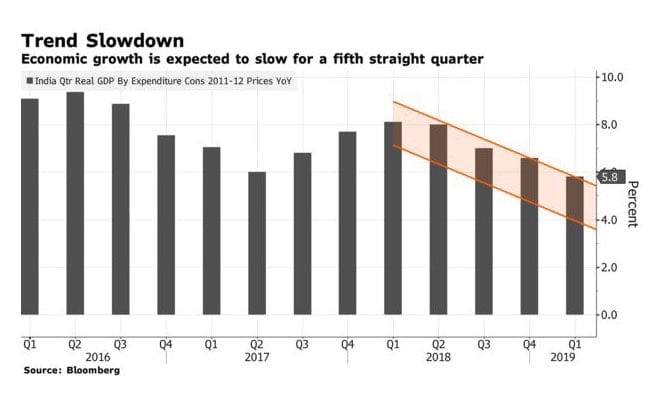
Demand for everything from cars to cookies has waned as the country's lingering shadow-banking crisis weighs on private consumption, which accounts for almost 60 per cent of the gross domestic product. And the increasingly bitter trade war has complicated the government's task of re-igniting Asia's third-largest economy.
Not surprisingly, data due Friday will likely to show that gross domestic product slowed in the June quarter, to 5.7 per cent.
"Fundamentals remain challenging for the rupee, and it will keep depreciating given the global and local headwinds," said Ashish Vaidya, head of trading at DBS Bank Ltd. in Mumbai. India no longer enjoys "a premium" over other emerging markets, he said.
Equity Outflows
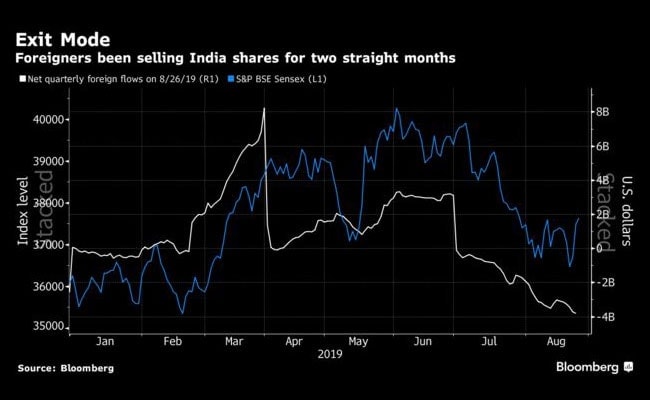
Foreigners have pulled $3.8 billion from local shares since July, as a tax on the super rich announced in the budget last month combined with the risk-off mood triggered by the trade conflict.
While the government scrapped the levy Friday to prevent a vicious cycle of capital outflows and a weakening currency, the withdrawals have persisted this week.
Large outflows have fueled the rupee's weakness and the size of the drop "has caught a lot of people by surprise," said Mitul Kotecha, senior emerging-markets strategist at TD Securities in Singapore.
China Angle
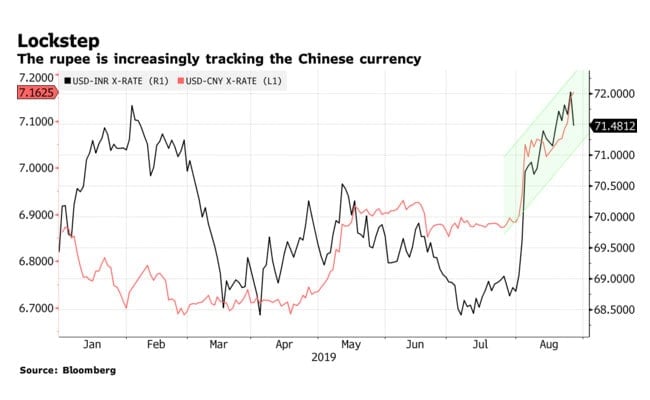
Rupee's fortunes are also getting linked to the moves in the yuan, according to JPMorgan, which has moved away from its call of rupee outperformance against the more-trade oriented currencies like the Korean won.
"If the CNY continues to depreciate against the USD, as we expect, we believe the rupee will depreciate virtually lockstep with the CNY," analysts including Sajid Chinoy and Jonathan Cavenagh wrote in a recent note.
August Wall
Weak fundamentals aside, the currency is also in a seasonally weak month. The rupee has slid an average 2.3 per cent in August over the past nine years, data compiled by Bloomberg show. Yet this time, the losses are much larger than usual and have erased gains accumulated in June and July.

-
Why Amazon And Flipkart Are Struggling To Beat Meesho In India's Smaller Cities

With 274 million users and lowest-cost logistics, Meesho is defending its value commerce crown against giants like Amazon and Flipkart.
-
High US Salaries, No Green Card Certainty: The Financial Calculation Facing Indian H-1B Families
The suspension of PERM processing at eight technology employers does not cancel existing H-1B visas. What it does is force a question many Indian families have been avoiding: is the US salary worth tying your career and family plans to one employer?
-
Swiggy vs Eternal: Food Delivery's Two Rivals Are No Longer In The Same Race
Eternal is building a private AI assistant, dark.ai. Swiggy is still working out how to make Instamart pay, with an operating loss of Rs 895 crore in the July-September quarter while Blinkit stayed profitable.
-
Where You Live Shapes How You Get To Work | The Reason Why
Two-wheelers are the most popular way to get to work in India, accounting for nearly 43% of workplace commutes.
-
Unhedged Position: Can India See An Indonesia-Style Time Correction?
The Nifty is trading below levels it first clocked in 2024. Is there, then, as I have suggested in the headline, potential that the current time correction drags on painfully for the next three-five, even ten years?
-
Navigating Friction And Energy Realities: An Analysis Of Marco Rubio's October Visit To India
Occurring at a critical juncture marked by stalled trade negotiations and escalating geopolitical pressures over global energy supplies, the visit offers a profound window into modern US-India relations.
-
India Exports Capital. Why Not Export Trusteeship?
The big question, then, is whether India can build an institution that global borrowers, investors, banks, and lawyers can trust, even without an Indian connection.
-
France's Economy & Politics Are In Crisis | The Reason Why
Let's look at how the French economy and politics evolved under Nicolas Sarkozy, Franois Hollande and Emmanuel Macron.
-
You May Inherit The Business. You Must Earn Its Credibility.
Succession tests the founder's ability to share authority as much as it tests the next generation's readiness to assume it.
-
Signing Deals Is One Thing; Making Them Work Is Another | The Week In Whys
Sometimes, things don't turn out as planned. Indian companies have lost some bids to rivals, some projects won't produce until 2030.










