Rupee Hits 4-Week Intra-day Low As Dollar Reigns Supreme On Rate Hike Concerns
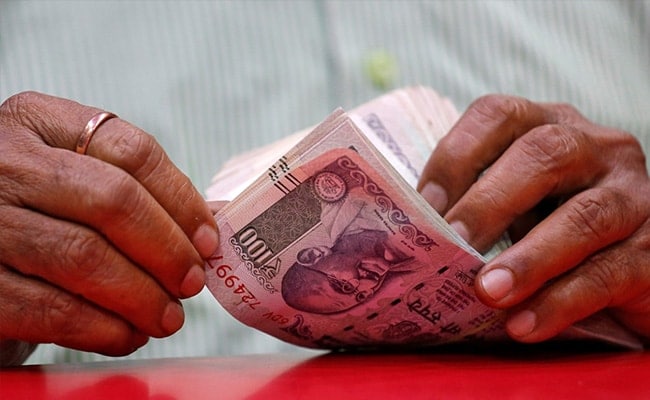
The rupee slumped on Monday as the dollar extends gains to hit a five-week high after policymakers from Asia to Europe to Americas promised to keep raising interest rates to tame high inflation even at the cost of economic slowdown.
Bloomberg showed the rupee was last changing hands at 79.8638 per dollar, from its previous close of 79.7825, with the Indian currency trading in 79.7762 to 79.9200 range.
The top of the range level of 79.92 marks the weakest in four weeks for the rupee.
Reuters reported that the rupee dropped to 79.9125 per U.S. dollar, lowest level since July 27, compared with 79.7750 in the previous session.
According to PTI, the rupee fell 4 paise to close provisionally at 79.87 against the US dollar.
PTI reported that at the interbank foreign exchange market, the local currency opened weak at 79.90 and moved in a range of 79.78 to 79.92 during the session. It finally settled flat at 79.84 against the US dollar.
Considering the extent of bad news, it is surprising that the rupee is still holding on the stronger side of 80, a currency trader at a private bank, told Reuters.
"It is quite clear that the markets still sees 80 as a level that the RBI will want to defend," the trader added.
A volatile equities market dragged on the rupee, as investors locked-in gains after a recent rally.
Ahead of the Federal Reserve's Jackson Hole symposium this week, officials from the central bank maintained their aggressive monetary tightening stance, pushing the dollar index - which compares the value of the dollar to a basket of peers - to new five-week highs.
"The dollar index's strength, weakness in the Chinese yuan and local equities is pressuring the rupee," a trader at a private bank, told Reuters.
There is a chance the greenback will strengthen further and if it touches 110-level by the Fed's symposium, the Reserve Bank of India may let the currency breach 80 gradually, he added.
After the rupee hit a record low of 80.065 on July 19, the Reserve Bank of India took proactive measures to protect the crucial level of 8- per dollar. Many analysts now believe there is a chance the rupee will return to this level this week, according to Reuters.
After Russia stated late on Friday that it would stop supplying European gas through the Nord Stream 1 pipeline for three days at the end of this month, the euro took the brunt of the selling pressure versus the dollar.
Concern that a three-day suspension of European gas supply later this month may exacerbate an energy crisis caused the euro to briefly fall back below parity against a strong dollar on Monday and to wallow at five-week lows.
The currency fell to as low as $0.99945, its lowest level since mid-July, and was last down 0.4% on the day.
"The euro's fair value has been damaged by the energy shock - meaning that euro/dollar is not especially cheap even at these levels," Chris Turner, global head of markets at ING, told Reuters.
German economy, one of the most vulnerable to delays in Russian gas supply, is "likely" to experience a recession over the winter if the energy crisis deepens, Bundesbank President Joachim Nagel told German weekly Rheinischen Post.
China's yuan dropped to its lowest in nearly two years after the central bank cut key lending rates.
Indeed, the dollar rose as high as 6.8420 yuan in onshore trading for the first time since September, 2020 after the People's Bank of China cut the one and five-year loan prime rates, as widely expected. That came after it eased other key borrowing benchmarks in a surprise move last week.

-
Why Amazon And Flipkart Are Struggling To Beat Meesho In India's Smaller Cities

With 274 million users and lowest-cost logistics, Meesho is defending its value commerce crown against giants like Amazon and Flipkart.
-
High US Salaries, No Green Card Certainty: The Financial Calculation Facing Indian H-1B Families
The suspension of PERM processing at eight technology employers does not cancel existing H-1B visas. What it does is force a question many Indian families have been avoiding: is the US salary worth tying your career and family plans to one employer?
-
Swiggy vs Eternal: Food Delivery's Two Rivals Are No Longer In The Same Race
Eternal is building a private AI assistant, dark.ai. Swiggy is still working out how to make Instamart pay, with an operating loss of Rs 895 crore in the July-September quarter while Blinkit stayed profitable.
-
Where You Live Shapes How You Get To Work | The Reason Why
Two-wheelers are the most popular way to get to work in India, accounting for nearly 43% of workplace commutes.
-
Unhedged Position: Can India See An Indonesia-Style Time Correction?
The Nifty is trading below levels it first clocked in 2024. Is there, then, as I have suggested in the headline, potential that the current time correction drags on painfully for the next three-five, even ten years?
-
Navigating Friction And Energy Realities: An Analysis Of Marco Rubio's October Visit To India
Occurring at a critical juncture marked by stalled trade negotiations and escalating geopolitical pressures over global energy supplies, the visit offers a profound window into modern US-India relations.
-
India Exports Capital. Why Not Export Trusteeship?
The big question, then, is whether India can build an institution that global borrowers, investors, banks, and lawyers can trust, even without an Indian connection.
-
France's Economy & Politics Are In Crisis | The Reason Why
Let's look at how the French economy and politics evolved under Nicolas Sarkozy, Franois Hollande and Emmanuel Macron.
-
You May Inherit The Business. You Must Earn Its Credibility.
Succession tests the founder's ability to share authority as much as it tests the next generation's readiness to assume it.
-
Signing Deals Is One Thing; Making Them Work Is Another | The Week In Whys
Sometimes, things don't turn out as planned. Indian companies have lost some bids to rivals, some projects won't produce until 2030.










