Rupee’s Plunging Volatility Leaves Investors Guessing RBI Moves
(Bloomberg) -- Even in a year where currency volatility is falling worldwide, the slump in swings in the Indian rupee has traders from London to Singapore asking when the central bank will loosen its iron grip.
The rupee's one-month implied volatility versus the dollar crashed to its lowest since 2005 in June, drawing queries from investors on roadshows of Citigroup Inc. and ICICI Securities Primary Dealership Ltd. to gauge the path ahead for the Indian currency. That's largely because of the outsized role of the Reserve Bank of India in keeping the rupee in a tight range.
The RBI has added back $32 billion in reserves already this year as it absorbed foreign inflows to keep the currency steady, while its dollar forward book also climbed by around $10 billion in the first four months of the year. The central bank's efforts for a stable rupee may be aimed at boosting its appeal as an international trade currency, according to Citigroup.
“Fixed-income investors are basically looking for ways to trade the Goldilocks environment in India and the clearest way for those that believe dollar can weaken also is to go long the rupee,” said Abhishek Upadhyay, economist at ICICI Securities Primary Dealership, who is back from a recent client trip to Singapore and Kuala Lumpur. “Traders clearly want higher vols, even as investors are still willing to wait longer for RBI to let go of rupee.”
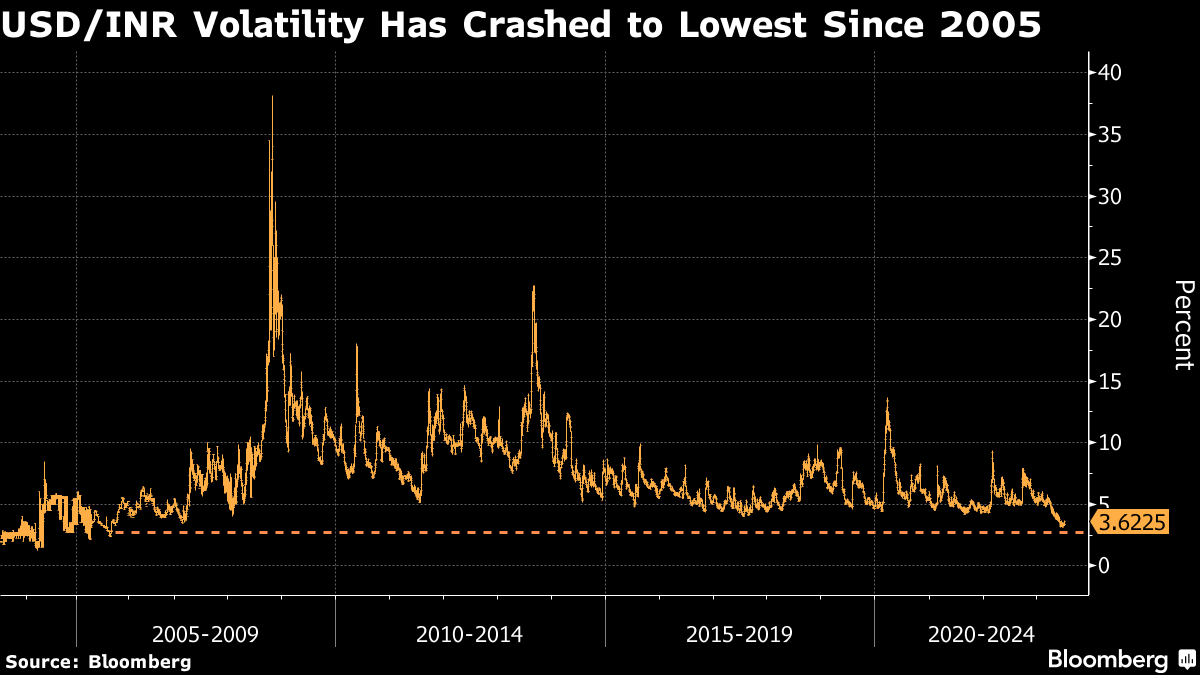
The rupee's historical volatility is the lowest in Asia over the past year, barring the pegged Hong Kong dollar. It has coincided with a global decline in assets volatility. The JPMorgan Global FX Volatility Index is at 8.2%, down from this year's high of 11.6% seen in March.
The rupee's gains have been muted this year despite over $12 billion of inflows into the nation's stocks, while its high-yielding rival Indonesia is up about 3% with only a small fraction of those inflows. RBI has maintained that it intervenes to keep undue rupee volatility in check.
Investors from M&G Investments Inc. to T. Rowe Price Group Inc. are largely positive on the rupee driven by improved macros and the world's fastest-growing major economy.
“India's balance of payment has moved back into surplus,” said Guan Yi Low, head of fixed income, Asia Pacific at M&G. “India is also benefiting from the relocation of global supply chains. We see upward potential for India's growth outlook in the coming years, and are positive for the rupee.”
The rupee stability has analysts and investors discussing the RBI's currency strategy, and its pros and cons.
“RBI may be ascribing the same weight to currency stability as it does to price stability and financial stability in an uncertain global environment,” Samiran Chakraborty, India economist at Citigroup, wrote in a note.
Yet, the dangers of lower volatility can't be overstated. Historically, long periods of unusual stability in the rupee have been followed by a sharp depreciation as periods of tranquility can lead to complacency, according to Citigroup.
“The negative side effects of low volatility are often insufficient hedging by corporates which can lead to unwanted currency exposure in case of a sharp downward move in the rupee,” said Rajeev De Mello, global macro portfolio manager at Gama Asset Management in Geneva. “Foreign investors adjust their positions based on volatility and could increase their rupee positions excessively.”
More stories like this are available on bloomberg.com
©2023 Bloomberg L.P.

-
Navigating Energy Crossroads: S Jaishankar's Call For Diversified Supply Chains At G20 Ministerial Meeting

As geopolitical fault lines continue to test maritime trade routes and commodity flows, Jaishankar's message remains pertinent: true economic resilience requires open markets, protected transit lines, and a genuine commitment to multilateral cooperation rather than coercion.
-
Indians Are Travelling, But Not Every Journey Is A Holiday | The Week In Whys
Pilgrims, patients and working women are the real travellers, and the system hasn't quite caught up with them.
-
Getting To Work Costs Women More | The Reason Why
It is not just about women paying more than men. It is about women paying much more in cities than in villages.
-
AI Bias In Investing Cannot Be Eliminated, But It Can Be Governed
Framing is a particularly important example as identical financial information presented in terms of gains rather than losses can lead an LLM to reach a different assessment.
-
Joining The Dots | Dark Skies, Steady Diya: Why Hope Holds This Diwali
With war, a weak rupee and foreign outflows weighing on sentiment, policymakers at the NDTV World Summit and market veterans at NDTV Profit Ignite: Diwali Edition offered the same advice: stay invested and filter out the noise.
-
The Curious Case of Equitas Small Finance Bank And A CEO Who Quit For Stock
PN Vasudevan believes persistent investor concerns over a perceived conflict of interest had become a governance overhang on Equitas Small Finance Bank's stock, even as the lender improved profitability and asset quality.
-
Talking Points This Week: AI Cash Burn, A Tiger Comeback And An India That Still Finds Its Own Path
India is not immune to higher oil or tighter global liquidity, yet its earnings base is broader, its domestic policy levers are still available.
-
Foreign Investors Own Half Of HDFC Bank and ICICI Bank. An LTCG Cut Could Matter Most Here
Foreign portfolio investors have US$115 billion parked in HDFC Bank, ICICI Bank. If the government cuts long-term capital gains tax, Jefferies says returning foreign money could land here first.
-
'Never Seen This Level Of Negativity': Sandeep Tandon Says The Next Rally May Be Closer Than You Think
Veteran investor Sandeep Tandon says foreign selling is easing, large-caps are due a comeback and mid-caps are crowded, while he turns positive on gold, power and pharma this Diwali.










