Rupee Hits A New Record Low Of 83.12 Per Dollar
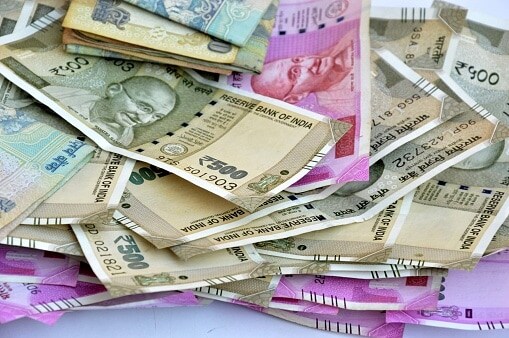
The rupee hit a new record low of 83.08 against a resurgent dollar early on Thursday, after breaching the 83-mark for the first time ever in the previous session as investor concerns about an impending recession reduced risk appetite.
Bloomberg quoted the rupee at 83.0925 per dollar after opening at 82.9825 and hitting a new record low of 83.1212.
PTI reported that the rupee fell 6 paise to a new all-time low of 83.06 against the US dollar in early trade.
In the previous see-saw session, the domestic currency had reversed sharp gains from earlier on Wednesday to close at its weakest level of 83.02 per dollar, driven by the Reserve Bank of India likely buying dollars at about 82 in currency futures to buffer up its capacity to intervene.
"After consolidating in the range of 82 to 82.70 for 8 trading sessions, the rupee all of sudden jumped to 83 levels, making the uneventful day an eventful one. The show began in the last one and a half hours when it depreciated by 60 paise from 82.43 to 83.03," said Amit Pabari, Managing Director of CR Forex Advisors.
The rupee's slide was amplified by broad dollar strength and stop losses at 72.40, a level the RBI probably wanted to protect.
"Yesterday, the rupee's weakness was caused by probable dollar buying at 82.02 by the RBI in currency futures and outflows of large size of about $500 million from Gas Authority of India Limited (GAIL) and Mangalore Refinery and Petrochemicals Limited (MRPL)," said Anil Kumar Bhansali, Head of Treasury at Finrex Treasury Advisors.
"The RBI did not protect 82.40, and short covering of the pair took it to 83.00, with stop losses triggered between 82.40 to 83.50," he added.
Reuters quoting traders reported that a sell-off in the currency had occurred in the last 1.5 hours of trading on Wednesday due to significant corporate dollar and custodian outflows.
The domestic currency's "saving grace" following "yesterday's disaster" is that it stayed largely unchanged at about the 83 levels after regular trading hours, a Currency Dealer at a Mumbai-based bank told Reuters.
"In initial trades, traders will be looking to assess how sticky this new big figure proves," added the trader.
Separately, more indications that elevated inflation will keep major central banks in rate-hike mode after British inflation rose to 40-year highs boosted the dollar's appeal.
A rise in US Treasury yields on predictions that the Federal Reserve would continue to raise interest rates aggressively hurt global risk assets' recent rebound rally.
The scorching inflation data released this week by Canada, Britain, and New Zealand also showed that central banks throughout the world are still struggling to rein in decades-high inflation, even at the cost of stunting economic growth, fanned recession worries, and rising demand for safe-haven assets.
The dollar loomed over major peers on Thursday and the yen fell to a new 32-year low on Thursday, keeping markets on high alert for any indications of an intervention.
"You still can't write off the US dollar, I'm still not convinced that we've necessarily seen the highs for this cycle," Ray Attrill, Head of FX Strategy at National Australia Bank (NAB), told Reuters.
The Japanese yen hit a fresh trough of 149.96 per dollar, with the brittle Japanese currency losing ground for 11 successive sessions, including 32-year lows six times.
"Looks like it's the rabbit caught in the headlights at the moment," said NAB's Mr Attrill.
"Given that Treasury yields have moved decisively above 4 per cent, were it not for the threat of intervention, then I think dollar/yen would already be trading north of 150."

-
Why Amazon And Flipkart Are Struggling To Beat Meesho In India's Smaller Cities

With 274 million users and lowest-cost logistics, Meesho is defending its value commerce crown against giants like Amazon and Flipkart.
-
High US Salaries, No Green Card Certainty: The Financial Calculation Facing Indian H-1B Families
The suspension of PERM processing at eight technology employers does not cancel existing H-1B visas. What it does is force a question many Indian families have been avoiding: is the US salary worth tying your career and family plans to one employer?
-
Swiggy vs Eternal: Food Delivery's Two Rivals Are No Longer In The Same Race
Eternal is building a private AI assistant, dark.ai. Swiggy is still working out how to make Instamart pay, with an operating loss of Rs 895 crore in the July-September quarter while Blinkit stayed profitable.
-
Where You Live Shapes How You Get To Work | The Reason Why
Two-wheelers are the most popular way to get to work in India, accounting for nearly 43% of workplace commutes.
-
Unhedged Position: Can India See An Indonesia-Style Time Correction?
The Nifty is trading below levels it first clocked in 2024. Is there, then, as I have suggested in the headline, potential that the current time correction drags on painfully for the next three-five, even ten years?
-
Navigating Friction And Energy Realities: An Analysis Of Marco Rubio's October Visit To India
Occurring at a critical juncture marked by stalled trade negotiations and escalating geopolitical pressures over global energy supplies, the visit offers a profound window into modern US-India relations.
-
India Exports Capital. Why Not Export Trusteeship?
The big question, then, is whether India can build an institution that global borrowers, investors, banks, and lawyers can trust, even without an Indian connection.
-
France's Economy & Politics Are In Crisis | The Reason Why
Let's look at how the French economy and politics evolved under Nicolas Sarkozy, Franois Hollande and Emmanuel Macron.
-
You May Inherit The Business. You Must Earn Its Credibility.
Succession tests the founder's ability to share authority as much as it tests the next generation's readiness to assume it.
-
Signing Deals Is One Thing; Making Them Work Is Another | The Week In Whys
Sometimes, things don't turn out as planned. Indian companies have lost some bids to rivals, some projects won't produce until 2030.










