Highlights: Due Date For Income Tax Returns Extended To November 30
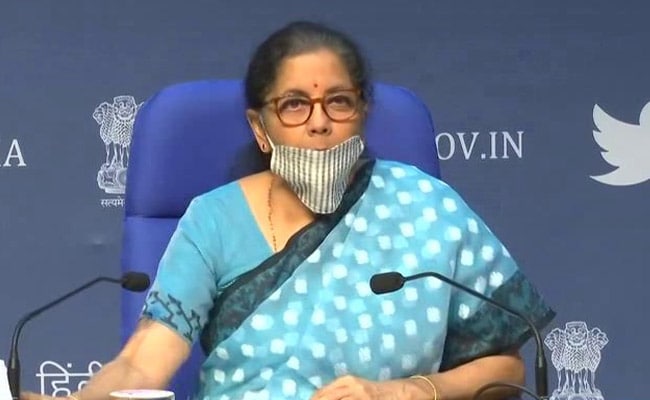
Finance Minister Nirmala Sitharaman made a slew of big ticket announcements on Wednesday, providing details of the monetary and fiscal support of Rs 20 lakh crore worth announced by Prime Minister Narendra Modi the previous day. The Finance Minister said the "Atma Nirbhar Bharat Abhiyan" initiative will help in spurring growth and building a self-reliant India, as envisioned by the Prime Minister. "Beginning today, I will lay out details of PM's Vision over next few days," said Nirmala Sitharaman. The Finance Minister said the government will offer bank loans amounting to Rs 3 lakh crore to small businesses as part of measures to combat the damage caused by the coronavirus (COVID-19) pandemic. In a media briefing of around 90 minutes, the Finance Minister also announced a credit guarantee to businesses to avail collateral-free loans from banks, aiming to help 45 lakh businesses by October 2020. The first instalment of the series of presentations by the Finance Minister comes at a time when the country remains in a nationwide lockdown with few exceptions to curb the spread of the coronavirus (COVID-19) pandemic. The COVID-19-triggered lockdown has pushed an already-ailing economy into a standstill, hampering businesses and landing thousands jobless.
Here are highlights of Finance Minister Nirmala Sitharaman's key announcements about the government's Atma Nirbhar Bharat Abhiyan package:
- Ministries held detailed talks with industries and PM's Office on economic package
- The "Atma Nirbhar Bharat Abhiyan" initiative to spur growth and help in building self-reliant India
- Plan based on five important pillars: economy, infrastructure, tech-driven systems, demography and demand
- Prime Minister has laid out a comprehensive vision, which is based on wide and deep consultations with several sections of society
- Beginning today, I will lay out details of PM's Vision over next few days
- Government to announce 15 different measures
- 6 for MSMEs
- 2 for employees
- 2 for NBFCs and MFIs
- Focus to be on factors of production - land, labour, liquidity and law
- Local brands to be brought to global level
- Focus will be on nurturing local brands as part of this mission
- Global value chain integration part of PM's plan
- We have capability to build such enterprises
- All schemes rolled out by government since it came to power are driven by reforms
- Direct Benefit Transfer (DBT) scheme helped government deliver money directly to Jan Dhan accounts of the poor
- Rs 52,606 crore transferred to 41 crore Jan Dhan account holders under PM Garib Kalyan scheme
- Refunds of Rs 18,000 crore made to income tax assessees, 40 lakh taxpayers benefitted
- Finance Minister announces collateral-free loans worth Rs 3 lakh crore for MSMEs with turnover up to Rs 100 crore till October 31, 2020
- Move likely to benefit 45 lakh units so they can resume their businesses
- 4-year collateral-free loans to be 100% credit-free, with a moratorium for first 12 months
- Definition of MSMEs being changed
- Company with investment of Rs 1 crore, turnover of Rs 5 crore is a micro enterprise under new definition; one with Rs 10 crore investment, turnover of Rs 50 crore a small enterprise; one with Rs 20 crore investment, Rs 100 crore turnover a medium enterprise
- No global tender for government procurement up to Rs 200 crore
- EPF support of Rs 2,500 crore extended for another three months: June, July and August (government to pay employee, employer contribution to EPF accounts)
- Support towards months March, April, May already announced earlier as part of PM Garib Kalyan scheme; that scheme being extended for another three months (June-August)
- 3,67,000 organisations to benefit
- Announces Rs 30,000 crore liquidity push for non-banking financial companies (NBFC), housing finance companies (HFC), microfinance institutions (MFI)
- Rs 90,000 crore liquidity for power distribution companies
- Six-month extension for government contractors; builders get more time to finish projects
- Income tax return assessment due date for financial year 2019-20 extended from July 31 and October 31 to November 30; tax audit date from September 30 to October 31

-
A New Samvat Wishlist: Inclusive Prosperity And Human Development

India has strengthened its economic foundations through infrastructure, digital access and enterprise. Its next growth chapter must deepen productivity, create better livelihoods and widen participation in prosperity.
-
Love, Sex Aur Dhokha: The Audacious Plot To Spy On Jensen Huang
A Taipei dinner, a Singapore chip buyer and a suspected Chinese asset: inside the alleged spy operation that got close to NVIDIA's Jensen Huang.
-
Ten Things I Learnt This Samvat
Patience can be a trap. Cheap stocks can stay cheap. Leverage can wipe you out. What did Samvat 2082 teach us? Niraj Shah writes on 10 lessons from the year gone by.
-
Talking Points This Week: Tech Nerves, FII Buying, And A Faraway Banking Shock
The global markets are not shining this Diwali. The exception in the large markets is, India.
-
Midterm Rally Lasted A Day. The Hard Reality Of A Divided US May Last Two Years | Opinion
Between a contested AI boom, a debt ceiling that arrives in 2027 and a president with every incentive to act alone, the next two years may prove more volatile than the first day's rally suggests.
-
Blue Wave Will Derail the AI Trade but Won't Dismantle the AI Era | Unhedged Position
The Democrats' sweep of the US Congress will see politics collide with economic forces both over the long and short term.
-
It's Time To Take The GST Council's Bet On Trust Global
Payment records can prove India's services exports, and clear, proportionate rules can bring foreign digital sellers into the tax net.
-
Opinion | India at 38: From Innovation Overperformer to Innovation Powerhouse
India now has 453 VC-backed deep science startups, 18 of them late-stage, after 117 percent growth since 2020. Laurus Labs, at USD 9.3 billion, is the most valuable deep science company in any middle-income economy outside China.
-
Navigating Energy Crossroads: S Jaishankar's Call For Diversified Supply Chains At G20 Ministerial Meeting
As geopolitical fault lines continue to test maritime trade routes and commodity flows, Jaishankar's message remains pertinent: true economic resilience requires open markets, protected transit lines, and a genuine commitment to multilateral cooperation rather than coercion.









