Rs 2.5 Fuel Price Cut Could Cost Centre $1.42 Billion Till End Of March
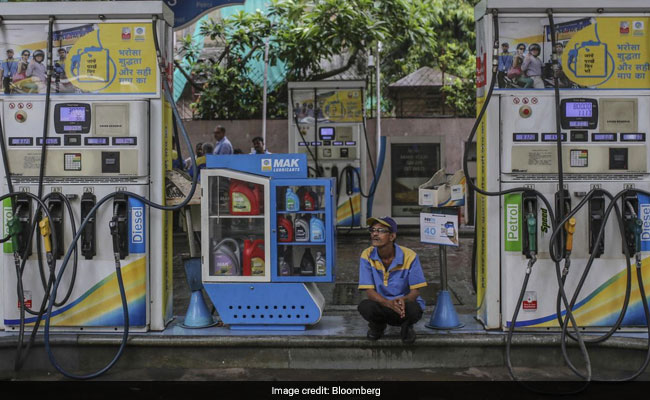
The government lowered retail fuel prices, offering relief to consumers hurt by surging crude oil prices and adding pressure on one of Asia's widest budget deficits.
The central government will cut excise duty on petrol and diesel by Rs 1.5 a liter, Finance Minister Arun Jaitley said in Delhi on Thursday, a day before the inflation-targeting Reserve Bank of India decides on monetary policy. State-run oil marketing companies will offer relief of 1 rupee a liter on the sale of these fuels. State governments have been asked to match the combined cuts, he said.
The government had so far resisted cutting prices as it kept a close watch on its fiscal deficit target, a move that helped Prime Minister Narendra Modi win a credit-rating upgrade from Moody's Investors Service last year. The goal is to narrow the budget deficit to 3.3 percent of gross domestic product in the fiscal year ending March 2019 from 3.5 percent in the previous year.
Thursday's measures would cost the central government Rs 10,500 crore ($1.42 billion) in the six months through March and widen the budget gap by 0.05 percent of gross domestic product, Mr Jaitley said.
For state-run fuel retailers, Indian Oil Corp., Bharat Petroleum Corp. and Hindustan Petroleum Corp., it would reduce pretax profit by a combined Rs 4,500 in the year ending March 31, according to people with knowledge of the matter. On an annualized basis, profit before tax may drop by about Rs 9,000 crore based on current sales volumes, they said, asking not to be identified as they aren't authorized to speak to the media.
India joins counterparts in Indonesia, Brazil and elsewhere that have offered relief to fuel consumers as global oil prices rallied, albeit belatedly as attention shifts to elections next year. The Reserve Bank of India has cited strengthening oil prices as a key risk to its inflation outlook, although gains in consumer prices are for now within the 4 percent midpoint of its target band.
The price of Brent crude, benchmark for half the world's oil, has jumped about 20 percent since mid-August due to concerns of supply shrinking, after U.S. imposed sanctions on Iran come into effect in November. Prices are hovering close to $87 a barrel, the highest in four years.
That's fueled retail fuel prices to a record in India, the world's fastest growing oil user. On Thursday, gasoline prices in Mumbai was Rs 91.43 a liter while diesel was selling at Rs 80.20 before the price cuts were announced.
The move to provide relief is "good economics," Mr Jaitley said, adding that he wanted consumers to spend more on other things apart from energy. He said he was confident of meeting the 3.3 percent budget-deficit target for the fiscal year ending March, pointing to robust direct tax collections.
But not all are convinced about the benefits of the steps announced by Mr Jaitley.
"If crude moves higher and rupee continues to depreciate, what are the next steps," Mayuresh Joshi, the Mumbai-based head of institutional sales at Angel Securities, told BloombergQuint, adding that it's unclear what happens to oil refiners who have to share the burden of subsidies. "This is something that these stocks have taken on their chin."
The S&P BSE Energy index fell the most since August 2015 led by oil refiners after Mr Jaitley announced the cuts. Each of the three state-run refiners - IOCL, BPCL and HPCL - dropped intraday by at least 20 percent.
"This move to ask fuel retailers to absorb prices is bad in spirit," said Deven Choksey, managing director of K.R. Choksey Shares & Securities Pvt. "Asking your treasury department or states to cut taxes is fair, but you can't be asking the companies."

-
Talking Points This Week: Tech Nerves, FII Buying, And A Faraway Banking Shock

The global markets are not shining this Diwali. The exception in the large markets is, India.
-
Midterm Rally Lasted A Day. The Hard Reality Of A Divided US May Last Two Years | Opinion
Between a contested AI boom, a debt ceiling that arrives in 2027 and a president with every incentive to act alone, the next two years may prove more volatile than the first day's rally suggests.
-
Blue Wave Will Derail the AI Trade but Won't Dismantle the AI Era | Unhedged Position
The Democrats' sweep of the US Congress will see politics collide with economic forces both over the long and short term.
-
It's Time To Take The GST Council's Bet On Trust Global
Payment records can prove India's services exports, and clear, proportionate rules can bring foreign digital sellers into the tax net.
-
Opinion | India at 38: From Innovation Overperformer to Innovation Powerhouse
India now has 453 VC-backed deep science startups, 18 of them late-stage, after 117 percent growth since 2020. Laurus Labs, at USD 9.3 billion, is the most valuable deep science company in any middle-income economy outside China.
-
Navigating Energy Crossroads: S Jaishankar's Call For Diversified Supply Chains At G20 Ministerial Meeting
As geopolitical fault lines continue to test maritime trade routes and commodity flows, Jaishankar's message remains pertinent: true economic resilience requires open markets, protected transit lines, and a genuine commitment to multilateral cooperation rather than coercion.
-
Indians Are Travelling, But Not Every Journey Is A Holiday | The Week In Whys
Pilgrims, patients and working women are the real travellers, and the system hasn't quite caught up with them.
-
Getting To Work Costs Women More | The Reason Why
It is not just about women paying more than men. It is about women paying much more in cities than in villages.
-
AI Bias In Investing Cannot Be Eliminated, But It Can Be Governed
Framing is a particularly important example as identical financial information presented in terms of gains rather than losses can lead an LLM to reach a different assessment.









