"Parathas Not Same As Rotis:" Ruling Backs 18% GST On Parathas
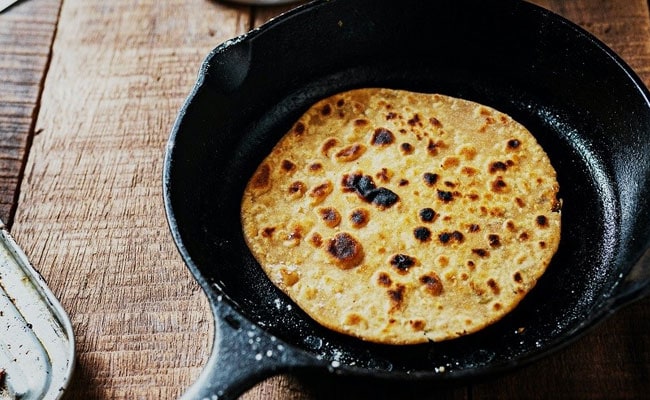
Are parathas different from rotis under Goods and Services Tax (GST) laws? According to a ruling by the Karnataka bench of the Authority for Advance Rulings, parathas are not rotis and therefore can be taxed at a higher GST rate of 18 per cent compared to 5 per cent for rotis. A Bengaluru-based food manufacturer had sought clarity on whether parathas can be classified in the same category as khakhara, plain chapati or roti, which would mean lower tax.
In its ruling, the Authority of Advance Rulings distinguished between parathas and rotis, holding that parathas will continue to be taxed at the rate of 18 per cent under the indirect tax regime.
iD Fresh Food, a manufacturer of ready-to-cook food products, had demanded a ruling on whether its products such as Malabar parathas and whole-wheat parathas fall under the same category as roti, which draws a GST rate of 5 per cent.
The company supplies the two products - which have a shelf life of 3-7 days - to distributors, retailers and other operators in the food services segment within the country as well as overseas. It contends that its products should be treated in the same way as khakhra, plain chapati or roti under the law.
According to the authority, khakra, plain chapatti or roti are prepared or completely-cooked products, so they fall in the category of ready-to-use food products under the Customs Tariff Act, 1975. But parathas need to be heated before consumption and cannot be placed in the same category, said the AAR.
"The products roti and chapati are of mass consumption and therefore a lower GST rate of 5 per cent is notified in Entry 99A (rate notification under GST law) with expressions 'khakhra, plain chapati or roti'. While classifying the product paratha, the Authority did not lay down any manifest principle and merely concluded based on the nomenclature of the product," said Sunil Kumar, deputy general manager-R&D at Taxmann.
iD Fresh Food said it has decided to appeal against the ruling by the Authority of Advance Ruling, Karnataka. "I'm hopeful that we will get this matter resolved soon so that our consumers can continue to enjoy healthy Indian foods at affordable prices," iD Fresh Food CEO and co-founder PC Musthafa said in a statement.
Twitter was abuzz with a slew of comments from users including industrialist Anand Mahindra, who said: "With all the other challenges the country is facing, it makes you wonder if we should be worrying about an existential crisis for the 'Parota.' In any case, given Indian jugaad skills, I'm pretty sure there will be a new breed of 'Parotis' that will challenge any categorisation!"
With all the other challenges the country is facing, it makes you wonder if we should be worrying about an existential crisis for the ‘Parota.' In any case, given Indian jugaad skills, I'm pretty sure there will be a new breed of ‘Parotis' that will challenge any categorisation! https://t.co/IwHXKYpGHG
June 12, 2020The Central Board of Indirect Taxes and Customs also took to Twitter to reiterate the authority's stance on the matter.
4/4 It has been held by AAR that frozen and preserved parota would attract GST at the rate of 18%.
June 12, 20202/4 The authority has decided that frozen (and preserved) wheat parota and malabar parota available in ambient and frozen form with a shelf life of 3-7 days is not plain roti but is a distinct product.
June 12, 2020Founded in 2005, iD Fresh Food makes a range of ready-to-cook products such as chapati, vada, idly and dosa batter and filter coffee, according to its website.

-
India Exports Capital. Why Not Export Trusteeship?

The big question, then, is whether India can build an institution that global borrowers, investors, banks, and lawyers can trust, even without an Indian connection.
-
France's Economy & Politics Are In Crisis | The Reason Why
Let's look at how the French economy and politics evolved under Nicolas Sarkozy, Franois Hollande and Emmanuel Macron.
-
You May Inherit The Business. You Must Earn Its Credibility.
Succession tests the founder's ability to share authority as much as it tests the next generation's readiness to assume it.
-
Signing Deals Is One Thing; Making Them Work Is Another | The Week In Whys
Sometimes, things don't turn out as planned. Indian companies have lost some bids to rivals, some projects won't produce until 2030.
-
FOMC Wall, PERM Suspension, Hospital Stocks | Talking Points This Week
A PERM suspension would directly affect green-card sponsorship rather than H-1B visas, so the near-term earnings impact could remain relatively limited. The key question is whether this marks a new phase in US scrutiny of Indian IT.
-
Everything, Everywhere, All At Once: Dalal Street's Week To Forget | Joining The Dots
Visa curbs, a Starlink spat and cancer drug caps: what connects this week's shocks for Indian markets
-
India Is Going Abroad For Critical Minerals. But It May Take Years To Pay Off | The Reason Why
Although India's steps are in the right direction, they remain modest compared with India's growing dependence.
-
When Everyone Has AI, What Gives You An Edge?
India's young workforce is entering an uncertain world of work where powerful AI tools are becoming widely accessible. The advantage will belong to those who combine deep expertise with digital fluency, and the distinctly human capabilities that technology cannot manufacture.
-
Wrong Labels, High Pesticide Residues Holding Back Agri Exports | The Reason Why
India needs stronger domestic food-safety and labelling standards, with best practices becoming part of everyday business for farmers, traders and food companies.
-
India Is Easy To Enter, Harder To Attract | The Week In Whys
The question is no longer just whether India can attract companies and capital. It is how much value they create here, how deeply they invest, and whether India remains relatively attractive when they have plenty of other options.










