A Debt Iceberg Threatens To Turn Resources Titan Into Titanic
(Bloomberg Opinion) -- Indian billionaire Anil Agarwal is shuffling the deck chairs, as his Vedanta Resources Ltd. approaches a $3 billion iceberg of dollar bonds due over the next two years. Can the commodities titan avoid the fate of the Titanic? The answer may only partly depend on investors' greed for dividends.
Vedanta Ltd., the Indian publicly traded firm controlled by privately held Vedanta Resources, has announced a plan to split itself into six companies. For every share of Vedanta Ltd., investors will receive one share in each of the five new businesses: aluminum, oil and gas, power, steel and ferrous, and base metals. They will also retain their original share in Vedanta Ltd., which will continue to own 65% of Hindustan Zinc Ltd., apart from hosting new bets like semiconductors and LCD displays.
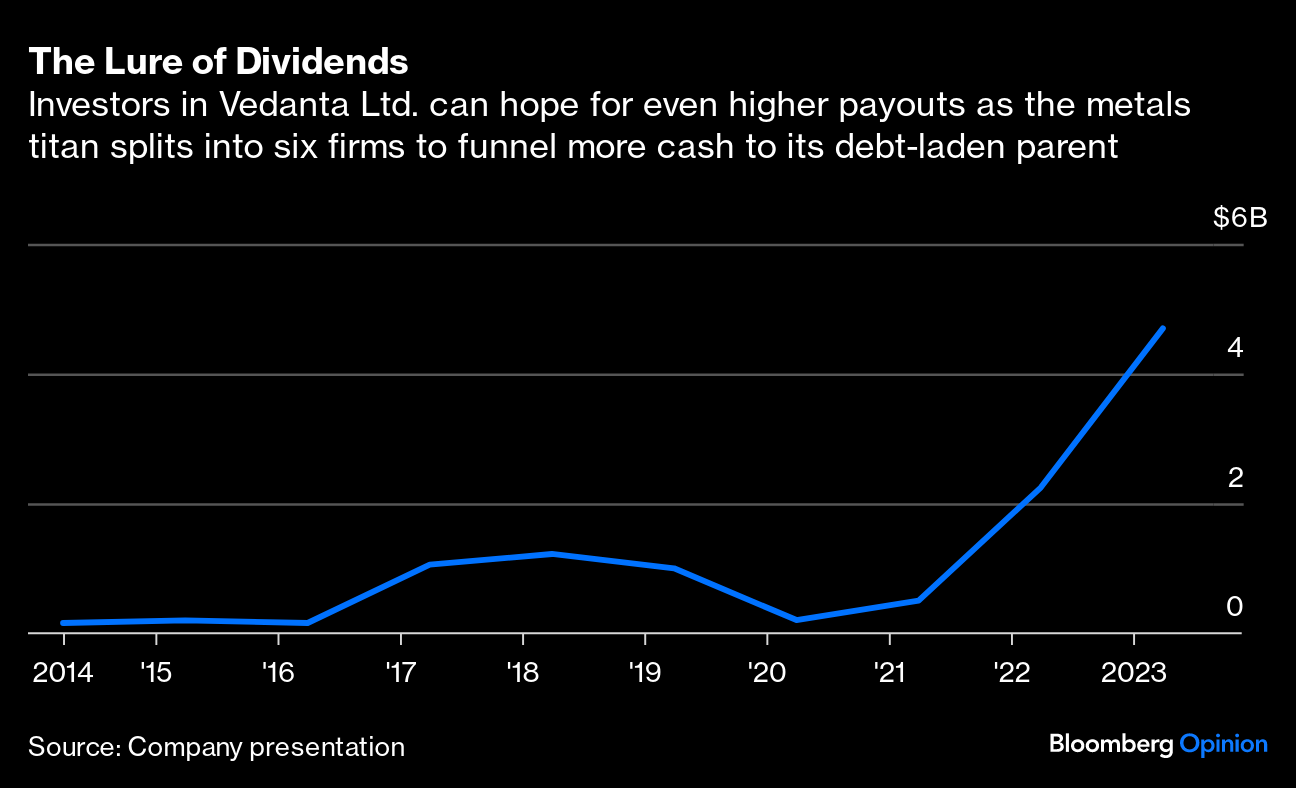
The carrot being dangled before minority investors is of payouts. A corporate presentation notes the “consistent shareholder returns” from more than $11 billion in dividends over the past decade. That was from one listed firm. Now there will be cash rolling in from half a dozen of them. Which is why perhaps the initial stock-market reaction to the spin-off had none of the pessimism that the news triggered in the bond market. Vedanta Ltd. shares rose nearly 4% on Tuesday, even as the Vedanta Resources dollar notes slipped deeper into distressed territory.
Equity investors are betting that the brood will funnel as much cash to the parent as possible. A part of it will come to them. Bondholders are saying it won't be enough to make them whole, especially given UK-based Vedanta Resources' large funding gap in the fiscal year that will start in April 2024. Both could be right.
Alternatively, Agarwal may be able to sell one or two of the operating companies, or extend the maturities on his debt. Slimming down may be a better route to staying afloat than asking bondholders to be patient. S&P Global Ratings cut its Vedanta Resources assessment to CCC from B- on the increased likelihood of a liability management exercise that “we could consider distressed under our criteria,” the agency said Friday. CCC is four rungs away from default, and according to S&P, there is a chance of further rating downside over the next three months.
Even if he isn't out of options, the metals magnate is certainly in a pinch. Minus a boom in global commodities demand, saving the empire will be a touch-and-go affair. To get the benefit of the doubt from markets, Agarwal needs something more than dividends.
The timeline of his troubles holds a clue as to what that may be.
The group's debt woes intensified earlier this year. That was just when Gautam Adani, the businessman from Prime Minister Narendra Modi's home state of Gujarat, came under a brutal short-seller attack, followed by intense scrutiny of his conglomerate's corporate governance practices. Adani has denied all allegations. But more importantly, he has managed to keep his financing channels open, despite depressed equity and bond prices. He has persuaded lenders and investors that if India Inc. is a national team, he is its most valuable player. This is where Agarwal seems to be floundering. Forget being an MVP. Is he even on the team?
For one thing, his aggressive financial engineering has ended up annoying New Delhi. In January, the publicly traded part of Vedanta decided to offload some of its African zinc assets to Hindustan Zinc. That deal was valued at roughly $3 billion in phases over 18 months. Back then, Vedanta Ltd. was 70% owned by Vedanta Resources. The money floating up to the parent would have taken care of the latter's liquidity needs. Except that the Indian government, which still owns about 30% of the privatized zinc miner, got spooked by the raid on its cash. A thwarted Agarwal had no option except to offload a small part of Vedanta Ltd. in the market.
The second thing that went wrong was semiconductors. India promised to pick up half the cost of chipmaking factories, and then balked at Agarwal when it looked like he couldn't deliver on a 28-nanometer fab. In July, Hon Hai Technology Group, also known as Foxconn, pulled the plug on the $19 billion joint venture. The Taiwanese contract manufacturer may yet produce 40-nanometer microprocessors in partnership with STMicroelectronics NV. That leaves Agarwal, who once boasted of creating “a self-reliant Silicon Valley” in Modi's Gujarat, in search of a new partner.
The tycoon can shuffle the financial deck chairs all he wants. But after this year's misadventures, does he still have enough political clout to secure a lifeline? That's what investors will need to know. And yes, they will want the dividends, too.
More from Bloomberg Opinion:
- Adani Isn't the Only Indian Tycoon in Trouble: Andy Mukherjee
- The Chip Sector Has a New Sport — Finding the Bottom: Tim Culpan
- Nvidia Stock Rides the AI Wave With More to Come: Jonathan Levin
This column does not necessarily reflect the opinion of the editorial board or Bloomberg LP and its owners.
Andy Mukherjee is a Bloomberg Opinion columnist covering industrial companies and financial services in Asia. Previously, he worked for Reuters, the Straits Times and Bloomberg News.
More stories like this are available on bloomberg.com/opinion
©2023 Bloomberg L.P.

-
Navigating Energy Crossroads: S Jaishankar's Call For Diversified Supply Chains At G20 Ministerial Meeting

As geopolitical fault lines continue to test maritime trade routes and commodity flows, Jaishankar's message remains pertinent: true economic resilience requires open markets, protected transit lines, and a genuine commitment to multilateral cooperation rather than coercion.
-
Indians Are Travelling, But Not Every Journey Is A Holiday | The Week In Whys
Pilgrims, patients and working women are the real travellers, and the system hasn't quite caught up with them.
-
Getting To Work Costs Women More | The Reason Why
It is not just about women paying more than men. It is about women paying much more in cities than in villages.
-
AI Bias In Investing Cannot Be Eliminated, But It Can Be Governed
Framing is a particularly important example as identical financial information presented in terms of gains rather than losses can lead an LLM to reach a different assessment.
-
Joining The Dots | Dark Skies, Steady Diya: Why Hope Holds This Diwali
With war, a weak rupee and foreign outflows weighing on sentiment, policymakers at the NDTV World Summit and market veterans at NDTV Profit Ignite: Diwali Edition offered the same advice: stay invested and filter out the noise.
-
The Curious Case of Equitas Small Finance Bank And A CEO Who Quit For Stock
PN Vasudevan believes persistent investor concerns over a perceived conflict of interest had become a governance overhang on Equitas Small Finance Bank's stock, even as the lender improved profitability and asset quality.
-
Talking Points This Week: AI Cash Burn, A Tiger Comeback And An India That Still Finds Its Own Path
India is not immune to higher oil or tighter global liquidity, yet its earnings base is broader, its domestic policy levers are still available.
-
Foreign Investors Own Half Of HDFC Bank and ICICI Bank. An LTCG Cut Could Matter Most Here
Foreign portfolio investors have US$115 billion parked in HDFC Bank, ICICI Bank. If the government cuts long-term capital gains tax, Jefferies says returning foreign money could land here first.
-
'Never Seen This Level Of Negativity': Sandeep Tandon Says The Next Rally May Be Closer Than You Think
Veteran investor Sandeep Tandon says foreign selling is easing, large-caps are due a comeback and mid-caps are crowded, while he turns positive on gold, power and pharma this Diwali.
-
Indians Stay With Family, Not In Hotels | The Reason Why
India still lacks enough clean, reliable and affordable hotels for budget-conscious travellers.










