RBI May Maintain Low Interest Rates As Economic Recovery Slows Down
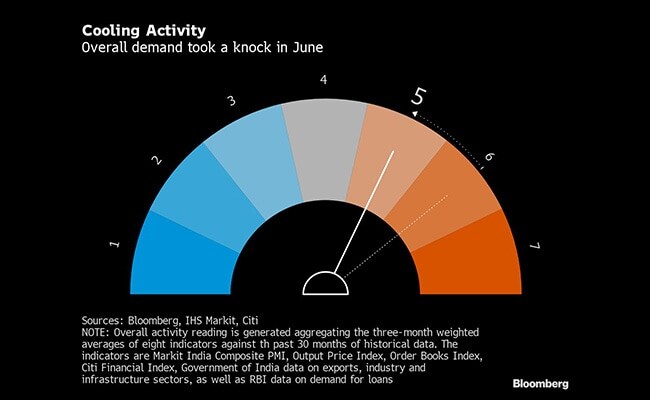
India's economy showed signs of cooling in June as the slow easing of localized lockdowns hurt activity, a factor likely to encourage monetary policy makers meeting next week to consider keeping interest rates at record lows to foster a durable recovery. Contractions in both manufacturing and services sectors, which contribute more than two-thirds of India's gross domestic product, pulled the needle on an overall activity indicator to 5 from 6, a level not seen since February and the first downward shift since May 2020 data. The gauge uses a three-month weighted average to smooth out volatility, and a move left signifies loss of momentum.
While the deadly second wave of Covid-19 has receded, the economy is facing a bumpy ride given the slow pace of vaccinations and the looming threat of another wave. A basket of high-frequency, alternative and market indicators such as retail activity and road congestion isn't showing the kind of strong recovery that was expected, Abhishek Gupta, India economist at Bloomberg Economics, said in a report published Tuesday.
Here's more India data coming in the days ahead:
- Goods and services tax data released by the Finance Ministry around the first week of every month is a key indicator of consumption
- Auto sales published by companies such as Maruti Suzuki India and Hero MotoCorp on the first day of every month serve as an indicator of consumer demand
- Surveys of purchasing managers by IHS Markit, out early next month, will offer an early glimpse of manufacturing and services activity
- July unemployment rate from research firm Center for Monitoring Indian Economy Pvt. will be out early next week, offering a window on the labor market in the absence of real-time official data
- Reserve Bank of India interest-rate decision on August 6
Here are the details of the dashboard for June:
Business Activity
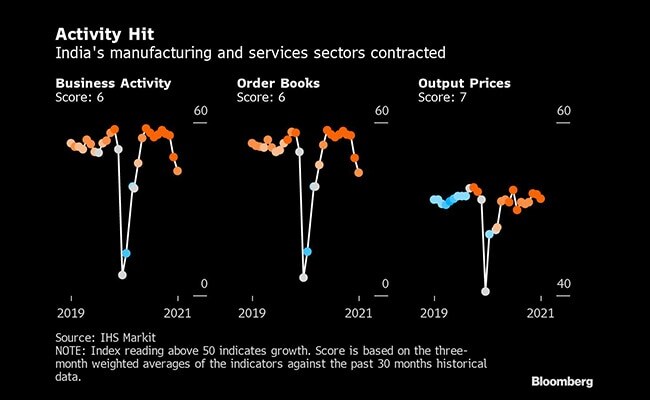
A contraction in India's services sector deepened as localized curbs to control the virus spread hurt consumer demand and business activity. The Markit India Services Index declined to 41.2 last month, from 46.4 in May, with a reading under 50 indicating a contraction. A similar survey also pointed to shrinking activity in the manufacturing sector, both of which dragged the composite index deeper into contraction territory.
Exports
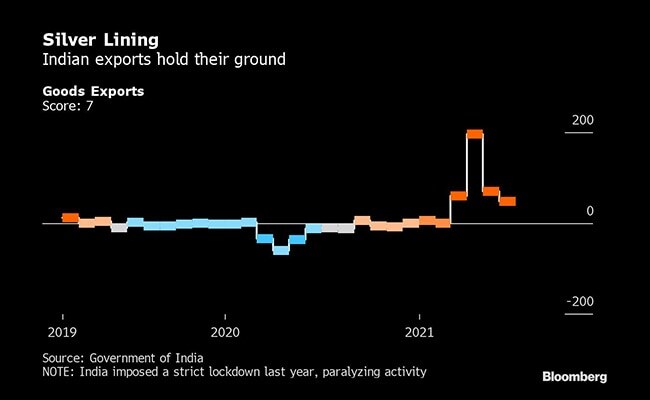
Exports rose 48.3 per cent year-on-year in June, having clocked a 69.4 per cent year-on-year rise in May, aided by steady global demand. Overseas demand for engineering goods and chemical products helped, as did shipments of farm produce.
Consumer Activity
Retail auto sales, a bellwether of consumer demand, recovered, although the industry was facing headwinds like a steep increase in commodity prices, a semi-conductor shortage and fear of a third wave, according to Kenichi Ayukawa, president of the Society of Indian Automobile Manufacturers. Neverthless, with the second wave's impact on rural demand abating, motorcycle and two-wheeler sales recorded a recovery in June. The tractor segment also recovered last month, with better monsoon prospects helping sentiment.
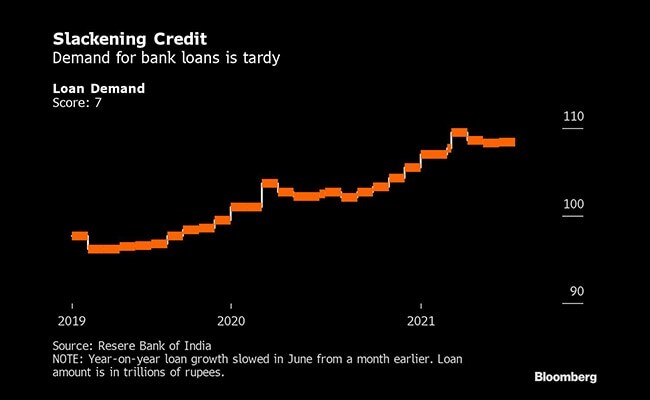
Bank credit grew 5.8 per cent in June from a year earlier, easing from a 6 per cent annual expansion seen in end-May, central bank data showed. Liquidity conditions stayed comfortable, with the banking system in surplus.
Industrial Activity
Industrial production expanded but at a slower pace, growing 29.3 per cent in May from a year earlier, compared with almost 135 per cent in April. More importantly, month-on-month industrial output fell 8.0 per cent from April, with Bloomberg Economics' Gupta citing lockdowns that led to retail closings.
Similarly, output at infrastructure industries, which makes up 40 per cent of the industrial production index, expanded 16.8 per cent, slowing from year-on-year growth of 61 per cent in April. Both data are published with a one-month lag.
(Except for the headline, this story has not been edited by NDTV staff and is published from a syndicated feed.)

-
Unhedged Position: Can India See An Indonesia-Style Time Correction?

The Nifty is trading below levels it first clocked in 2024. Is there, then, as I have suggested in the headline, potential that the current time correction drags on painfully for the next three-five, even ten years?
-
Navigating Friction And Energy Realities: An Analysis Of Marco Rubio's October Visit To India
Occurring at a critical juncture marked by stalled trade negotiations and escalating geopolitical pressures over global energy supplies, the visit offers a profound window into modern US-India relations.
-
India Exports Capital. Why Not Export Trusteeship?
The big question, then, is whether India can build an institution that global borrowers, investors, banks, and lawyers can trust, even without an Indian connection.
-
France's Economy & Politics Are In Crisis | The Reason Why
Let's look at how the French economy and politics evolved under Nicolas Sarkozy, Franois Hollande and Emmanuel Macron.
-
You May Inherit The Business. You Must Earn Its Credibility.
Succession tests the founder's ability to share authority as much as it tests the next generation's readiness to assume it.
-
Signing Deals Is One Thing; Making Them Work Is Another | The Week In Whys
Sometimes, things don't turn out as planned. Indian companies have lost some bids to rivals, some projects won't produce until 2030.
-
FOMC Wall, PERM Suspension, Hospital Stocks | Talking Points This Week
A PERM suspension would directly affect green-card sponsorship rather than H-1B visas, so the near-term earnings impact could remain relatively limited. The key question is whether this marks a new phase in US scrutiny of Indian IT.
-
Everything, Everywhere, All At Once: Dalal Street's Week To Forget | Joining The Dots
Visa curbs, a Starlink spat and cancer drug caps: what connects this week's shocks for Indian markets
-
India Is Going Abroad For Critical Minerals. But It May Take Years To Pay Off | The Reason Why
Although India's steps are in the right direction, they remain modest compared with India's growing dependence.
-
When Everyone Has AI, What Gives You An Edge?
India's young workforce is entering an uncertain world of work where powerful AI tools are becoming widely accessible. The advantage will belong to those who combine deep expertise with digital fluency, and the distinctly human capabilities that technology cannot manufacture.