Record $82 Billion Dealmaking Spree Sees India Defy Global Slump
(Bloomberg) -- Bankers in India recorded their best-ever quarter for mergers and acquisitions while dealmaking elsewhere slows to a crawl.
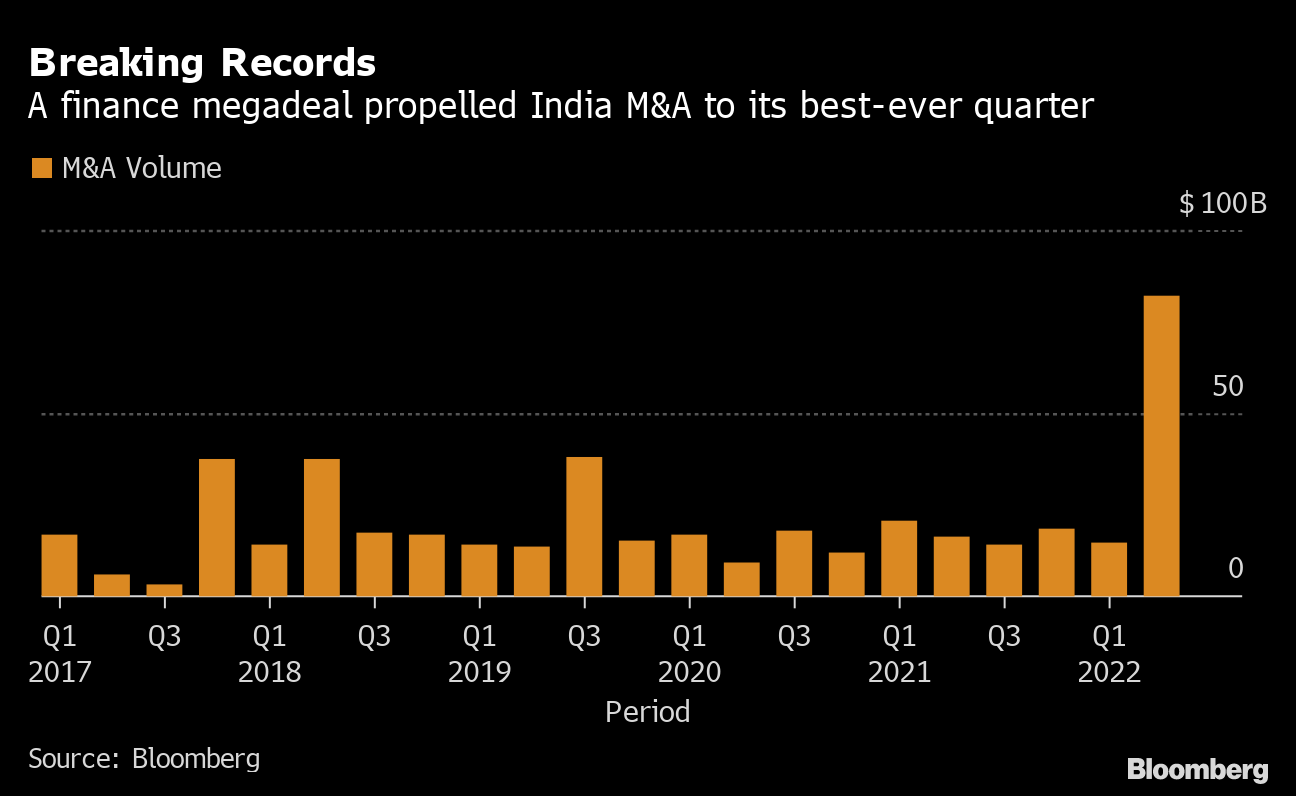
India saw $82.3 billion pending and completed M&A deals in the second quarter, the highest amount on record, according to data compiled by Bloomberg. That's more than twice as much than the previous record of $38.1 billion in the third quarter of 2019. Globally, M&A volume in the quarter reached $827.6 billion, down 8.7% from the same period in 2021.
The surge in India was dominated by HDFC Bank Ltd.'s $60 billion all-stock purchase of Housing Development Finance Corp. in April, combining India's most valuable bank and largest mortgage lender in the country's biggest ever M&A transaction. The move illustrated how India's flagship companies, facing disruptive trends such as the rise of fintech and climate change, are turning to dealmaking as a tactic to dramatically reshape themselves.
“While conglomerates will consolidate to become stronger and gain market share in their core sectors, there will be renewed or new initiatives around two big themes: ESG and digital,” according to Sonjoy Chatterjee, chairman and chief executive officer for Goldman Sachs Group Inc. in India. The second in particular is a focus for all companies, no matter the sector, he added.
“There won't be a strategy going forward that doesn't provide a clear path to deliver this,” Chatterjee said.
The combination of Mindtree Ltd. and Larsen & Toubro Infotech Ltd., two software firms controlled by engineering conglomerate Larsen & Toubro Ltd., in a $3.3 billion all-stock deal announced in May further illustrated how India's largest firms are positioning themselves for a changed landscape in technology, aided by volatility in the markets.
Even without the HDFC megadeal, India's second quarter would still rank as its fifth-best quarter on record, thanks to transactions such as billionaire Gautam Adani's $10.5 billion deal to buy Ambuja Cements Ltd., giving his conglomerate a sizable presence in the industry.
“The appetite of strategic investors has definitely increased, with market correction resetting the valuations in India,” said Ganeshan Murugaiyan, head of corporate coverage and advisory at BNP Paribas SA in India.
Companies in India leading the shift to renewable energy were among the biggest dealmakers. Shell Plc agreed to buy renewable power supplier Sprng Energy Pvt for $1.5 billion in April, while French oil giant TotalEnergies SE purchased a 25% stake in Adani New Industries Ltd. this month. The firm plans to invest more than $50 billion in technologies such as green hydrogen over the next decade.
Read More: Big Oil Bets That Green Hydrogen Is the Future of Energy
Large acquisitions will be challenging to put together, Murugaiyan said. “It is not that easy to get long term financing and the high-yield leverage buyout market -- corporate loans -- is literally shut down.”
Like Chatterjee, Murugaiyan sees the green and digital transitions driving more transactions. His team has grown from nine bankers in 2021 to 12 this year, and he is looking to add another three.
The next wave of deals could come in the mid-market, where a cohort of aging founders is starting to hand the reins to their offspring.
“Regularly, we find the next generation has interests in other themes, particularly tech platforms and ESG,” Chatterjee said. “Themes coming out of the pandemic have revised perspectives and choices around what the next generation want to do with their futures -- in a very personal way.”
More stories like this are available on bloomberg.com
©2022 Bloomberg L.P.

-
Blue Wave Will Derail the AI Trade but Won't Dismantle the AI Era | Unhedged Position

The Democrats' sweep of the US Congress will see politics collide with economic forces both over the long and short term.
-
It's Time To Take The GST Council's Bet On Trust Global
Payment records can prove India's services exports, and clear, proportionate rules can bring foreign digital sellers into the tax net.
-
Opinion | India at 38: From Innovation Overperformer to Innovation Powerhouse
India now has 453 VC-backed deep science startups, 18 of them late-stage, after 117 percent growth since 2020. Laurus Labs, at USD 9.3 billion, is the most valuable deep science company in any middle-income economy outside China.
-
Navigating Energy Crossroads: S Jaishankar's Call For Diversified Supply Chains At G20 Ministerial Meeting
As geopolitical fault lines continue to test maritime trade routes and commodity flows, Jaishankar's message remains pertinent: true economic resilience requires open markets, protected transit lines, and a genuine commitment to multilateral cooperation rather than coercion.
-
Indians Are Travelling, But Not Every Journey Is A Holiday | The Week In Whys
Pilgrims, patients and working women are the real travellers, and the system hasn't quite caught up with them.
-
Getting To Work Costs Women More | The Reason Why
It is not just about women paying more than men. It is about women paying much more in cities than in villages.
-
AI Bias In Investing Cannot Be Eliminated, But It Can Be Governed
Framing is a particularly important example as identical financial information presented in terms of gains rather than losses can lead an LLM to reach a different assessment.
-
Joining The Dots | Dark Skies, Steady Diya: Why Hope Holds This Diwali
With war, a weak rupee and foreign outflows weighing on sentiment, policymakers at the NDTV World Summit and market veterans at NDTV Profit Ignite: Diwali Edition offered the same advice: stay invested and filter out the noise.
-
The Curious Case of Equitas Small Finance Bank And A CEO Who Quit For Stock
PN Vasudevan believes persistent investor concerns over a perceived conflict of interest had become a governance overhang on Equitas Small Finance Bank's stock, even as the lender improved profitability and asset quality.










