RBI Saw Slowdown, Acted Ahead Of Time By Cutting Rates: Shaktikanta Das
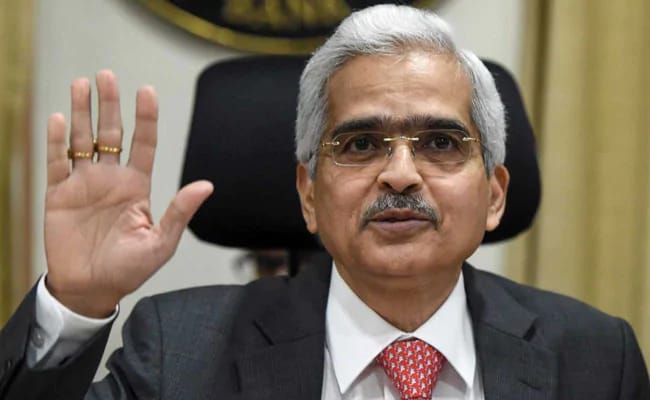
RBI Governor Shaktikanta Das on Monday said the central bank saw economic growth slowdown in February, prompting it to cut rates ahead of the curve and wondered why markets were surprised with the decision to pause rate reduction.
Noting that there is a need for an "informed and objective discussion" on the country's economy, Mr Das said the RBI would do "whatever is necessary" to address growth slowdown, spike in inflation as well to ensure good health of banks and non-bank lenders.
The RBI chief hoped that the US-China truce on trade tariffs, announced over the weekend, would last as he pitched for coordinated efforts to push global growth like those after the 2008 financial crisis. The apex bank went for five consecutive rate cuts starting in February this year, making it a cumulative reduction of 1.35 per cent.
"Both the government and RBI have acted in time... we have acted a little bit ahead of time in terms of reducing our policy rates. As early as February this year, the RBI saw that there was a growth slowdown, we saw that a momentum for slowdown was building up, so started cutting rates this year," he said.
Speaking at the India Economic Conclave organised by the Times Network here, Mr Das said that in February, the market was surprised with the RBI's call to cut rates and wondered why are market participants surprised now also with the pause call.
"In the last Monetary Policy Committee (MPC) meeting when we took a pause, I don't know why the market was surprised. (In) February, I was told that the markets were surprised, but subsequently I am happy and thank all of you for accepting that it was a right call to take.
"This time... I do hope that the events will unfold in a manner which will prove that the MPC decision was right," he said.
At the time of deciding to pause rate cuts on December 5, the RBI had maintained an accommodative stance of the policy and that it would be waiting for upcoming data before taking a final call.
Experts had said that would include level of transmission into actual lending rates in the economy, inflation trajectory which is on the rise and also the fiscal moves by the government.
Many market participants had factored another rate cut given that growth had slid to an over six-year low of 4.5 per cent for the September quarter.
However, headline inflation accelerated to 5.54 per cent, much above the central bank's 4 per cent medium term target.
On Monday, Mr Das cited a six-month-old statement from the RBI where it had said that growth is the priority for the central bank till inflation is under check. Apart from rate cuts, Mr Das said the RBI has also ensured liquidity is in surplus mode with over Rs 2.5-3 lakh crore being absorbed through the reverse repo window daily to help in pushing growth.
It has also introduced many policies for helping banks and the troubled non-bank lending sector, he added. Mr Das said the RBI would do "whatever is necessary" for addressing growth slowdown, spikes in inflation and also ensure good health of banks and non-bank lenders.
Investments in infrastructure by both the Centre and states are critical to push up growth, Mr Das said, adding that the latter grouping needs to do a bit more.
"I was looking at the data of capital expenditure of the states it has remained stagnant around 2.6-2.7 per cent of their GSDP over last few years and the infrastructure spending, capital expenditure of state governments also need to be stepped up," he said.
The Governor also said that there is a need to focus more on manufacturing in order to push up the growth process, and asked Indian companies to integrate with the global supply chain to ensure that exports go up.
He said the RBI did a survey as well as earnings analysis of 1,539 manufacturing companies ahead of the last week's policy review, which showed early signs of a revival in investment cycle.
The survey pointed out that the companies put over 45 per cent of the funds available with them for fixed assets in the first half of the fiscal, as against 18.9 per cent in the year-ago period.
He said there is a clear process of balance sheet de-leveraging at corporates, banks and non-banks, which will aid in getting in higher growth in the future. Mr Das also said that India should focus more on textiles and food processing sectors in order to push up growth in the future, along with manufacturing and infrastructure spends.
At the global front, he said there is a need for "timely and coordinated" response by all the emerging and advanced economies in the world to take the right policies for lifting the global economy. Making it clear that Indian slowdown is not entirely attributable to the global factors, he said a higher growth at the world level will be of help for countries like India.
He also rued that Europe has been late in opening up on the fiscal side in response to signs of a slowing growth in the continent.
The RBI chief also welcomed the Supreme Court judgement in the Essar Steel matter as one which has "unclogged" a major issue for resolution of non-performing assets and would help the lenders in the future. Further, Mr Das said the National Payments Corporation of India is creating a subsidiary to take the UPI (Unified Payment Interface) to world markets.

-
Unhedged Position: Can India See An Indonesia-Style Time Correction?

The Nifty is trading below levels it first clocked in 2024. Is there, then, as I have suggested in the headline, potential that the current time correction drags on painfully for the next three-five, even ten years?
-
Navigating Friction And Energy Realities: An Analysis Of Marco Rubio's October Visit To India
Occurring at a critical juncture marked by stalled trade negotiations and escalating geopolitical pressures over global energy supplies, the visit offers a profound window into modern US-India relations.
-
India Exports Capital. Why Not Export Trusteeship?
The big question, then, is whether India can build an institution that global borrowers, investors, banks, and lawyers can trust, even without an Indian connection.
-
France's Economy & Politics Are In Crisis | The Reason Why
Let's look at how the French economy and politics evolved under Nicolas Sarkozy, Franois Hollande and Emmanuel Macron.
-
You May Inherit The Business. You Must Earn Its Credibility.
Succession tests the founder's ability to share authority as much as it tests the next generation's readiness to assume it.
-
Signing Deals Is One Thing; Making Them Work Is Another | The Week In Whys
Sometimes, things don't turn out as planned. Indian companies have lost some bids to rivals, some projects won't produce until 2030.
-
FOMC Wall, PERM Suspension, Hospital Stocks | Talking Points This Week
A PERM suspension would directly affect green-card sponsorship rather than H-1B visas, so the near-term earnings impact could remain relatively limited. The key question is whether this marks a new phase in US scrutiny of Indian IT.
-
Everything, Everywhere, All At Once: Dalal Street's Week To Forget | Joining The Dots
Visa curbs, a Starlink spat and cancer drug caps: what connects this week's shocks for Indian markets
-
India Is Going Abroad For Critical Minerals. But It May Take Years To Pay Off | The Reason Why
Although India's steps are in the right direction, they remain modest compared with India's growing dependence.
-
When Everyone Has AI, What Gives You An Edge?
India's young workforce is entering an uncertain world of work where powerful AI tools are becoming widely accessible. The advantage will belong to those who combine deep expertise with digital fluency, and the distinctly human capabilities that technology cannot manufacture.









