RBI Joins Government’s Effort To Push Growth In The Housing Sector

The Reserve Bank of India (RBI) on Wednesday moved to make home loans cheaper by reducing the amount of capital that banks have to set aside against such loans. In doing so, the RBI joins the government in trying to push growth in the residential real estate segment, which, in turn, could provide a boost to the economy.
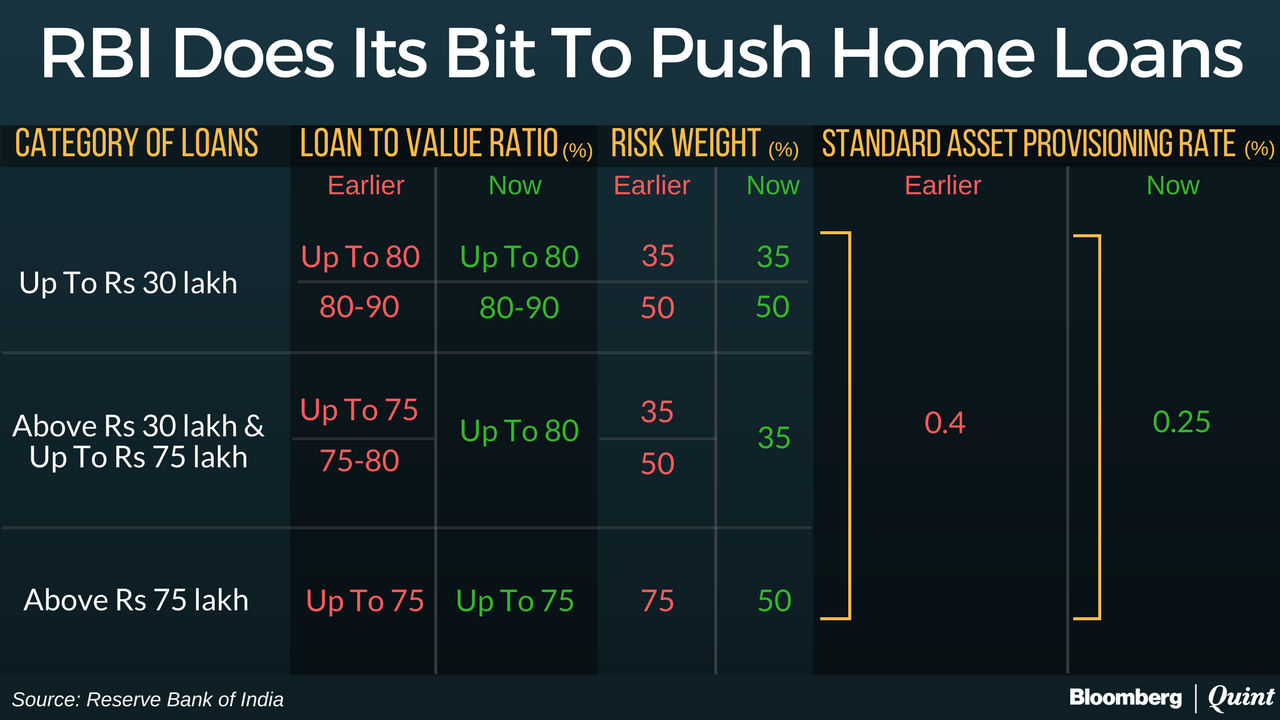
The central bank has cut the standard asset provisioning on housing loans to 0.25 percent from 0.4 percent currently, according to its statement on developmental and regulatory policies.
The RBI also increased the loan-to-value (LTV) ratio on loans between Rs 30 lakh and Rs 75 lakh to 80 percent. The loan-to-value ratio is the ratio of the loan given to the value of the property. The risk weightage on these properties has been reduced to 35 percent, as compared with a range of 35-50 percent earlier. Similarly, for houses worth over Rs 75 lakh, the risk weightage has been brought down to 50 percent, from 75 percent earlier.
Also Read: RBI Maintains Status Quo But Leaves The Door Open For A Rate Cut
A reduction in risk weights and provisioning, coupled with a higher LTV ratio in some segments, could encourage banks to give out more housing loans while also reducing the cost of these loans. This, in turn, could help push growth in the housing sector, which is considered to have a multiplier effect of the broader economy.
Considering the importance of the housing sector and given its forward and backward linkages to the economy, it has been decided, as a counter-cyclical measure, to reduce the risk weight on certain categories of housing loans sanctioned on and after today. It has also been decided to reduce the standard asset provisioning on such loans.RBI Statement
Also Read: RBI Done With Rate Cuts For Remainder Of The Year, Says Morgan Stanley's Chetan Ahya
Keki Mistry, vice chairman and chief executive officer of mortgage lender HDFC Ltd, said that the revised norms will apply to new loans. “The recognition that housing loans are relatively safe is a positive,” said Mistry while adding that a change in norms applicable to all loans, including existing ones, would have had a broader impact.
Arundhati Bhattacharya, chairman of State Bank of India, took a similar view. “The decision to reduce the risk weights for home loans over Rs. 30 lakh category will release capital for the banking industry and is a positive move,” said Bhattacharya in an email statement.
Interestingly, the RBI's push for housing comes against the backdrop of already strong growth in home loans. Data from the central bank shows that housing loans rose 18 percent between April 2015 and April 2016 and by 13.4 percent between April 2016 and April 2017. In both years, the pace of growth in housing loans was well ahead of the overall credit growth.
Banks have been pushing loans to this segment as it is considered to be relatively safer than other retail loan categories. As a result, large banks like State Bank of India Ltd. and ICICI Bank Ltd. and housing finance companies like Housing Development Finance Corporation Ltd. have been bringing down home loan rates in a bid to attract more customers.
Lenders have particularly focused on the affordable segment against the backdrop of the government's housing push. The government has set a target of ‘housing for all' by 2022 through a scheme announced in June 2015.
RBI classifies loans to housing under the priority sector as well as loans of up to Rs 50 lakh to individuals as lending for affordable housing. The definition also covers loans for houses valued up to Rs 65 lakh in the six metros – Mumbai, New Delhi, Chennai, Kolkata, Bengaluru and Hyderabad – and up to Rs 50 lakh in other centres.
The government also gave affordable housing ‘infrastructure' status in Budget 2017. In addition, it tweaked the area requirements that qualify as affordable housing.
Niranjan Hiranandani, co-founder and managing director of the Hiranandani Group said the RBI's norms, together with the government's push for affordable housing, will be positive for the real estate sector.
I think that's a very good positive. Along with the government's policy on affordable housing and the benefits given to affordable housing in the budget, it is a good measure. Increasing LTV ratio and reducing risk weightage, both are positive for the real estate sector.Niranjan Hiranandani, Managing Director, Hiranandani Group
Also Read: RBI To Examine Masala Bond Issuances, Caps Pricing

-
Navigating Energy Crossroads: S Jaishankar's Call For Diversified Supply Chains At G20 Ministerial Meeting

As geopolitical fault lines continue to test maritime trade routes and commodity flows, Jaishankar's message remains pertinent: true economic resilience requires open markets, protected transit lines, and a genuine commitment to multilateral cooperation rather than coercion.
-
Indians Are Travelling, But Not Every Journey Is A Holiday | The Week In Whys
Pilgrims, patients and working women are the real travellers, and the system hasn't quite caught up with them.
-
Getting To Work Costs Women More | The Reason Why
It is not just about women paying more than men. It is about women paying much more in cities than in villages.
-
AI Bias In Investing Cannot Be Eliminated, But It Can Be Governed
Framing is a particularly important example as identical financial information presented in terms of gains rather than losses can lead an LLM to reach a different assessment.
-
Joining The Dots | Dark Skies, Steady Diya: Why Hope Holds This Diwali
With war, a weak rupee and foreign outflows weighing on sentiment, policymakers at the NDTV World Summit and market veterans at NDTV Profit Ignite: Diwali Edition offered the same advice: stay invested and filter out the noise.
-
The Curious Case of Equitas Small Finance Bank And A CEO Who Quit For Stock
PN Vasudevan believes persistent investor concerns over a perceived conflict of interest had become a governance overhang on Equitas Small Finance Bank's stock, even as the lender improved profitability and asset quality.
-
Talking Points This Week: AI Cash Burn, A Tiger Comeback And An India That Still Finds Its Own Path
India is not immune to higher oil or tighter global liquidity, yet its earnings base is broader, its domestic policy levers are still available.
-
Foreign Investors Own Half Of HDFC Bank and ICICI Bank. An LTCG Cut Could Matter Most Here
Foreign portfolio investors have US$115 billion parked in HDFC Bank, ICICI Bank. If the government cuts long-term capital gains tax, Jefferies says returning foreign money could land here first.
-
'Never Seen This Level Of Negativity': Sandeep Tandon Says The Next Rally May Be Closer Than You Think
Veteran investor Sandeep Tandon says foreign selling is easing, large-caps are due a comeback and mid-caps are crowded, while he turns positive on gold, power and pharma this Diwali.










