RBI Currency Strategy Draws More Hot Money To India, Spurs Vicious Cycle
The Reserve Bank of India's strategy to shift some of its currency intervention to the forwards market is adding to its problems.
Its balancing act to keep the rupee stable amid heavy foreign inflows while also keeping excess liquidity in check is flooding the market with more foreign funds, prompting a vicious cycle of interventions.
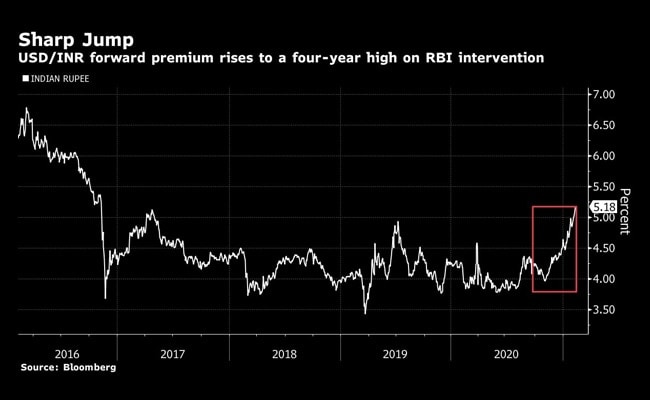
The RBI's outstanding forwards book grew to $28.3 billion as of November from a negative $4.9 billion in the fiscal year 2019-20, highlighting the extent of its operations. That's pushed the 12-month implied yields, which typically reflect the interest rate differential between India and U.S., to the highest in more than four years, fueling further inflows.
The RBI's currency intervention works like this -- it buys dollars in the spot market to prevent sharp gains in the rupee. It then sells these dollars in the forwards market to offset the liquidity impact. However, banks need to deliver these dollars to the RBI at a later date, which drives up forward premiums.
"The forwards curve has become a casualty of the RBI handling multiple objectives," said Abhishek Goenka, chief executive at India Forex Advisors Pvt. "Elevated forward premia continues to attract carry-seeking inflows and it becomes a self-fulfilling prophecy," he said.
Selling market stabilization scheme bonds or term reverse repos could be another way of mopping up liquidity, though the RBI may be averse to selling such bonds as it could lead to a spike in shorter rates, which the RBI may want to avoid, according to Goenka.
The central bank will act on forward premiums when necessary, RBI Governor Shaktikanta Das said last week. "We are very watchful of the forward premia rates" he said. The 1-year annualized dollar/rupee forward premium rose two basis points to 5.1948% on Thursday.
Deterring Importers
The rise in forward premium is also deterring importers to hedge their currency exposure while also impacting stable inflows into the bond market, according to Kotak Securities Ltd.
"Speculators are gravitating to short the U.S. dollar and buy rupee due to the high forward premium," said Anindya Banerjee, currency strategist at Kotak Securities said. "In order to prevent speculators from taking the rupee higher, the RBI is being forced to buy more dollars in the forwards market, which is pushing premia higher. This is a vicious cycle."
(Except for the headline, this story has not been edited by NDTV staff and is published from a syndicated feed.)

-
A New Samvat Wishlist: Inclusive Prosperity And Human Development

India has strengthened its economic foundations through infrastructure, digital access and enterprise. Its next growth chapter must deepen productivity, create better livelihoods and widen participation in prosperity.
-
Love, Sex Aur Dhokha: The Audacious Plot To Spy On Jensen Huang
A Taipei dinner, a Singapore chip buyer and a suspected Chinese asset: inside the alleged spy operation that got close to NVIDIA's Jensen Huang.
-
Ten Things I Learnt This Samvat
Patience can be a trap. Cheap stocks can stay cheap. Leverage can wipe you out. What did Samvat 2082 teach us? Niraj Shah writes on 10 lessons from the year gone by.
-
Talking Points This Week: Tech Nerves, FII Buying, And A Faraway Banking Shock
The global markets are not shining this Diwali. The exception in the large markets is, India.
-
Midterm Rally Lasted A Day. The Hard Reality Of A Divided US May Last Two Years | Opinion
Between a contested AI boom, a debt ceiling that arrives in 2027 and a president with every incentive to act alone, the next two years may prove more volatile than the first day's rally suggests.
-
Blue Wave Will Derail the AI Trade but Won't Dismantle the AI Era | Unhedged Position
The Democrats' sweep of the US Congress will see politics collide with economic forces both over the long and short term.
-
It's Time To Take The GST Council's Bet On Trust Global
Payment records can prove India's services exports, and clear, proportionate rules can bring foreign digital sellers into the tax net.
-
Opinion | India at 38: From Innovation Overperformer to Innovation Powerhouse
India now has 453 VC-backed deep science startups, 18 of them late-stage, after 117 percent growth since 2020. Laurus Labs, at USD 9.3 billion, is the most valuable deep science company in any middle-income economy outside China.
-
Navigating Energy Crossroads: S Jaishankar's Call For Diversified Supply Chains At G20 Ministerial Meeting
As geopolitical fault lines continue to test maritime trade routes and commodity flows, Jaishankar's message remains pertinent: true economic resilience requires open markets, protected transit lines, and a genuine commitment to multilateral cooperation rather than coercion.









