RBI Asks Banks To Peg Floating-Rate Loans To External Benchmarks
The Reserve Bank of India has asked lenders to link all new floating-rate loans to external benchmarks to improve transparency.
Starting April 1, floating-rate personal or retail loans and small business loans will be linked to an external benchmark, according to the change announced along with the monetary policy. Final guidelines will be issued by the end of December.
Banks will have the discretion to decide on the spread at the inception of the loan but that should remain constant over the period of the loan unless there is a change in the borrower's credit score.
The external benchmarks that the banks can choose from include:
- RBI's repo rate
- The 91-day T-bill yield
- The 182-day T-bill yield
- Any other benchmark market interest rate produced by the FBIL.
After linking base rate to the marginal cost of funds-based lending rate, the RBI is now making it mandatory for banks to link interest rates to the external benchmarks, NS Vishwanathan, deputy governor at the Reserve Bank of India, said. This, he said, would make interest rates transparent for borrowers.
Calling the move long overdue, Jaideep Iyer, head of strategy at RBL Bank Ltd., said the external benchmarks should help better reflect the global rate environment. The RBI has always felt that monetary transmission is supposed to happen like repo rate change. However, banks have a lot more to grapple with, he said, adding that the move will be challenging for interest-rate management by banks.
Ananth Narayan, professor at SP Jain Institute of Management and Research Narayan described the move as “very positive”. One of the issues in the financial ecosystem is that the real users' benchmarks are very different from the financial sector's benchmarks, he said. Banks in the financial system look at T-bills, CD rates, government bond yields and so forth. Whereas actual users, corporate or retail, look at bank PLR, bank base rates, banks MCLR and so on. The two don't talk to each other, he pointed out.
The Long Battle Over Loan Pricing
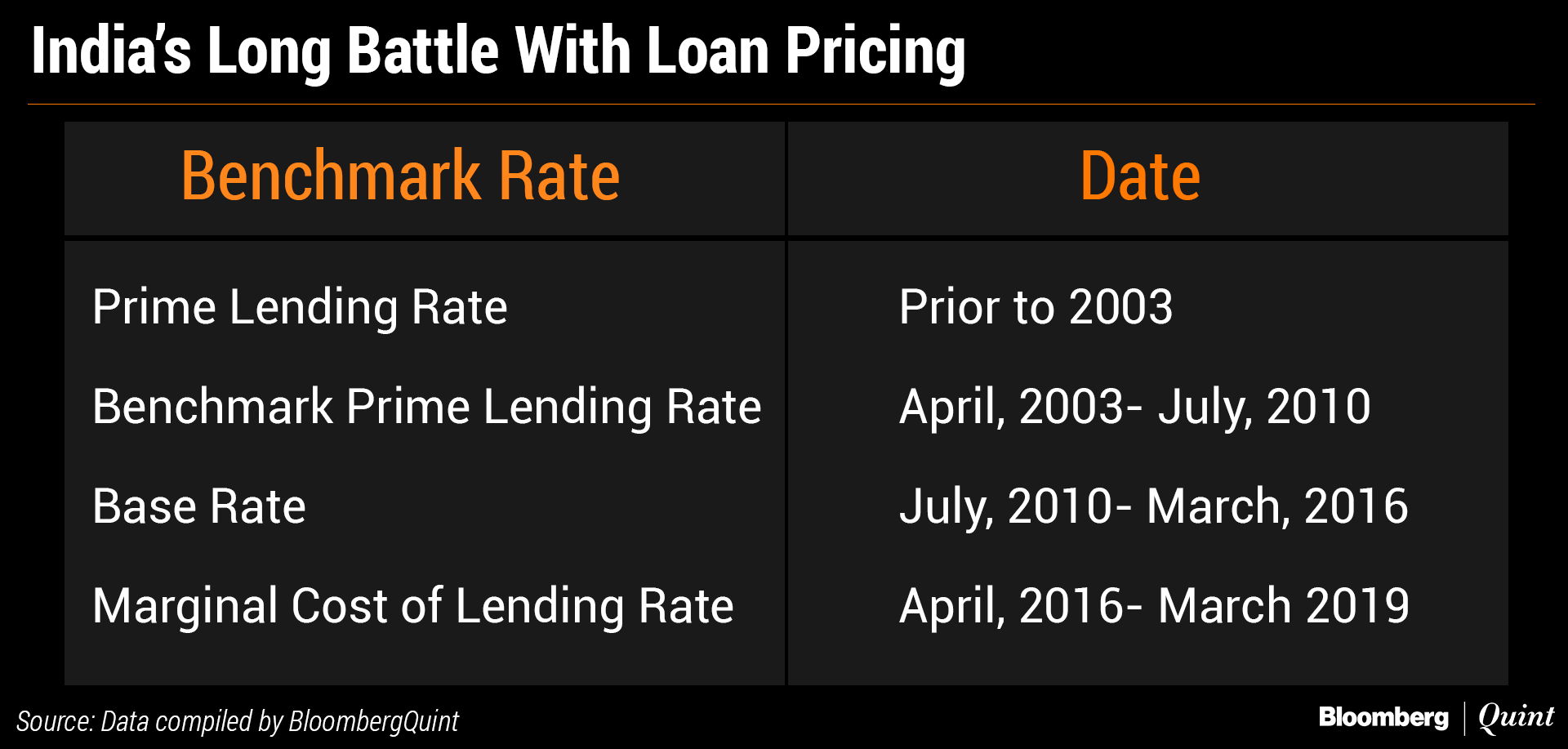
The new loan pricing mechanism follows recommendations of an internal study group chaired by the RBI's Janak Raj in October 2017. It will come into place just three years after the Marginal Cost Lending Rate (MCLR) system was introduced in 2016. The MCLR had replaced the ‘Base Rate'.
When the MCLR was first introduced, it was pitched as a solution to the perennial problem of banks not seeing an immediate change in their average cost of funds, even after a change in policy rates by the central bank. This meant that loan rates would also be slow to adjust.
Under the base rate mechanism and in the case of its predecessor-- the benchmark prime lending rate (BPLR) introduced in 2003--banks would consider the average cost of funds, rather than the marginal cost, while calculating their lending rate.
The average cost of funds takes in to account the cost that the bank pays on old as well as new deposits. So even if banks would reduce the interest rate they paid on their new fixed deposits, the interest they paid on the old stock would ensure that they would see hardly any reduction in their average cost.
Analysts estimate that 60-70 percent of the fixed deposits in a bank fall in the one year bracket. Thus the time it would take for a reduction in deposit rate to reflect on a bank's cost structure would be two to three quarters.
Under the marginal cost system used as part of the MCLR system, lenders would have to consider the cost they pay on every additional deposit they receive from depositors. Theoretically, this cost would adjust more quickly, making transmission more effective.
Since the MCLR was introduced, two problems arose. First, banks continued to price old loans using the base rate while new loans were priced using the MCLR. And so, starting April 1, the RBI made it mandatory for banks to link the base rate to the MCLR.
But even then the problem of divergence between loan rates and the policy and market rates persisted.
This, prompted another relook at the loan pricing mechanism, leading, finally, to the RBI recommending linking lending rates to market based benchmarks.
Watch the interview of SBI's PK Gupta on the new loan pricing rules.

-
High US Salaries, No Green Card Certainty: The Financial Calculation Facing Indian H-1B Families

The suspension of PERM processing at eight technology employers does not cancel existing H-1B visas. What it does is force a question many Indian families have been avoiding: is the US salary worth tying your career and family plans to one employer?
-
Swiggy vs Eternal: Food Delivery's Two Rivals Are No Longer In The Same Race
Eternal is building a private AI assistant, dark.ai. Swiggy is still working out how to make Instamart pay, with an operating loss of Rs 895 crore in the July-September quarter while Blinkit stayed profitable.
-
Where You Live Shapes How You Get To Work | The Reason Why
Two-wheelers are the most popular way to get to work in India, accounting for nearly 43% of workplace commutes.
-
Unhedged Position: Can India See An Indonesia-Style Time Correction?
The Nifty is trading below levels it first clocked in 2024. Is there, then, as I have suggested in the headline, potential that the current time correction drags on painfully for the next three-five, even ten years?
-
Navigating Friction And Energy Realities: An Analysis Of Marco Rubio's October Visit To India
Occurring at a critical juncture marked by stalled trade negotiations and escalating geopolitical pressures over global energy supplies, the visit offers a profound window into modern US-India relations.
-
India Exports Capital. Why Not Export Trusteeship?
The big question, then, is whether India can build an institution that global borrowers, investors, banks, and lawyers can trust, even without an Indian connection.
-
France's Economy & Politics Are In Crisis | The Reason Why
Let's look at how the French economy and politics evolved under Nicolas Sarkozy, Franois Hollande and Emmanuel Macron.
-
You May Inherit The Business. You Must Earn Its Credibility.
Succession tests the founder's ability to share authority as much as it tests the next generation's readiness to assume it.
-
Signing Deals Is One Thing; Making Them Work Is Another | The Week In Whys
Sometimes, things don't turn out as planned. Indian companies have lost some bids to rivals, some projects won't produce until 2030.
-
FOMC Wall, PERM Suspension, Hospital Stocks | Talking Points This Week
A PERM suspension would directly affect green-card sponsorship rather than H-1B visas, so the near-term earnings impact could remain relatively limited. The key question is whether this marks a new phase in US scrutiny of Indian IT.









