Public Sector Banks' Profit Tripled To Rs 1 Lakh Crore In 9 Years: Nirmala Sitharaman
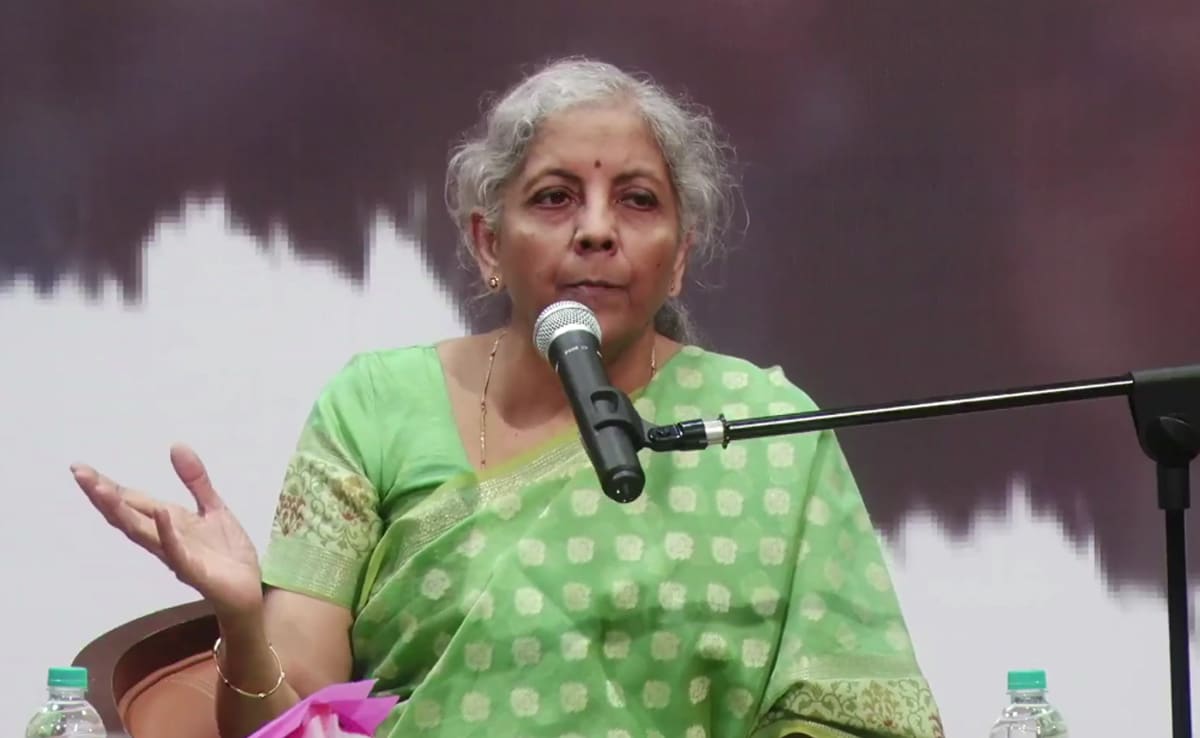
Finance Minister Nirmala Sitharaman on Saturday said the public sector banks' profit in the last nine years has tripled to Rs 1.04 lakh crore due to initiatives taken by the government and underlined the need for continuing the momentum to fuel economy.
The net profit of public sector banks (PSBs) has almost tripled to Rs 1.04 lakh crore in FY23 from Rs 36,270 crore in FY2014.
Inaugurating the corporate office of Punjab and Sind Bank in Delhi, the minister said that banks need to "build on laurels" by following the best corporate governance principles.
"Banks should not sit back and revel in success. They should follow best corporate governance practices, adhere to regulatory norms, ensure prudent liquidity management and continue to focus on having robust asset-liability and risk management," she said, stressing that the Indian economy has moved away from the 'twin balance sheet problem' to 'twin balance sheet advantage'.
The finance minister said that there was a time when the Indian economy faced the problem of twin balance sheets -- stress on the balance sheets of banks and corporate at the same time.
Before the Modi government came to power in 2014, difficulty in the Indian banking system actually started because of irrational 'Phone Banking', which happened during the tenure of the UPA government, she said.
Back then, Ms Sitharaman said, the priority in lending was given to not-so-worthy customers in an unprofessional manner. As a result, they became NPAs.
"As a result (of various initiatives of the government), I'm glad to say the problems of twin balance sheets have gone away," she said, adding that as per the Reserve Bank, it is a twin balance sheet advantage that is benefiting the Indian economy.
Observing that combined profits of the public sector banks tripled to Rs 1.04 lakh crore in 2022-23 against Rs 36,270 crore in FY14, Ms Sitharaman said the banks "need to build on laurels".
"At this stage, it is our duty towards the people of India to ensure that the banks can build on the strength and not lose this momentum that we have achieved," the minister noted.
She said that the performance of the public sector banks has improved on account of various initiatives taken by the Modi government since 2014.
There was an improvement in all critical parameters like return on asset, net interest margin and provisioning coverage ratio, she added.
The 4R strategy followed by the Modi government to revitalise the state-owned banks has yielded results, she said.
The 4R strategy refers to recognising the problem of non-performing assets, recapitalising the banks, resolving their problems, and reforming them.
Ms Sitharaman further said the banks should endeavour to adopt a proactive approach in reaching out to people to achieve optimum utilisation of financial inclusion schemes.
There should be a focus on credit outreach in states where the credit offtake is lower than the national average, particularly in the northeast and eastern parts of the country, she said, adding they must aim to increase brick-and-mortar banking presence in border areas, particularly in the those covered in the Vibrant Village Programme.
The minister also recalled the story of the Punjab and Sind Bank, which had suffered due to partition in 1947. Only two of the ten branches remained in India, while the rest went to Pakistan.
Starting from just two branches in 1947, the Punjab and Sind Bank has 1,553 branches, and the 1,554th at Karimganj in Assam was inaugurated remotely by the minister on Saturday.
(Except for the headline, this story has not been edited by NDTV staff and is published from a syndicated feed.)

-
Unhedged Position: Can India See An Indonesia-Style Time Correction?

The Nifty is trading below levels it first clocked in 2024. Is there, then, as I have suggested in the headline, potential that the current time correction drags on painfully for the next three-five, even ten years?
-
Navigating Friction And Energy Realities: An Analysis Of Marco Rubio's October Visit To India
Occurring at a critical juncture marked by stalled trade negotiations and escalating geopolitical pressures over global energy supplies, the visit offers a profound window into modern US-India relations.
-
India Exports Capital. Why Not Export Trusteeship?
The big question, then, is whether India can build an institution that global borrowers, investors, banks, and lawyers can trust, even without an Indian connection.
-
France's Economy & Politics Are In Crisis | The Reason Why
Let's look at how the French economy and politics evolved under Nicolas Sarkozy, Franois Hollande and Emmanuel Macron.
-
You May Inherit The Business. You Must Earn Its Credibility.
Succession tests the founder's ability to share authority as much as it tests the next generation's readiness to assume it.
-
Signing Deals Is One Thing; Making Them Work Is Another | The Week In Whys
Sometimes, things don't turn out as planned. Indian companies have lost some bids to rivals, some projects won't produce until 2030.
-
FOMC Wall, PERM Suspension, Hospital Stocks | Talking Points This Week
A PERM suspension would directly affect green-card sponsorship rather than H-1B visas, so the near-term earnings impact could remain relatively limited. The key question is whether this marks a new phase in US scrutiny of Indian IT.
-
Everything, Everywhere, All At Once: Dalal Street's Week To Forget | Joining The Dots
Visa curbs, a Starlink spat and cancer drug caps: what connects this week's shocks for Indian markets
-
India Is Going Abroad For Critical Minerals. But It May Take Years To Pay Off | The Reason Why
Although India's steps are in the right direction, they remain modest compared with India's growing dependence.
-
When Everyone Has AI, What Gives You An Edge?
India's young workforce is entering an uncertain world of work where powerful AI tools are becoming widely accessible. The advantage will belong to those who combine deep expertise with digital fluency, and the distinctly human capabilities that technology cannot manufacture.









