Profitability Of Solar, Wind Farms Erodes As Renewable Industry Gains Heft
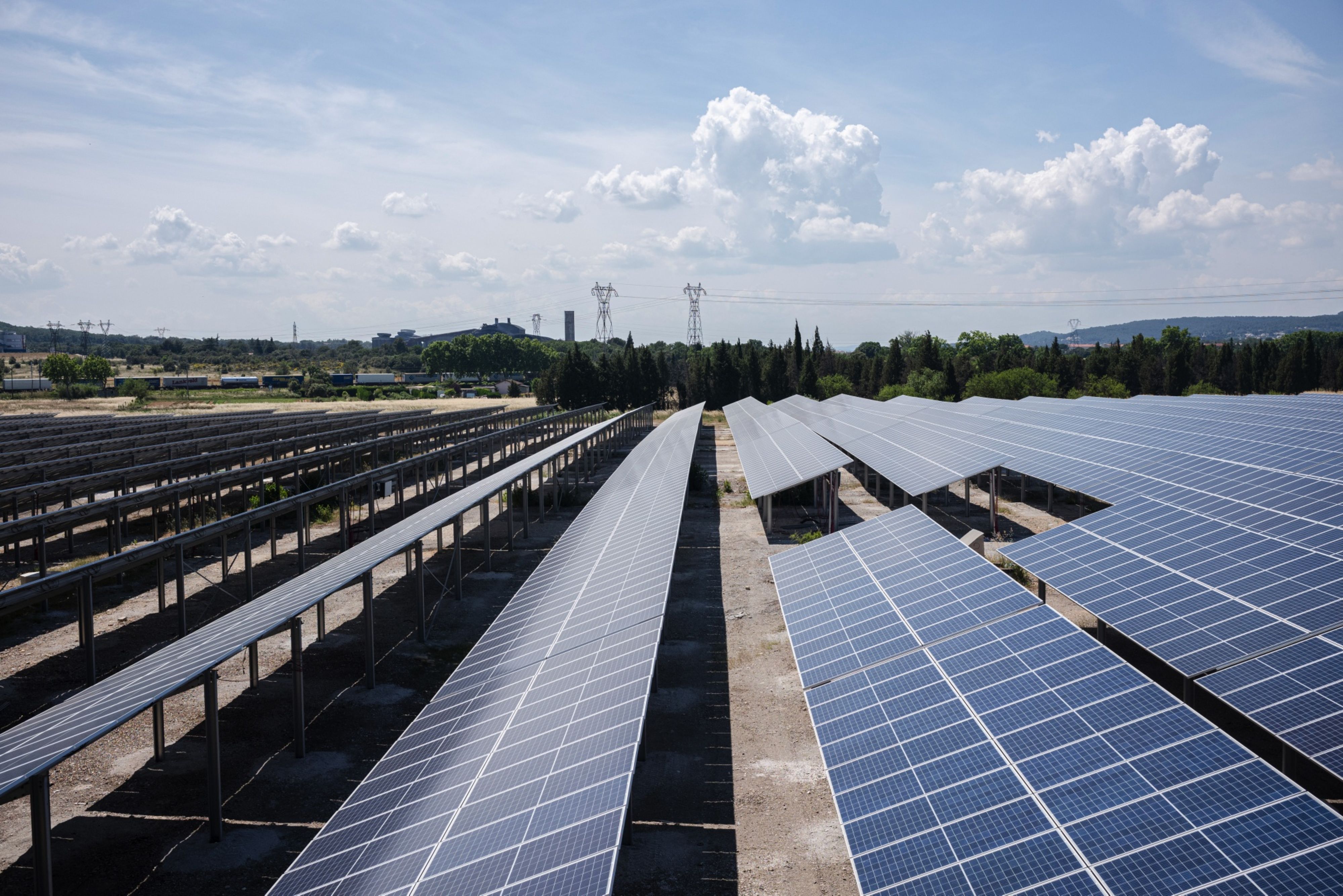
India aims to more than treble its renewable power capacity by 2030 to wean the economy away from pricey fossil fuels and clean up toxic air in its cities. But profitability of the nation's privately owned solar and wind farms remains strained, putting future investments at risk.
Operating income on every megawatt of power declined in the previous two years for the top renewable energy producers, according to BloombergQuint's analysis of their financials. The median earnings before interest, tax, depreciation and amortisation per megawatt fell from Rs 85 lakh to Rs 50 lakh.
That's lower than the minimum Rs 55 lakh/MW that state-owned renewable power plants are ensured. The government makes up for any shortfall via its viability-gap funding support.
To be sure, conventional power companies earn Ebitda between Rs 670 crore and Rs 800 crore per MW. But that's not comparable as coal-based units are protected by sections 62/63 of the Electricity Act and a fixed return on equity of 15.5%, excluding incentives.
A decline in operating efficiency threatens the viability of renewable projects and could deter fresh investments. Private participation is crucial as India wants to increase its clean energy capacity from 153 gigawatts now to 500 GW by 2030. Bulk of that is targeted from solar and wind farms.
Some of the key reasons behind the troubled financials of the sector include execution challenges, lack of funding at competitive cost and delays in signing pacts to sell long-term power, Sabyasachi Majumdar, senior vice president at ICRA Ltd., said in a December report.
Higher module prices and delivery delays have increased costs, he said. Yet, tariffs quoted in auctions of renewable projects have fallen.
According to a government reply to Lok Sabha, the country has seen record-low renewable tariffs of Rs 1.99 per kilowatt hour for solar power and Rs 2.43 per KWh for wind power.
Analysts do not see the pressure easing.
The operating income that solar and wind power companies earn on every megawatt of power is expected to go down further, according to Rohit Natrajan, research analyst, institutional equities at Antique Stock Broking (Institutional Equities).
The historical Ebitda/MW won't serve as an appropriate benchmark, Natrajan said. The cost per megawatt is going down and efficiency of modules is improving with battery storage, he said.
Still, he says basic customs duty on imported solar modules, higher GST and rising commodity prices will weigh on the financials of renewable firms in the near term.
Financials
Among India's top six private renewable energy firms, three are unprofitable because of higher interest and depreciation as they scale up.
The six companies, accounting for 25% of the capacity, will double their production once the 23-24 GW under-construction projects are operational. According to a government response in Lok Sabha, these account for a third of the total capacity worth 72.61 GW being implemented.
ReNew Power Ltd. and Greenko Group Plc are among the biggest renewable companies in India by capacity. Once under-construction projects are commissioned, Adani Green Energy Ltd. will leap ahead to become the leader.
ReNew Power Ltd. and Greenko, with up to half of their capacity coming from wind energy, have reported the biggest losses.
Large dollar borrowing with interest cost of 8.9% for outstanding debt dented its ReNew Power's profitability. The company has net debt-to-Ebitda ratio of 4.9 times. Total debt is expected to rise to around $5.85 billion at 10.2GW capacity.
ReNew Power, Greenko, Adani Green, Tata Power Ltd., ACME Solar and Azure Power didn't respond to BloombergQuint's emailed queries.
According to the data sourced from the annual reports, companies like Adani Green and Tata Power Renewable Ltd. that focus on solar energy have been profitable.
Azure Power, though solar-focused, is struggling to report profits on account of higher interest and depreciation for projects commissioned since third quarter of FY21.
Wind Or Solar?
Returns Under Pressure
ReNew Power's under-construction projects when completed will generate a return of 16-20% on account of lower interest cost despite a marginal increase in costs, the company said in its investor presentations.
ReNew also said that because of higher efficiency of models, the balance of systems costs (batteries, charge controllers, inverters) have down 20-25%.
But returns of renewable companies have been under pressure from high receivables from state utilities, which aggravates interest costs.
Fitch Rating recently assigned 'BB' with a negative outlook to the proposed U.S. dollar senior notes of Greenko Wind Projects (Mauritius) Ltd., an indirect subsidiary of Greenko Energy Holdings.
The negative outlook reflects a sharp increase in its trade receivables over the last two years and lack of clarity over the timing and quantum of improvement. It cited the increase in receivables to a delay in payments by state utilities after disbursements from the central government's liquidity support package slowed down.
Further deterioration in the receivables beyond expectations over next 12-to-18 months will result in negative rating action, Fitch said.
By comparison, the conventional power companies work under a regulated regime. Their return is protected under the Electricity Act and are assured a fixed return on equity of 15.5%, excluding incentives. These firms earn average internal rate of return of 12-15%.
To be sure, conventional and renewable energy companies operate under separate regulatory regimes.
Steep Targets
While returns for renewable energy companies have been falling, the government has set aggressive targets for the sector.
India targets to reach 175GW renewable energy capacity this year. It has crossed 150 GW but only after brining larger hydel projects within the category.
India has now set target of 500 GW of installed capacity from non-fossil fuel sources by 2030 as part of the COP26 commitment by Prime Minister Narendra Modi.
According to a government study cited in response to a Lok Sabha query, the country has an aggregate potential of over 1636 GW of renewable energy including large hydro projects.

-
Talking Points This Week: Tech Nerves, FII Buying, And A Faraway Banking Shock

The global markets are not shining this Diwali. The exception in the large markets is, India.
-
Midterm Rally Lasted A Day. The Hard Reality Of A Divided US May Last Two Years | Opinion
Between a contested AI boom, a debt ceiling that arrives in 2027 and a president with every incentive to act alone, the next two years may prove more volatile than the first day's rally suggests.
-
Blue Wave Will Derail the AI Trade but Won't Dismantle the AI Era | Unhedged Position
The Democrats' sweep of the US Congress will see politics collide with economic forces both over the long and short term.
-
It's Time To Take The GST Council's Bet On Trust Global
Payment records can prove India's services exports, and clear, proportionate rules can bring foreign digital sellers into the tax net.
-
Opinion | India at 38: From Innovation Overperformer to Innovation Powerhouse
India now has 453 VC-backed deep science startups, 18 of them late-stage, after 117 percent growth since 2020. Laurus Labs, at USD 9.3 billion, is the most valuable deep science company in any middle-income economy outside China.
-
Navigating Energy Crossroads: S Jaishankar's Call For Diversified Supply Chains At G20 Ministerial Meeting
As geopolitical fault lines continue to test maritime trade routes and commodity flows, Jaishankar's message remains pertinent: true economic resilience requires open markets, protected transit lines, and a genuine commitment to multilateral cooperation rather than coercion.
-
Indians Are Travelling, But Not Every Journey Is A Holiday | The Week In Whys
Pilgrims, patients and working women are the real travellers, and the system hasn't quite caught up with them.
-
Getting To Work Costs Women More | The Reason Why
It is not just about women paying more than men. It is about women paying much more in cities than in villages.
-
AI Bias In Investing Cannot Be Eliminated, But It Can Be Governed
Framing is a particularly important example as identical financial information presented in terms of gains rather than losses can lead an LLM to reach a different assessment.









