Points Mean Pain For Small Firms In UK Immigration Overhaul

The UK's plans to tighten immigration could hurt small businesses, who can't find local workers as it is and will soon face tough restrictions on hiring from the European Union.
Almost 40 per cent of firms say they've struggled to recruit the right staff in the past year, and more than a third of those say a reason is that UK citizens are unwilling to do the jobs, according to the Federation of Small Businesses.
The survey highlights the economic challenge facing Prime Minister Boris Johnson's government as it attempts to take greater control over its borders after Brexit. The nation has long relied on imported labor for jobs such as construction, agriculture and social care, and many firms are ill-prepared for the change.
"Firms want to upskill their workforce, improve productivity and bring through the next generation, but they need support to make that happen," said Mike Cherry, FSB national chairman. "It's critical that we get this new system right, particularly when timeframes are so tight."
With the Brexit transition period due to expire at the end of the year, the UK government is proposing using a scorecard system to favor skilled people coming to the country. Among the EU nationals currently in Britain, 70 per cent wouldn't make the cut under the new rules.
While the FSB said a points-based system might work, it also has concerns. Locals may not be able to fill in, hiring foreigners may become too expensive and there will be a bigger administrative burden for companies that have never filed immigration paperwork before.
Nearly half of companies in the survey said they can't afford the fees that will be levied on them for employing EU staff. That charge, currently applied to non-EU workers, can exceed 3,000 pounds ($4,000).
The changes give little time to adapt for businesses that have long relied on the free flow of people from the EU.
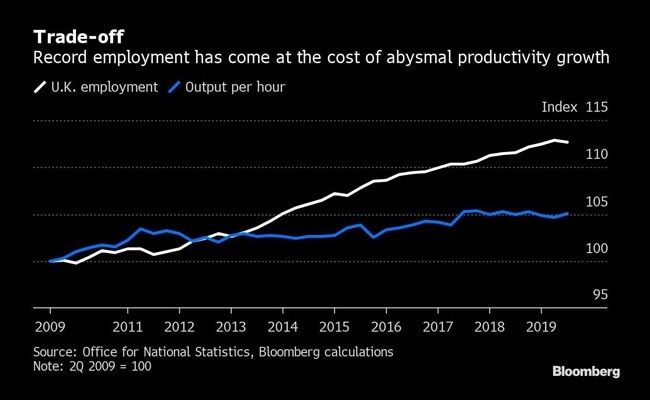
Small businesses should be allocated funds for training and new technologies, Cherry said. That could prove key in addressing the lack of efficiency in the economy.
In 2018, gains in UK output per hour were almost 20 per cent below their pre-crisis trend. Economists say that the increasing use of artificial intelligence will help, but it has yet to have much of an impact.

-
High US Salaries, No Green Card Certainty: The Financial Calculation Facing Indian H-1B Families

The suspension of PERM processing at eight technology employers does not cancel existing H-1B visas. What it does is force a question many Indian families have been avoiding: is the US salary worth tying your career and family plans to one employer?
-
Unhedged Position: Can India See An Indonesia-Style Time Correction?
The Nifty is trading below levels it first clocked in 2024. Is there, then, as I have suggested in the headline, potential that the current time correction drags on painfully for the next three-five, even ten years?
-
Navigating Friction And Energy Realities: An Analysis Of Marco Rubio's October Visit To India
Occurring at a critical juncture marked by stalled trade negotiations and escalating geopolitical pressures over global energy supplies, the visit offers a profound window into modern US-India relations.
-
India Exports Capital. Why Not Export Trusteeship?
The big question, then, is whether India can build an institution that global borrowers, investors, banks, and lawyers can trust, even without an Indian connection.
-
France's Economy & Politics Are In Crisis | The Reason Why
Let's look at how the French economy and politics evolved under Nicolas Sarkozy, Franois Hollande and Emmanuel Macron.
-
You May Inherit The Business. You Must Earn Its Credibility.
Succession tests the founder's ability to share authority as much as it tests the next generation's readiness to assume it.
-
Signing Deals Is One Thing; Making Them Work Is Another | The Week In Whys
Sometimes, things don't turn out as planned. Indian companies have lost some bids to rivals, some projects won't produce until 2030.
-
FOMC Wall, PERM Suspension, Hospital Stocks | Talking Points This Week
A PERM suspension would directly affect green-card sponsorship rather than H-1B visas, so the near-term earnings impact could remain relatively limited. The key question is whether this marks a new phase in US scrutiny of Indian IT.
-
Everything, Everywhere, All At Once: Dalal Street's Week To Forget | Joining The Dots
Visa curbs, a Starlink spat and cancer drug caps: what connects this week's shocks for Indian markets
-
India Is Going Abroad For Critical Minerals. But It May Take Years To Pay Off | The Reason Why
Although India's steps are in the right direction, they remain modest compared with India's growing dependence.