GST Improves Transport Sector Efficiency By 30%: PM Modi
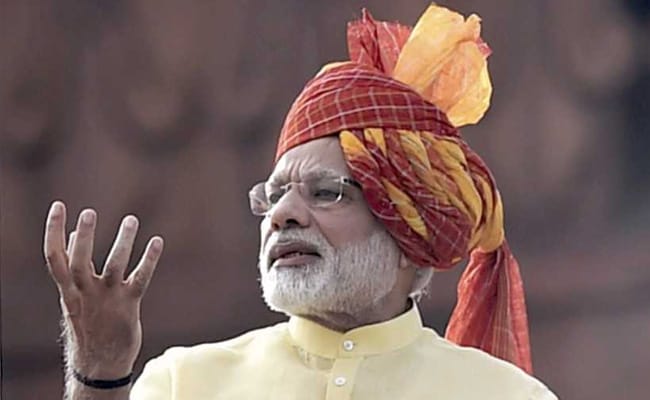
New Delhi: Abolition of inter-state check posts after the implementation of GST (Goods and Services Tax) has reduced time for movement of goods by 30 per cent and saved thousands of crores of rupees, Prime Minister Narendra Modi said on Tuesday. GST, which unified more than a dozen central and state levies, is a result of cooperative federalism and its smooth rollout from July 1 has increased efficiencies of business, he said. Addressing the nation from the ramparts of the Red Fort on the occasion of 71st Independence Day, PM Modi said technology has made the rollout smooth in a short span on time.
"Trucks (carrying goods) are saving 30 per cent (travel) time post GST as check posts have been removed. This has helped save thousands of crores of rupees and more importantly time," he said.
Business efficiency, he said, has increased. "Efficiency has increased in transport sector by 30 per cent and because of GST such a big change has happened," he said.
The biggest tax reform since Independence, GST was rolled out from July 1. The new indirect tax regime has subsumed over a dozen state and central levies like excise duty, service tax and VAT, and has replaced them with four tier tax structure of 5, 12, 18 and 28 per cent for goods and services across the country.
GST has removed inter-state barriers to convert the country into a single market where goods and services can flow seamlessly.
State border check posts scrutinised material and location-based tax compliance, resulting in delays in delivery of goods and cause environment pollution as trucks queue up for clearance.
PM Modi said crores of people are behind the success of GST and the implementation of the new indirect tax regime is an example of the benefits that can be reaped if there is cooperative federalism in place between the Centre and states.
"Technology is a miracle. Some find it astonishing that GST has been rolled out in such a vast country in such short span of time," he said.
He said in initiatives like GST, ease of doing business and cleanliness drive, the Centre and states have worked shoulder to shoulder to make them a success. He said the steps taken by the government will benefit the country and with GST the country will benefit.
PM Modi said there was a time when the Centre and states used to fight over allocation of urea and kerosene.
The Central government, he said, had a "big brother" approach towards the states. But all this is a thing of past with increased urea production in last three years and alternate LPG and natural gas usage cutting down kerosene demand, he said.
"Since I have myself been a Chief Minister for long, I know that states are important for the growth of a country. I understand the importance of chief ministers and state governments."
"And that is why we focused on cooperative federalism and now competitive cooperative federalism. And now we are taking all decision together," PM Modi said.

-
High US Salaries, No Green Card Certainty: The Financial Calculation Facing Indian H-1B Families

The suspension of PERM processing at eight technology employers does not cancel existing H-1B visas. What it does is force a question many Indian families have been avoiding: is the US salary worth tying your career and family plans to one employer?
-
Unhedged Position: Can India See An Indonesia-Style Time Correction?
The Nifty is trading below levels it first clocked in 2024. Is there, then, as I have suggested in the headline, potential that the current time correction drags on painfully for the next three-five, even ten years?
-
Navigating Friction And Energy Realities: An Analysis Of Marco Rubio's October Visit To India
Occurring at a critical juncture marked by stalled trade negotiations and escalating geopolitical pressures over global energy supplies, the visit offers a profound window into modern US-India relations.
-
India Exports Capital. Why Not Export Trusteeship?
The big question, then, is whether India can build an institution that global borrowers, investors, banks, and lawyers can trust, even without an Indian connection.
-
France's Economy & Politics Are In Crisis | The Reason Why
Let's look at how the French economy and politics evolved under Nicolas Sarkozy, Franois Hollande and Emmanuel Macron.
-
You May Inherit The Business. You Must Earn Its Credibility.
Succession tests the founder's ability to share authority as much as it tests the next generation's readiness to assume it.
-
Signing Deals Is One Thing; Making Them Work Is Another | The Week In Whys
Sometimes, things don't turn out as planned. Indian companies have lost some bids to rivals, some projects won't produce until 2030.
-
FOMC Wall, PERM Suspension, Hospital Stocks | Talking Points This Week
A PERM suspension would directly affect green-card sponsorship rather than H-1B visas, so the near-term earnings impact could remain relatively limited. The key question is whether this marks a new phase in US scrutiny of Indian IT.
-
Everything, Everywhere, All At Once: Dalal Street's Week To Forget | Joining The Dots
Visa curbs, a Starlink spat and cancer drug caps: what connects this week's shocks for Indian markets
-
India Is Going Abroad For Critical Minerals. But It May Take Years To Pay Off | The Reason Why
Although India's steps are in the right direction, they remain modest compared with India's growing dependence.









