PM Modi Lays Foundation Stone Of Navi Mumbai Airport
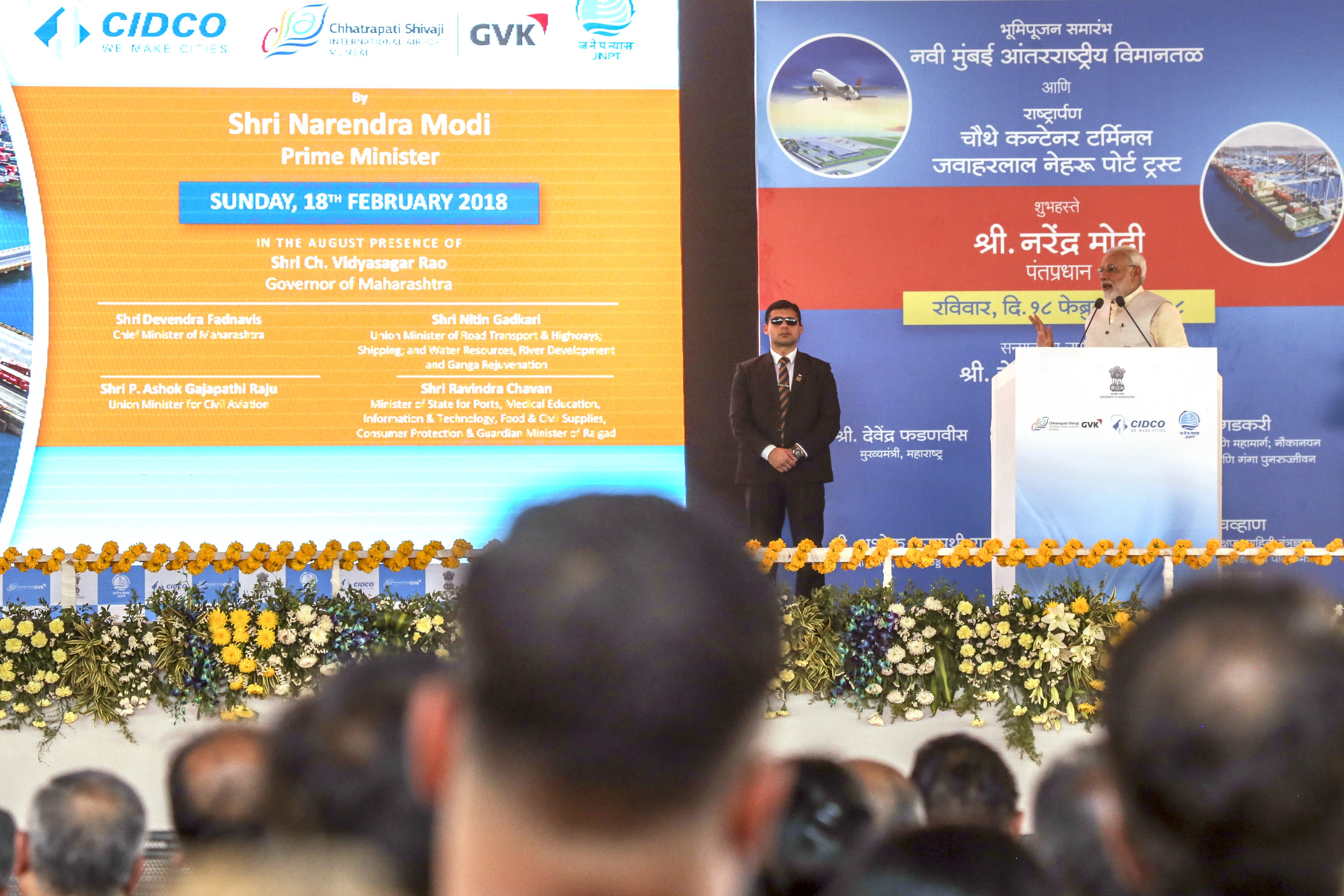
Prime Minister Narendra Modi today laid the foundation stone of the Navi Mumbai International Airport site in Panvel, nearly 21 years after it was mooted. The first phase the Rs 16,700-crore project is expected to be completed by 2019.
“We said why not people who wear ‘hawai chappal' should use ‘hawai jahaj'... There were about 450 operational airplanes in the country, but in the last one year, 900 new aircraft were booked to order in last one year,” he said at the event. The growing aviation sector will boost tourism sector as well, he added.
Delayed largely due to land acquisition, the state last month gave a letter of approval to Mumbai International Airport Ltd., 74 percent owned by GVK Power and Infrastructure Ltd. and 26 percent by the City and Industrial Development Corporation of Maharashtra Ltd., the nodal agency.
“This is the country's largest greenfield airport... Navi Mumbai airport will have capacity of handling 60 million passengers,” said Devendra Fadnavis, chief minister of Maharashtra. He added that a dedicated metro corridor between Mumbai and Navi Mumbai is being constructed.
Fadnavis said he is confident that the first flight from the airport will take off by December, 2019 and that the airport will help grow Maharashtra's GDP by 1 percent.
The airport complex, to be spread over 2,268 hectares, and will have two parallel runways, unlike the existing Mumbai airport where the runways cross each other, making simultaneously use difficult. The Mumbai airport, which handled 45.2 million passengers in the last financial year, has been facing a capacity crunch. According to CAPA, the airport will reach its maximum design capacity of 48 million by March.
Also Read: GVK Power Signs Agreement To Develop Navi Mumbai Airport
The Navi Mumbai's airport's core area consists of a hillock, river, and marshland. The pre-development work, which includes diverting the river, shifting high-voltage lines and flattening a hill into a plateau that will be 5.5 metres above the sea level would cost around Rs 3,500 crore.
Along with this, about 3,000 families will have to be shifted. So far, 400 families have been moved, said Cidco officials.
To improve connectivity to the airport, the state has planned high-speed corridors such as the Metro line and the Mumbai -Trans Harbour Link, a 22-km link road connecting Mumbai with the twin city of Navi Mumbai. It's is expected to be completed by 2023.

-
Ten Things I Learnt This Samvat

Patience can be a trap. Cheap stocks can stay cheap. Leverage can wipe you out. What did Samvat 2082 teach us? Niraj Shah writes on 10 lessons from the year gone by.
-
Talking Points This Week: Tech Nerves, FII Buying, And A Faraway Banking Shock
The global markets are not shining this Diwali. The exception in the large markets is, India.
-
Midterm Rally Lasted A Day. The Hard Reality Of A Divided US May Last Two Years | Opinion
Between a contested AI boom, a debt ceiling that arrives in 2027 and a president with every incentive to act alone, the next two years may prove more volatile than the first day's rally suggests.
-
Blue Wave Will Derail the AI Trade but Won't Dismantle the AI Era | Unhedged Position
The Democrats' sweep of the US Congress will see politics collide with economic forces both over the long and short term.
-
It's Time To Take The GST Council's Bet On Trust Global
Payment records can prove India's services exports, and clear, proportionate rules can bring foreign digital sellers into the tax net.
-
Opinion | India at 38: From Innovation Overperformer to Innovation Powerhouse
India now has 453 VC-backed deep science startups, 18 of them late-stage, after 117 percent growth since 2020. Laurus Labs, at USD 9.3 billion, is the most valuable deep science company in any middle-income economy outside China.
-
Navigating Energy Crossroads: S Jaishankar's Call For Diversified Supply Chains At G20 Ministerial Meeting
As geopolitical fault lines continue to test maritime trade routes and commodity flows, Jaishankar's message remains pertinent: true economic resilience requires open markets, protected transit lines, and a genuine commitment to multilateral cooperation rather than coercion.
-
Indians Are Travelling, But Not Every Journey Is A Holiday | The Week In Whys
Pilgrims, patients and working women are the real travellers, and the system hasn't quite caught up with them.
-
Getting To Work Costs Women More | The Reason Why
It is not just about women paying more than men. It is about women paying much more in cities than in villages.









