New Pirola Covid Variant Shows Value of Booster Shots
(Bloomberg Opinion) -- Preliminary data from three separate research teams suggest the latest anxiety-inducing Covid variant isn't quite the threat many had feared. BA.2.86 — or what some armchair epidemiologists have dubbed “Pirola” — does seem capable of escaping some of our prior immunity, but we're not left defenseless.
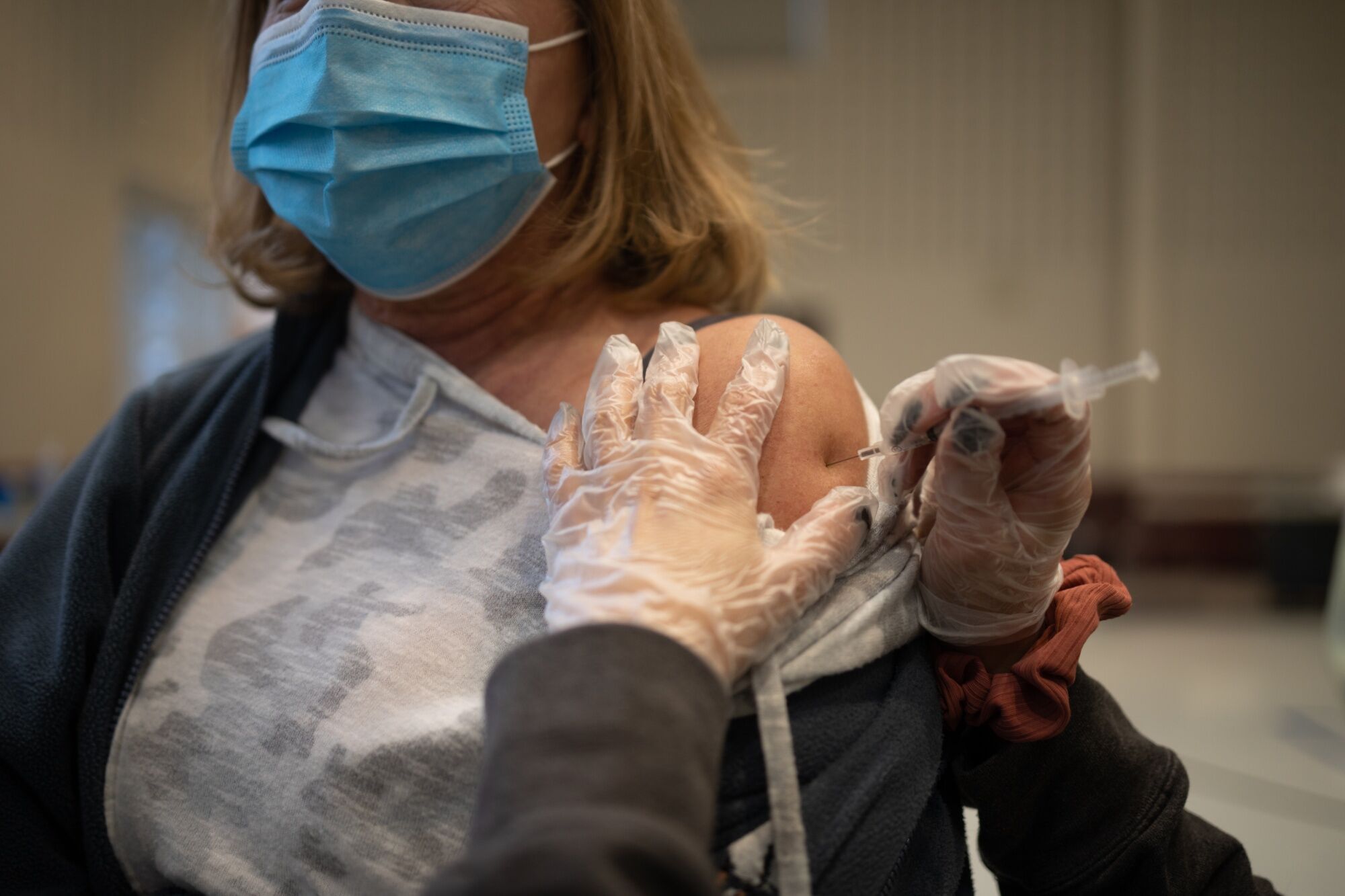
Even better, data suggests the updated boosters, which are matched to a previous variant known as XBB, could still offer decent protection against the new edition.
That's hugely reassuring.
But it doesn't mean we can ignore this late-summer bump in Covid cases or skip the updated boosters. Instead, it should serve as a reminder that the virus isn't quite done with us yet. New variants will continue to appear, and our increasingly limited tracking of the virus could make us slow to react to whatever descendent comes next. (In case you're wondering what happened to Eris, the other recent variant, it's still circulating but the World Health Organization has said it's likely no worse than other variants we've seen.)
Infectious disease experts start to sweat when a new variant emerges with lots of changes in the spike protein, the now-familiar knobby feature on the surface of the virus that allows it to pierce our cells. So despite only a few cases of BA.2.86 identified in recent weeks, the 30 or so mutations in its spike protein grabbed scientists' attention.
Moreover, the variant suddenly showed up in wastewater samples in nearly a dozen countries, suggesting it had been quietly spreading at a time when the world is doing much less Covid monitoring.
To understand the potential problem posed by a new variant, researchers need to understand three things: whether it can spread more quickly, infect people more easily, or evade our existing immunity. When all three collide, there's a real danger of fresh waves of hospitalizations and deaths. And with little data to go on, some predicted BA.2.86 presented enough of a problem to cause another omicron-like event.
Thankfully, the first studies of the variant suggest things aren't quite that dire.
A team led by Dan Barouch, director of the Center for Virology and Vaccine Research at Beth Israel Deaconess Medical Center, examined plasma samples from 66 people with a mix of exposures to vaccines and variants. Some had received the bivalent booster distributed last fall, while others hadn't, and each group included some people who had been recently infected by XBB.
The researchers made two key discoveries. The first is that everyone developed neutralizing antibodies against BA.2.86, and they were not any lower — and in fact were in most cases higher — than those generated against the already-circulating variants. In other words, the new variant does not seem to be as immune evasive as many had worried. “That was somewhat unexpected and welcome news,” Barouch says.
And people who were infected with XBB generated substantially higher antibodies against all circulating variants, including BA.2.86. That bodes well for the boosters matched to XBB that are expected to arrive later this month.
Two other as-yet-unpublished analyses support a similar narrative: BA.2.86 does evade some of our prior immunity, but it's not as bad is some had feared, and the updated boosters could prop up that protection.
Though the result is a happy one, it's still a bit of a head-scratcher: If BA.2.86 has so many new mutations, shouldn't it be more immune evasive? Barouch's hypothesis is that BA.2.86 descended from BA.2, the Omicron subvariant that became dominant in spring 2022 yet wasn't very good at evading immunity. While protection wobbled as it evolved, some amount of coverage remains.
To be sure, we're not out of the woods. One worry is that BA.2.86 could further mutate — or worse, combine with something XBB-like to take on scary new dimensions. And, of course, something entirely different could crop up. Scientists no longer have the funding or support to track the virus as closely as they did earlier in the pandemic, making it harder to detect something before it becomes a problem.
And hospitalizations have been ticking up from their historic lows for almost two months. We know many of the more serious cases are in older, more vulnerable people. The new data provide yet another motivation for people in those groups to get their updated booster as soon as they are available to ramp up their protection.
More From Bloomberg Opinion:
- Covid's Back. Who's Most Likely to Get It Again?: Lisa Jarvis
- Covid's Summer Resurgence Resists Easy Answers: F.D. Flam
- Not All Covid ‘Misinformation' Is Equal — or Even Misinformation: F.D. Flam
This column does not necessarily reflect the opinion of the editorial board or Bloomberg LP and its owners.
Lisa Jarvis is a Bloomberg Opinion columnist covering biotech, health care and the pharmaceutical industry. Previously, she was executive editor of Chemical & Engineering News.
More stories like this are available on bloomberg.com/opinion
©2023 Bloomberg L.P.

-
Navigating Energy Crossroads: S Jaishankar's Call For Diversified Supply Chains At G20 Ministerial Meeting

As geopolitical fault lines continue to test maritime trade routes and commodity flows, Jaishankar's message remains pertinent: true economic resilience requires open markets, protected transit lines, and a genuine commitment to multilateral cooperation rather than coercion.
-
Indians Are Travelling, But Not Every Journey Is A Holiday | The Week In Whys
Pilgrims, patients and working women are the real travellers, and the system hasn't quite caught up with them.
-
Getting To Work Costs Women More | The Reason Why
It is not just about women paying more than men. It is about women paying much more in cities than in villages.
-
AI Bias In Investing Cannot Be Eliminated, But It Can Be Governed
Framing is a particularly important example as identical financial information presented in terms of gains rather than losses can lead an LLM to reach a different assessment.
-
Joining The Dots | Dark Skies, Steady Diya: Why Hope Holds This Diwali
With war, a weak rupee and foreign outflows weighing on sentiment, policymakers at the NDTV World Summit and market veterans at NDTV Profit Ignite: Diwali Edition offered the same advice: stay invested and filter out the noise.
-
The Curious Case of Equitas Small Finance Bank And A CEO Who Quit For Stock
PN Vasudevan believes persistent investor concerns over a perceived conflict of interest had become a governance overhang on Equitas Small Finance Bank's stock, even as the lender improved profitability and asset quality.
-
Talking Points This Week: AI Cash Burn, A Tiger Comeback And An India That Still Finds Its Own Path
India is not immune to higher oil or tighter global liquidity, yet its earnings base is broader, its domestic policy levers are still available.
-
Foreign Investors Own Half Of HDFC Bank and ICICI Bank. An LTCG Cut Could Matter Most Here
Foreign portfolio investors have US$115 billion parked in HDFC Bank, ICICI Bank. If the government cuts long-term capital gains tax, Jefferies says returning foreign money could land here first.
-
'Never Seen This Level Of Negativity': Sandeep Tandon Says The Next Rally May Be Closer Than You Think
Veteran investor Sandeep Tandon says foreign selling is easing, large-caps are due a comeback and mid-caps are crowded, while he turns positive on gold, power and pharma this Diwali.
-
Indians Stay With Family, Not In Hotels | The Reason Why
India still lacks enough clean, reliable and affordable hotels for budget-conscious travellers.










