Biggest Gas Importer Petronet To Invest Rs 40,000 Crore In Next 5 Years
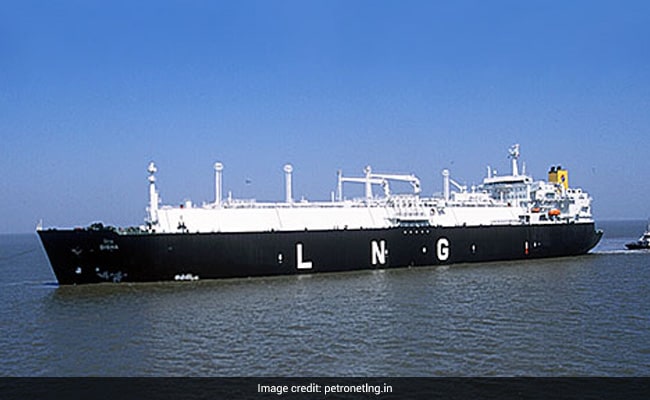
Petronet LNG Ltd, India's biggest gas importer, will invest Rs 40,000 crore in the next five years for expanding import infrastructure as well as foraying into new business to boost profitability to Rs 10,000 crore.
Petronet, which operates two liquefied natural gas (LNG) import facilities at Dahej in Gujarat and Kochi in Kerala, is looking to foray into the petrochemicals business, according to the firm's latest annual report.
The company has formulated a '1-5-10-40' strategy for exponential growth and diversification. "The company aims at achieving an annual turnover of Rs 1 lakh crore over next five years and annual profit after tax of Rs 10,000 crore with investments of Rs 40,000 crore," it said.
It had a net profit or profit after tax of Rs 3,352 crore on a turnover of Rs 43,169 crore in fiscal 2021-22 (April 2021 to March 2022).
LNG is natural gas that has been cooled down to liquid form for ease of transporting in ships. At the import terminal, LNG is regassified into its gaseous state before piping it to users like power plants for production of electricity and fertiliser units for making urea and other crop nutrients.
Petronet said it is raising import capacity of the Dahej terminal from 17.5 million tonnes per annum to 22.5 million tonnes at an estimated cost of Rs 600 crore.
Also, it is adding two more LNG storage tanks to the present six tanks at Dahej at a cost of Rs 1,250 crore.
This is in line with the government vision of raising the share of natural gas in the primary energy basket of the country from 6.7 per cent to 15 per cent by 2030.
With both its terminals on the west coast, Petronet is now eyeing a third import facility on the east coast.
A floating LNG import terminal on high-seas "will cater to the increasing gas demand of the eastern and central part of the country," it said, adding a detailed feasibility report (DFR) for the 4 million tonnes FSRU based terminal with further scope for expansion to land based terminal of 5 million tonnes capacity has been completed.
Petronet's Kochi terminal has a capacity to import and regassify 5 million tonnes per annum of LNG. The company said it also plans to set up a petrochemical complex based on imported propane at Dahej LNG terminal.
It is also "exploring the option of setting up a propylene derivative complex in the near future." It, however, did not give cost estimates or the timelines for the project.
Petronet said it is also eyeing overseas projects and has been shortlisted as one of the potential bidders for an LNG terminal at Matarbari, Cox's Bazar in Bangladesh.
It is also "exploring the business opportunities in LNG value chain in Sri Lanka and in process of collaborating with potential counterparts including the government of Sri Lanka," the annual report said.
The firm "envisages to be a global LNG player and has thereby incorporated a wholly-owned subsidiary company 'Petronet LNG Singapore Pte Ltd' on March 7, 2022." "Petronet LNG Singapore Pte Ltd has been incorporated to carry out business/activities, including but not limited to purchase of LNG on long, spot and short-term basis and sale of LNG, trading of LNG to Indian and foreign companies, optimization and diversion of LNG under its portfolio, carry out hedging, investments in overseas ventures etc," it added.
Petronet currently imports LNG on long-term contracts from Qatar and Australia. The re-gassified LNG is supplied to offtakers GAIL (India) Ltd, Indian Oil Corporation (IOC) and Bharat Petroleum Corporation Ltd (BPCL) for further sale to actual users.
GAIL, IOC, BPCL and Oil and Natural Gas Corporation (ONGC) hold 12.5 per cent stake each in Petronet.
"In order to meet this challenging target (of 1-5-10-40), your company also identified a need for optimization of the decision-making process for its executives at various levels. Accordingly, the company undertook an extensive exercise to re-visit the existing delegation of authority, wherein the executive powers were rationalized to align with its growing business needs.
"Similarly, Petronet also recognizes that strategic goals require harmony and alignment with the company's HR policies and practices, therefore, it became imperative to revisit the entire spectrum of HR policies and align it with industry best practices," the annual report said.

-
Navigating Friction And Energy Realities: An Analysis Of Marco Rubio's October Visit To India

Occurring at a critical juncture marked by stalled trade negotiations and escalating geopolitical pressures over global energy supplies, the visit offers a profound window into modern US-India relations.
-
India Exports Capital. Why Not Export Trusteeship?
The big question, then, is whether India can build an institution that global borrowers, investors, banks, and lawyers can trust, even without an Indian connection.
-
France's Economy & Politics Are In Crisis | The Reason Why
Let's look at how the French economy and politics evolved under Nicolas Sarkozy, Franois Hollande and Emmanuel Macron.
-
You May Inherit The Business. You Must Earn Its Credibility.
Succession tests the founder's ability to share authority as much as it tests the next generation's readiness to assume it.
-
Signing Deals Is One Thing; Making Them Work Is Another | The Week In Whys
Sometimes, things don't turn out as planned. Indian companies have lost some bids to rivals, some projects won't produce until 2030.
-
FOMC Wall, PERM Suspension, Hospital Stocks | Talking Points This Week
A PERM suspension would directly affect green-card sponsorship rather than H-1B visas, so the near-term earnings impact could remain relatively limited. The key question is whether this marks a new phase in US scrutiny of Indian IT.
-
Everything, Everywhere, All At Once: Dalal Street's Week To Forget | Joining The Dots
Visa curbs, a Starlink spat and cancer drug caps: what connects this week's shocks for Indian markets
-
India Is Going Abroad For Critical Minerals. But It May Take Years To Pay Off | The Reason Why
Although India's steps are in the right direction, they remain modest compared with India's growing dependence.
-
When Everyone Has AI, What Gives You An Edge?
India's young workforce is entering an uncertain world of work where powerful AI tools are becoming widely accessible. The advantage will belong to those who combine deep expertise with digital fluency, and the distinctly human capabilities that technology cannot manufacture.
-
Wrong Labels, High Pesticide Residues Holding Back Agri Exports | The Reason Why
India needs stronger domestic food-safety and labelling standards, with best practices becoming part of everyday business for farmers, traders and food companies.










