Petrol, Diesel Prices Hiked Further. Check Out Today's Fuel Rates

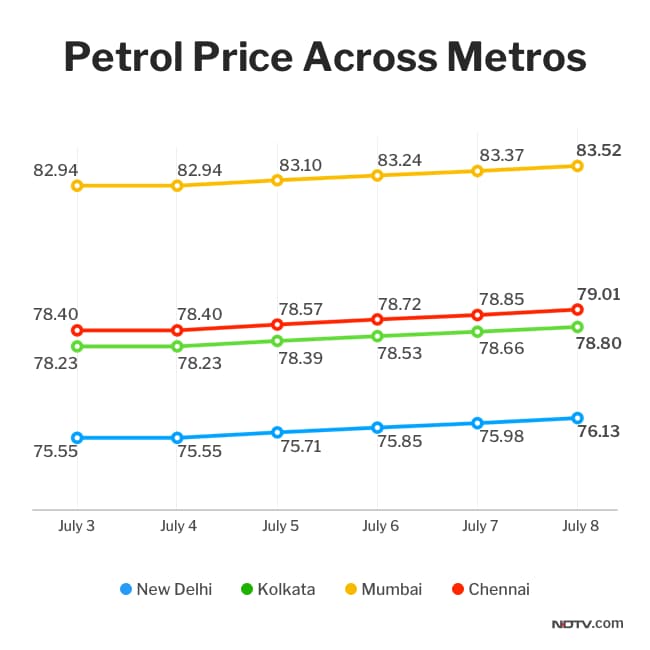
Petrol and diesel prices were increased on Sunday, marking the fourth straight day of marginal hikes. While the magnitude of hikes was in the range of 14-16 paise per litre in case of petrol in Delhi, Kolkata, Mumbai and Chennai, diesel prices were lifted by 10-11 paise per litre, according to data from Indian Oil Corporation. Petrol and diesel are deregulated in the country. State-run oil marketing companies such as Indian Oil review the fuel prices on a daily basis, and effect any revisions at fuel pumps with effect from 6 am every day.
On Sunday, petrol retailed at Rs 76.13 per litre in Delhi, Rs 78.8 per litre in Kolkata, Rs 83.52 per litre in Mumbai and Rs 79.01 per litre in Chennai. Diesel prices were at Rs 67.86 per litre, Rs 70.41 per litre, Rs 72 per litre and Rs 71.63 per litre respectively. Since Wednesday, July 4, petrol prices have been increased by a cumulative 57-61 paise per litre and diesel rates raised by 48-51 paise per litre. These hikes come after a gap of one month, when crude oil rates and weakness in the rupee had led to the prices touching all-time highs in some cities.
Domestic petrol and diesel prices are determined by the price of global crude oil and the exchange rate of the rupee against the US dollar, among other factors. Brent crude oil price - the global benchmark for crude oil - settled at $77.11 per barrel on Friday. The rupee gained 8 paise to end at 68.87 against the US currency on that day.
While the decision by the Organization of the Petroleum Exporting Countries (OPEC) last month to raise production led to some easing in global crude oil rates, the threat of sanctions on Iran, after the US withdrawal from the nuclear deal with the Gulf nation is again pushing prices. The US is putting pressure on importers of Iranian oil such as India and China to end all imports by November 4, news agency IANS cited oil marketing company officials as saying.
The OPEC, after a meeting last month, agreed for modest hikes in oil production. The move was aimed at compensation for production loss at a time of rising global consumption.
(With agency inputs)

-
Ten Things I Learnt This Samvat

Patience can be a trap. Cheap stocks can stay cheap. Leverage can wipe you out. What did Samvat 2082 teach us? Niraj Shah writes on 10 lessons from the year gone by.
-
Talking Points This Week: Tech Nerves, FII Buying, And A Faraway Banking Shock
The global markets are not shining this Diwali. The exception in the large markets is, India.
-
Midterm Rally Lasted A Day. The Hard Reality Of A Divided US May Last Two Years | Opinion
Between a contested AI boom, a debt ceiling that arrives in 2027 and a president with every incentive to act alone, the next two years may prove more volatile than the first day's rally suggests.
-
Blue Wave Will Derail the AI Trade but Won't Dismantle the AI Era | Unhedged Position
The Democrats' sweep of the US Congress will see politics collide with economic forces both over the long and short term.
-
It's Time To Take The GST Council's Bet On Trust Global
Payment records can prove India's services exports, and clear, proportionate rules can bring foreign digital sellers into the tax net.
-
Opinion | India at 38: From Innovation Overperformer to Innovation Powerhouse
India now has 453 VC-backed deep science startups, 18 of them late-stage, after 117 percent growth since 2020. Laurus Labs, at USD 9.3 billion, is the most valuable deep science company in any middle-income economy outside China.
-
Navigating Energy Crossroads: S Jaishankar's Call For Diversified Supply Chains At G20 Ministerial Meeting
As geopolitical fault lines continue to test maritime trade routes and commodity flows, Jaishankar's message remains pertinent: true economic resilience requires open markets, protected transit lines, and a genuine commitment to multilateral cooperation rather than coercion.
-
Indians Are Travelling, But Not Every Journey Is A Holiday | The Week In Whys
Pilgrims, patients and working women are the real travellers, and the system hasn't quite caught up with them.
-
Getting To Work Costs Women More | The Reason Why
It is not just about women paying more than men. It is about women paying much more in cities than in villages.









