Peabody, World's Top Private Coal Miner, Files For Bankruptcy
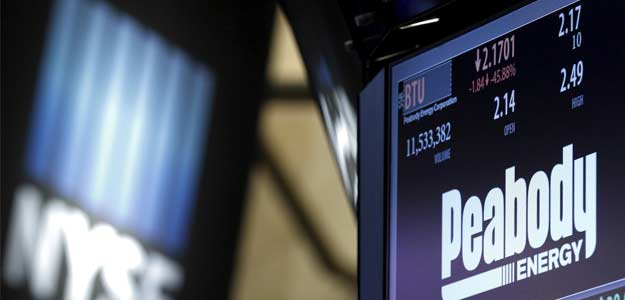
Peabody Energy Corp, the world's largest privately owned coal producer, filed for U.S. bankruptcy protection on Wednesday in the wake of a sharp fall in coal prices that left it unable to service a recent debt-fueled expansion into Australia.
The company listed both assets and liabilities in the range of $10 billion to $50 billion, according to a court filing.
The case is in the U.S. Bankruptcy Court for the Eastern District of Missouri, St. Louis, case number 16-42529.
Peabody's Chapter 11 bankruptcy filing ranks among the largest in the commodities sector since energy and metals prices began to fall in the middle of 2014 as once fast-growing markets such as China and Brazil began to slow.
"This was a difficult decision, but it is the right path forward for Peabody," Chief Executive Officer Glenn Kellow said in a statement. "This process enables us to strengthen liquidity and reduce debt, build upon the significant operational achievements we've made in recent years and lay the foundation for long-term stability and success in the future."
Peabody has secured $800 million in debtor-in-possession financing from both secured and unsecured creditors, including a $500 million term loan, $200 million bonding accommodation facility and a letter of credit worth $100 million, the company said in release.
Peabody's debt troubles date back to its $5.1 billion leveraged buyout of Australia's Macarthur in 2011, a coveted asset at the time meant to position it as a supplier of metallurgical coal for Asian steel mills.
But as demand for metallurgical coal fell, particularly in China, Peabody's financial woes intensified. It made a $700 million writedown on its Australian metallurgical coal assets last year.
At home, the miner was hit by the U.S. shale boom of the past few years that has made natural gas competitive with thermal coal, as well as by new environmental regulations by the Obama presidency that raised operational costs.
With coal-fired power generation struggling to compete on price with shale gas and new laws restricting investment in the sector, the U.S. coal industry went into an existential crisis.
Producers accounting for about 45 percent of U.S. coal output have filed for bankruptcy in the current industry downturn, based on 2014 government figures.
While coal use has also stalled globally, largely because of China's economic slowdown and its efforts to protect domestic miners and rein in rampant pollution, most analysts expect consumption of the fuel to remain stable or rise in the future.
Some 500 coal-fired power stations are currently under construction, 80 percent of which are in the Asia-Pacific region, where emerging markets as well as developed economies such as Japan and South Korea are still seeing consumption grow.
(This story has not been edited by NDTV staff and is auto-generated from a syndicated feed.)

-
Talking Points This Week: Tech Nerves, FII Buying, And A Faraway Banking Shock

The global markets are not shining this Diwali. The exception in the large markets is, India.
-
Midterm Rally Lasted A Day. The Hard Reality Of A Divided US May Last Two Years | Opinion
Between a contested AI boom, a debt ceiling that arrives in 2027 and a president with every incentive to act alone, the next two years may prove more volatile than the first day's rally suggests.
-
Blue Wave Will Derail the AI Trade but Won't Dismantle the AI Era | Unhedged Position
The Democrats' sweep of the US Congress will see politics collide with economic forces both over the long and short term.
-
It's Time To Take The GST Council's Bet On Trust Global
Payment records can prove India's services exports, and clear, proportionate rules can bring foreign digital sellers into the tax net.
-
Opinion | India at 38: From Innovation Overperformer to Innovation Powerhouse
India now has 453 VC-backed deep science startups, 18 of them late-stage, after 117 percent growth since 2020. Laurus Labs, at USD 9.3 billion, is the most valuable deep science company in any middle-income economy outside China.
-
Navigating Energy Crossroads: S Jaishankar's Call For Diversified Supply Chains At G20 Ministerial Meeting
As geopolitical fault lines continue to test maritime trade routes and commodity flows, Jaishankar's message remains pertinent: true economic resilience requires open markets, protected transit lines, and a genuine commitment to multilateral cooperation rather than coercion.
-
Indians Are Travelling, But Not Every Journey Is A Holiday | The Week In Whys
Pilgrims, patients and working women are the real travellers, and the system hasn't quite caught up with them.
-
Getting To Work Costs Women More | The Reason Why
It is not just about women paying more than men. It is about women paying much more in cities than in villages.
-
AI Bias In Investing Cannot Be Eliminated, But It Can Be Governed
Framing is a particularly important example as identical financial information presented in terms of gains rather than losses can lead an LLM to reach a different assessment.









