Paytm Free Fall: Shares Drop 30% From IPO Price
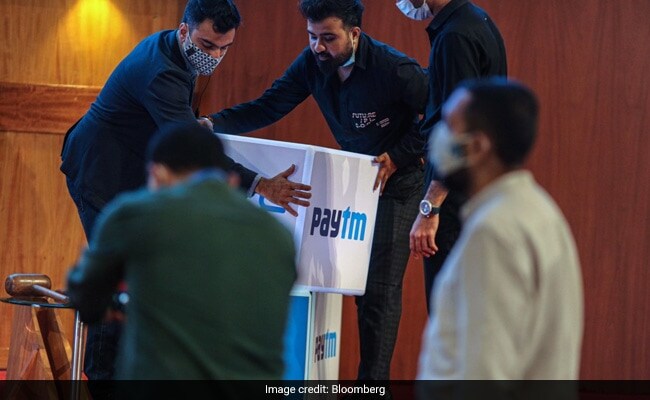
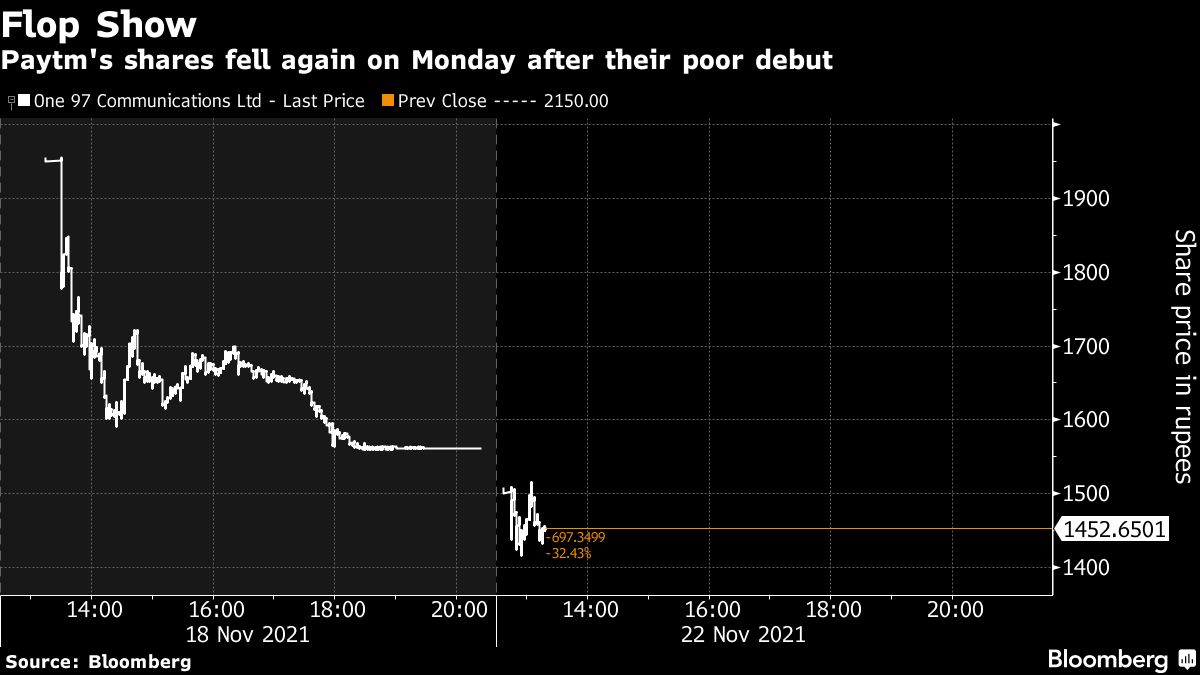
New Delhi: Shares of India's pioneering digital payments startup Paytm plummeted for a second day after its $2.5 billion initial public offering, marking one of the worst debuts ever by a major technology company.
The stock fell more than 10% on Monday after a 27% plunge in its debut Thursday. Shares have dropped more than 30% from the IPO price, hitting individual investors and global institutions such as BlackRock Inc. and the Canada Pension Plan Investment Board that had scooped up shares.
Paytm's parent company, One 97 Communications Ltd., raised a record IPO sum for India, but its disastrous trading debut sparked criticism the company and its investment bankers had pushed too hard in the offering. Founder and Chief Executive Officer Vijay Shekhar Sharma had persistently made clear that he wanted Paytm to surpass the long-standing IPO record set by Coal India Ltd. in 2010. Indian markets were shut Friday for a holiday.
“Investors should wait a bit for the stock to settle down,” said Mohit Nigam, a fund manager with Hem Securities Ltd. “There is too much volatility and pessimism in the stock.”
Over the weekend, Paytm released financial details for the month of October, which includes the critical period ahead of the Diwali holiday. Gross merchandise value rose 131% to Rs 83,200 crore ($11.2 billion) for the month, the company said. Loan disbursals, which analysts see as key to Paytm turning profitable, increased more than 400% to Rs 627 crore.
The stumble by India's largest digital-payments provider may chill India's stock-market boom, which had ranked among the world's most frenzied. The IPO had been touted by some as a symbol of the country's growing appeal as a destination for global capital, particularly for investors looking for alternatives to China.
Paytm's IPO was managed by leading banks, including Morgan Stanley, Goldman Sachs Group Inc., JPMorgan Chase & Co., ICICI Securities Ltd. and Axis Capital Holdings Ltd. They all either declined to comment or didn't respond to requests for comment.
Critics have questioned Paytm's prospects in recent months. While sales at its core payments and financial-services arm rose 11% in the year ended in March, overall revenue dropped 10% amid intensifying competition, the company reported in July.
Even before trading began, Macquarie Capital Securities (India) Pvt. Ltd. slapped the company with an initial “underperform” rating and a price target of Rs 1,200, 44% lower than the IPO price.
“Considering Paytm's heavily cash-burning business model, no clear path to profitability, large regulatory risks to the business and questionable corporate governance, we believe the company is overvalued at the upper end of price band of Rs 2,150,” analysts Suresh Ganapathy and Param Subramanian wrote in the note.
Others see promise in the Paytm model if it builds on its expanding customer base.
“Paytm is a strong company technology wise but they need to expand into finance side of the fintech business,” said Deven Choksey, a strategist at KRChoksey Investment Managers Pvt. “Just focusing on technology will not work.”
CEO Sharma has defended the company's prospects. He rallied employees during a four-hour town hall and encouraged them to look past the first-day drop, according to employees who participated.
Sharma invoked Elon Musk and Tesla Inc., reminding employees that the electric vehicle maker's stock used to be the among the most-shorted in the world. But the company overcame years of struggle to become one of the most recognized brands globally, he said.
The slump is “no indicator of the value of our company,” the 43-year-old said in an interview with Bloomberg News on Thursday. “We are in it for the long haul. We'll put our heads down and execute.”

-
Unhedged Position: Can India See An Indonesia-Style Time Correction?

The Nifty is trading below levels it first clocked in 2024. Is there, then, as I have suggested in the headline, potential that the current time correction drags on painfully for the next three-five, even ten years?
-
Navigating Friction And Energy Realities: An Analysis Of Marco Rubio's October Visit To India
Occurring at a critical juncture marked by stalled trade negotiations and escalating geopolitical pressures over global energy supplies, the visit offers a profound window into modern US-India relations.
-
India Exports Capital. Why Not Export Trusteeship?
The big question, then, is whether India can build an institution that global borrowers, investors, banks, and lawyers can trust, even without an Indian connection.
-
France's Economy & Politics Are In Crisis | The Reason Why
Let's look at how the French economy and politics evolved under Nicolas Sarkozy, Franois Hollande and Emmanuel Macron.
-
You May Inherit The Business. You Must Earn Its Credibility.
Succession tests the founder's ability to share authority as much as it tests the next generation's readiness to assume it.
-
Signing Deals Is One Thing; Making Them Work Is Another | The Week In Whys
Sometimes, things don't turn out as planned. Indian companies have lost some bids to rivals, some projects won't produce until 2030.
-
FOMC Wall, PERM Suspension, Hospital Stocks | Talking Points This Week
A PERM suspension would directly affect green-card sponsorship rather than H-1B visas, so the near-term earnings impact could remain relatively limited. The key question is whether this marks a new phase in US scrutiny of Indian IT.
-
Everything, Everywhere, All At Once: Dalal Street's Week To Forget | Joining The Dots
Visa curbs, a Starlink spat and cancer drug caps: what connects this week's shocks for Indian markets
-
India Is Going Abroad For Critical Minerals. But It May Take Years To Pay Off | The Reason Why
Although India's steps are in the right direction, they remain modest compared with India's growing dependence.
-
When Everyone Has AI, What Gives You An Edge?
India's young workforce is entering an uncertain world of work where powerful AI tools are becoming widely accessible. The advantage will belong to those who combine deep expertise with digital fluency, and the distinctly human capabilities that technology cannot manufacture.