Opinion: "Tulipmania Meets The Real Economy At WhatsApp Speed"

With the cryptocurrency world's luminaries having joined globetrotting elites at Davos — and punters swept up in the market crash suffering sleepless nights — it's time for regulators to reflect on the real-world impact of the next boom-and-bust crypto cycle.
Fintech and crypto apps have already expanded rapidly into digital cash, loans and complex products that can seem as simple as a credit card in e-mail form. That has created financial channels far beyond a one-way wager on Bitcoin or Bored Apes: Decentralized-finance (DeFi) platforms offer crypto yields of 8%-10% to investors; some then in turn fund startups around the world without touching banks. Tulipmania meets the real economy at WhatsApp speed.
In these times of market stress, rewards revealing themselves to be unsustainable have given way to a messy cascade of losses — highlighting the immense challenge facing policy makers, some of whom concede they've dropped the ball on crypto.
Crypto funds are currently being yanked from lending platforms, even those backed by real-world assets. One project offering 8% yields on tokenized debt issued by French payday lender Bling has been hit with “massive” redemptions in excess of its available cash and a credit line from venture-capital backers. For one investor I spoke to, that means potentially waiting months to get his money back. His main motivation for investing in the first place was free token rewards that have since evaporated.
Meanwhile, at the other end of the chain, lending for the end-consumer has also hit a brick wall. Bling suspended its cash-advance service in April, as regulators cracked down on the sector. One consumer-advocacy group estimated the cost of Bling's instant one-month advance as equivalent to a 128% annualized interest rate when including fees.
A small collateral-backed project like this rushing to sell assets is obviously nothing on the scale of the $60 billion Terra collapse, which has seen desperate Koreans beat a path to founder Do Kwon's door. But it does show why regulators are nervous about future risks to the financial system.
Those free rewards and high returns are reeling in people who might be least able to afford it. European Central Bank data shows crypto ownership is a U-shaped affair, with top and bottom-income households more likely to own crypto than those in the middle.
Links with the financial system are growing as venture funds and banks seek to capitalize on crypto's disruptive potential — Societe Generale SA has been tinkering with DeFi loans while others are launching stablecoins. “There is a very broad sense within the investor community that one has to dip one's toes,” says economist Eswar Prasad, author of “The Future of Money.”
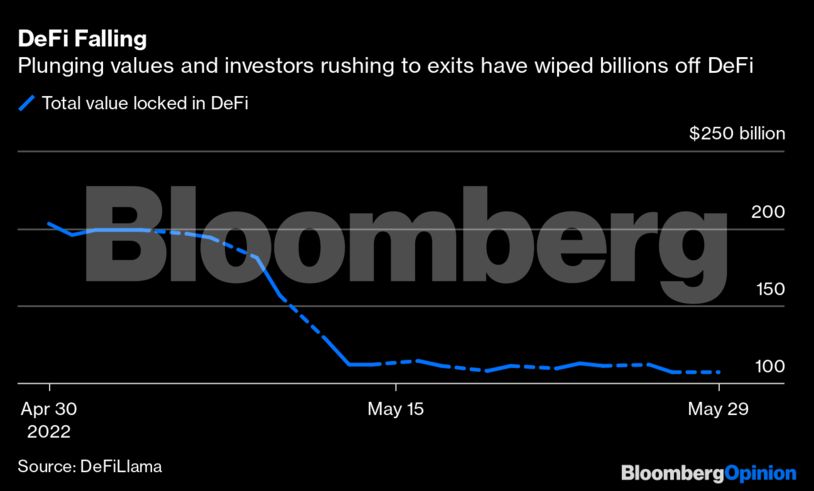
Crypto markets today are modest in size — the current total value locked in DeFi is around $100 billion, or about one-sixth of total venture-capital investing last year — but what might a dozen crypto lending blowups look like in the future if the sector keeps growing? A race to sell assets to meet crypto redemptions could have huge spillover effects, especially if managed algorithmically via smart contracts. Parallels with the subprime mortgage market that triggered a global financial meltdown in 2008 are being drawn more frequently.
“Although the risks are currently small, they could rise significantly if platforms started to offer services to the real economy, instead of remaining confined to the crypto universe,” the ECB said last week, noting that crypto credit on DeFi platforms grew by a factor of 14 in 2021.
The founders and financiers behind DeFi platforms such as Centrifuge or Goldfinch say that serving real-world businesses is still a good-news story for crypto. Algorithmically managing projects and cutting paper-shuffling means unlocking efficiency gains and access to capital, they argue, and builds useful infrastructure in the way past market bubbles built railroads and the internet.
Perhaps. But these are also bank-like activities that could do with more bank-like oversight. They often involve complex financial structures stringing together several Delaware-based LLCs with little legal recourse and high counterparty risk. And they're part of a broader explsoive proliferation of fintech lending that has yet to be properly tested in a downturn. Rather than a high-speed train, this can look more like “shadow banking squared,” says fintech investor Peter Lugli.
Expect some of this activity to be dragged more into the light as a result of institutional and regulatory focus: Maybe the next step is that the likes of Bling will behave more like regular banks and DeFi lending platforms will feature more centralized big-name funds doing due diligence. But given the way animal spirits have a tendency to return, regulators will know managing the risks will only get harder from here.
(Except for the headline, this story has not been edited by NDTV staff and is published from a syndicated feed.)

-
Ten Things I Learnt This Samvat

Patience can be a trap. Cheap stocks can stay cheap. Leverage can wipe you out. What did Samvat 2082 teach us? Niraj Shah writes on 10 lessons from the year gone by.
-
Talking Points This Week: Tech Nerves, FII Buying, And A Faraway Banking Shock
The global markets are not shining this Diwali. The exception in the large markets is, India.
-
Midterm Rally Lasted A Day. The Hard Reality Of A Divided US May Last Two Years | Opinion
Between a contested AI boom, a debt ceiling that arrives in 2027 and a president with every incentive to act alone, the next two years may prove more volatile than the first day's rally suggests.
-
Blue Wave Will Derail the AI Trade but Won't Dismantle the AI Era | Unhedged Position
The Democrats' sweep of the US Congress will see politics collide with economic forces both over the long and short term.
-
It's Time To Take The GST Council's Bet On Trust Global
Payment records can prove India's services exports, and clear, proportionate rules can bring foreign digital sellers into the tax net.
-
Opinion | India at 38: From Innovation Overperformer to Innovation Powerhouse
India now has 453 VC-backed deep science startups, 18 of them late-stage, after 117 percent growth since 2020. Laurus Labs, at USD 9.3 billion, is the most valuable deep science company in any middle-income economy outside China.
-
Navigating Energy Crossroads: S Jaishankar's Call For Diversified Supply Chains At G20 Ministerial Meeting
As geopolitical fault lines continue to test maritime trade routes and commodity flows, Jaishankar's message remains pertinent: true economic resilience requires open markets, protected transit lines, and a genuine commitment to multilateral cooperation rather than coercion.
-
Indians Are Travelling, But Not Every Journey Is A Holiday | The Week In Whys
Pilgrims, patients and working women are the real travellers, and the system hasn't quite caught up with them.
-
Getting To Work Costs Women More | The Reason Why
It is not just about women paying more than men. It is about women paying much more in cities than in villages.