Opinion: This Crypto Winter Will Be Long, Doesn't Bother Believers Though

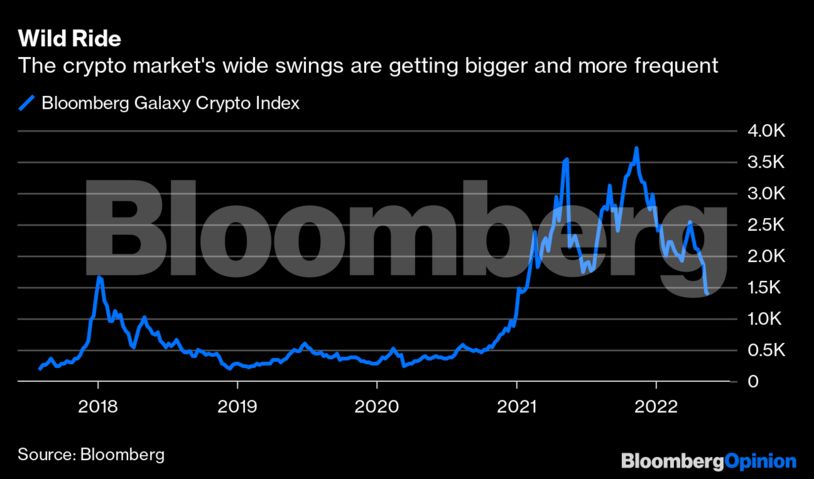
Bitcoin and other cryptocurrency assets are notoriously volatile, routinely suffering large drops of 50% or more. This doesn't seem to bother the diehard believers in crypto too much, who have become used to declines of this magnitude. They simply use the declines to buy more. Even so, there are still a lot of people in the space who remember “crypto winter,” the period between early 2018 and mid-2020 when prices went down and stayed down, and much of the innovation in crypto came to a halt.
So, the question is: What do we make of the recent gyrations in the space, with the Bloomberg Galaxy Crypto Index down some 60% from its peak in early November? Does this mark the beginning of a new, long winter after a short spring or is it just a pause that refreshes? Although the selloff in crypto may not be as big as others in its history, it feels worse because the market has grown so big -- to the trillions of dollars in size. The damage in crypto has been broad, with hundreds of coins having plunged by some 90%. Bitcoin, the biggest and most well-known of the cryptocurrencies, hasn't done as bad, but is still down a painful 56% from the peak.
At the top of the bull market last year, there was a lot of hubris, laser eyes, CryptoPunk avatars and rude behavior to go along with over-the-top Bitcoin conferences. All of it was a sign of the tough times to comes. Untold numbers of crypto skeptics ended up at the bottom of a Twitter dogpile for suggesting the bull market had bubble-like characteristics. A speaker at a recent conference I hosted was a former Ethereum miner. He talked about crypto winter, and in the midst of the carnage, he bet pretty much every last dollar he had that crypto would rebound, buying more and more GPUs to mine Ethereum when prices rose. They eventually did, but tellingly, he is no longer in the Ethereum mining business, repurposing his equipment into cloud storage.
Most smart people agree the blockchain technology underpinning cryptocurrencies has huge potential, though we don't really know what it will look like ten years from now. The venture capitalists believe it, and they've been making numerous Web3 (decentralized internet) investments and receiving tokens in return. Vast fortunes have been made in non-fungible tokens, or NFTs. But the value of all these assets has been decimated over the last few months.
If you think about the normal cycle of tech investing, the dot-com bust that started in 2000 and ended in late 2002 deterred venture capital investment for almost a decade, to the point where their best ideas were FarmVille and weird cleantech ventures. The big VC firms raised a lot of money for crypto in the last year, and the returns are going to be abysmal for a long time. That is normal. Whenever an asset generates no cash flow and no earnings, valuation is all based on confidence. Sometimes we feel good about these assets and other times we feel bad. You are seeing this play out right now in the stock market. The stocks that have been hit the hardest are the ones without any fundamental underpinnings. This is what makes investing in crypto so risky.
In previous crypto bear markets, people wondered if Bitcoin would rebound. Now, they wonder out loud about the future of blockchain in general. There should be no question about the unlimited potential of this technology. If you own a basket of crypto today, like I do, it will probably be worth much more in the future. But how much more and when is the question that nobody can answer. Crypto will have another winter, but out of that neglect will grow another bull market, led by a handful of cryptocurrencies that will grow to far beyond what exists today.
Sometimes confidence disappears for a while, but it always comes back. Maybe instead of Web3 and NFTs, it will be a different technology that captures the imagination. It is worth pointing out, though, that many survivors of the dot-com bust went on to be spectacular winners, including Amazon, Facebook and Google — and even eBay. The capital markets are a giant sorting machine, filtering out the bad ideas and rewarding the good ones. So, when people ask whether crypto will come back, the answer is yes, absolutely it will come back, but 98% of it won't.

-
Where You Live Shapes How You Get To Work | The Reason Why

Two-wheelers are the most popular way to get to work in India, accounting for nearly 43% of workplace commutes.
-
High US Salaries, No Green Card Certainty: The Financial Calculation Facing Indian H-1B Families
The suspension of PERM processing at eight technology employers does not cancel existing H-1B visas. What it does is force a question many Indian families have been avoiding: is the US salary worth tying your career and family plans to one employer?
-
Unhedged Position: Can India See An Indonesia-Style Time Correction?
The Nifty is trading below levels it first clocked in 2024. Is there, then, as I have suggested in the headline, potential that the current time correction drags on painfully for the next three-five, even ten years?
-
Navigating Friction And Energy Realities: An Analysis Of Marco Rubio's October Visit To India
Occurring at a critical juncture marked by stalled trade negotiations and escalating geopolitical pressures over global energy supplies, the visit offers a profound window into modern US-India relations.
-
India Exports Capital. Why Not Export Trusteeship?
The big question, then, is whether India can build an institution that global borrowers, investors, banks, and lawyers can trust, even without an Indian connection.
-
France's Economy & Politics Are In Crisis | The Reason Why
Let's look at how the French economy and politics evolved under Nicolas Sarkozy, Franois Hollande and Emmanuel Macron.
-
You May Inherit The Business. You Must Earn Its Credibility.
Succession tests the founder's ability to share authority as much as it tests the next generation's readiness to assume it.
-
Signing Deals Is One Thing; Making Them Work Is Another | The Week In Whys
Sometimes, things don't turn out as planned. Indian companies have lost some bids to rivals, some projects won't produce until 2030.
-
FOMC Wall, PERM Suspension, Hospital Stocks | Talking Points This Week
A PERM suspension would directly affect green-card sponsorship rather than H-1B visas, so the near-term earnings impact could remain relatively limited. The key question is whether this marks a new phase in US scrutiny of Indian IT.
-
Everything, Everywhere, All At Once: Dalal Street's Week To Forget | Joining The Dots
Visa curbs, a Starlink spat and cancer drug caps: what connects this week's shocks for Indian markets