Opinion: Paytm's Mega IPO And What World's Top Asset Manager Sees In It
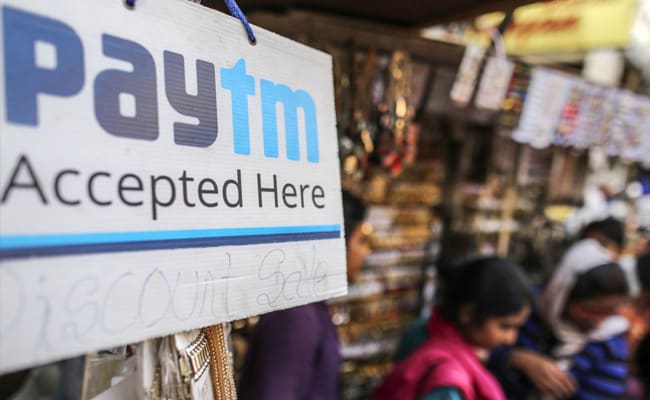
What exactly do the likes of BlackRock Inc. and Canada Pension Plan Investment Board see in the unprofitable Indian payments startup heading for the country's biggest-ever initial public offering? A simple answer: the raw power of data.
Paytm, formally known as One97 Communications Ltd., has signed up BlackRock, the world's largest asset manager, and CPPIB together with the sovereign wealth funds of Singapore and Abu Dhabi as anchor investors for next week's 183 billion rupee ($2.46 billion) IPO. The $1.1 billion sale to cornerstone investors saw more than 10 times as much demand as shares on offer, according to Bloomberg News.
The Indian online-payment pioneer had tremendous novelty value five years ago. When Prime Minister Narendra Modi suddenly immobilized 86% of the country's currency in November 2016 in a failed bid to freeze out ill-gotten cash, the fledgling app, whose name is shorthand for “pay through mobile,” won millions of new customers overnight. Founder Vijay Shekhar Sharma couldn't hide his glee. Warren Buffett's Berkshire Hathaway Inc. joined Masayoshi Son's SoftBank Group Corp. and Alibaba Group Holding Ltd. as investors in the startup.
That was then. India's technology landscape has evolved so rapidly since 2016 that most businesses nowadays pay next to nothing for receiving customer payments over smartphones. And the pricing pressure isn't going to ease, except that merchants will want to pay less even for add-on services, such as reconciling accounts and handling returns and refunds.
Back when it didn't have today's 57 million unique monthly users, Paytm incurred 162 rupees in direct costs — not counting overheads like salaries and brand-building — to garner 100 rupees of revenue. Of that, 70 rupees went toward processing payments and another 86 rupees were spent on cash-backs and other enticements. “You cannot have a business that says, ‘Pay a 500 rupees bill and take 250 rupees cash-back,''' Aditya Puri, the then-chief executive of HDFC Bank Ltd., India's largest lender by market value, said in 2017, adding that e-wallets have no future.
In its most recent quarter, however, Paytm ended up with a 27 rupees surplus on the same 100 rupees revenue. Thanks to additional overheads, it's not yet a profit — but it's getting closer. HDFC Bank is now a partner of Paytm.
The economics are improving, even though phone wallets have become a commodity. The underlying technology, which Paytm uses to compete against Alphabet Inc.'s Google Pay and Walmart Inc.'s PhonePe, is a shared utility anyone can commercialize. So while Paytm handles the equivalent of nearly $80 billion of payments annually to 22 million merchants, its “take rate” for translating transactions to revenue is just 0.6%.
But it's this very competitive nature of the payments game that encourages more merchants in small cities and towns to accept cashless instruments, bypassing expensive cards and contactless systems like PayPal Holdings Inc., which has left the Indian domestic scene entirely.
(Except for the headline, this story has not been edited by NDTV staff and is published from a syndicated feed.)

-
Navigating Friction And Energy Realities: An Analysis Of Marco Rubio's October Visit To India

Occurring at a critical juncture marked by stalled trade negotiations and escalating geopolitical pressures over global energy supplies, the visit offers a profound window into modern US-India relations.
-
India Exports Capital. Why Not Export Trusteeship?
The big question, then, is whether India can build an institution that global borrowers, investors, banks, and lawyers can trust, even without an Indian connection.
-
France's Economy & Politics Are In Crisis | The Reason Why
Let's look at how the French economy and politics evolved under Nicolas Sarkozy, Franois Hollande and Emmanuel Macron.
-
You May Inherit The Business. You Must Earn Its Credibility.
Succession tests the founder's ability to share authority as much as it tests the next generation's readiness to assume it.
-
Signing Deals Is One Thing; Making Them Work Is Another | The Week In Whys
Sometimes, things don't turn out as planned. Indian companies have lost some bids to rivals, some projects won't produce until 2030.
-
FOMC Wall, PERM Suspension, Hospital Stocks | Talking Points This Week
A PERM suspension would directly affect green-card sponsorship rather than H-1B visas, so the near-term earnings impact could remain relatively limited. The key question is whether this marks a new phase in US scrutiny of Indian IT.
-
Everything, Everywhere, All At Once: Dalal Street's Week To Forget | Joining The Dots
Visa curbs, a Starlink spat and cancer drug caps: what connects this week's shocks for Indian markets
-
India Is Going Abroad For Critical Minerals. But It May Take Years To Pay Off | The Reason Why
Although India's steps are in the right direction, they remain modest compared with India's growing dependence.
-
When Everyone Has AI, What Gives You An Edge?
India's young workforce is entering an uncertain world of work where powerful AI tools are becoming widely accessible. The advantage will belong to those who combine deep expertise with digital fluency, and the distinctly human capabilities that technology cannot manufacture.
-
Wrong Labels, High Pesticide Residues Holding Back Agri Exports | The Reason Why
India needs stronger domestic food-safety and labelling standards, with best practices becoming part of everyday business for farmers, traders and food companies.










