Indian Economy, Worst In 42 Years, Needs An Honest Look
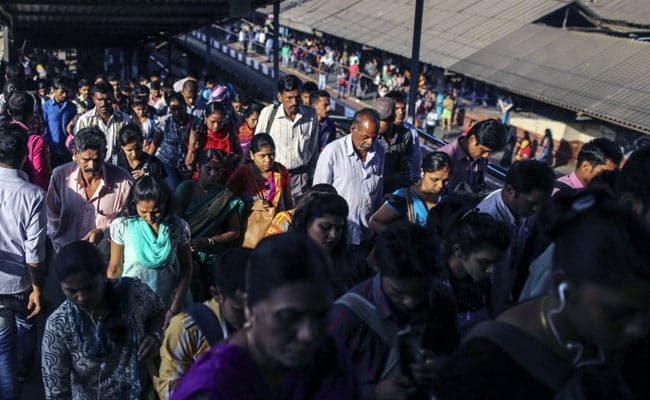
India's economy hasn't been this bad in 42 years. Pulling it back from the abyss will require more honesty than imagination.
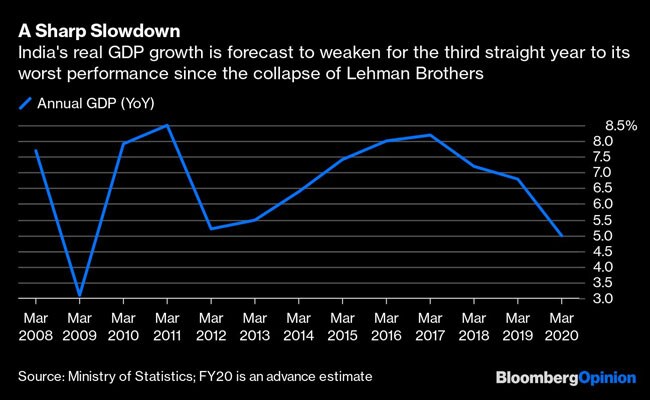
Tuesday's advance estimates for the financial year ending on March 31 peg the economy's inflation-adjusted growth rate at 5 per cent, a third year of slowdown. And even this figure could be optimistic. Consumer demand is in the doldrums and government spending - the only thing supporting growth - is bound to be pruned in the closing months of the fiscal year to avoid a budget blowout.
So much for the real economy. The main function of these advance statistics is to aid the upcoming government budget, which requires a handle on nominal GDP. By that measure, not only is the current fiscal year's 7.5 per cent growth the worst since 1978, it's substantially lower than the 12 per cent expansion the government had penciled in when projecting taxes. Needless to say, those revenue calculations have gone out of the window.
A dose of realism is called for. When Prime Minister Narendra Modi's government returned to power in 2019, it made rosy projections for public finances by completely glossing over the previous year's shortfall in tax revenue equal to 1 per cent of GDP. Any repeat of such machinations in the February 1 budget won't go down well with investors.
More well-grounded tax assumptions will reveal a big resource gap - closer perhaps to 5 per cent of GDP, including borrowings not captured in the budget but whose burden falls on the taxpayer nonetheless. State governments have a deficit equal to 3 per cent of GDP, higher than the budgeted 2.6 per cent. Add that, and the financial savings of India's households are almost fully spoken for. No wonder Indian corporate borrowers are making a beeline for overseas debt markets.
Even borrowing abroad, which hit a new record of $22 billion last year, will become costlier should India's sovereign rating fall one run into junk territory. S&P Global Ratings warned last month that it might cut India's ratings if economic growth doesn't recover. A shallow recovery will probably only show up in the second half of the fiscal year that starts in April. Meanwhile, should the recent escalation of US-Iran tensions sustain oil prices at a high level in a weakening global economy, the loss of discretionary consumer spending at home and abroad could hurt India further.
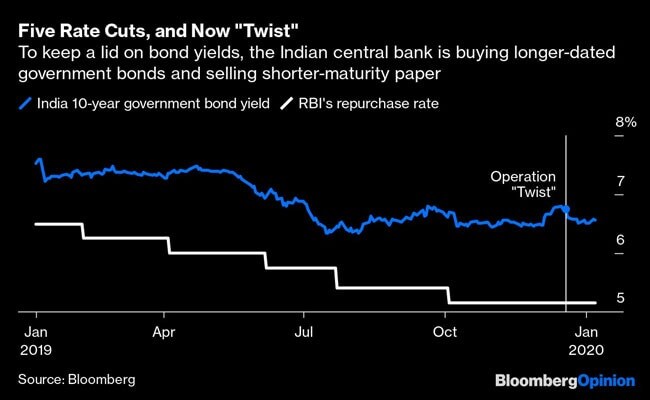
The Reserve Bank of India (RBI) is "twisting" its balance sheet - selling short-term government bonds to banks and buying long-term securities from them - to keep a lid on the benchmark 10-year bond yield. But this support may not be enough for the government's five-year, $1.5 trillion infrastructure plan, which will rely heavily on public funding.
So what's to be done? I've suggested that the central bank should purchase assets from the non-bank financial sector, which will help shadow financiers deal with their large overhang of bad loans and open up the clogged funding arteries of the economy. Tuesday's terrible nominal GDP growth figure should buttress the argument for this kind of quantitative easing.
But while the monetary authority should dare to be unconventional, the most creative tool in the government's possession - the Excel spreadsheet - won't help much. In fact, a badly needed overhaul of the broken goods-and-services tax can't even be attempted in the federal budget. It will require tough political bargaining with state governments, which share the proceeds.
Since its introduction in 2017, the GST has subsumed many of the country's indirect taxes, but it has several design flaws and compliance is both poor and expensive for small firms. According to IDFC Mutual Fund, GST collections this fiscal year may grow only 4 per cent. That's even slower than nominal GDP. A budget that papers over the very real fiscal constraints to paint a picture of business as usual will do a disservice to the task. A sober acknowledgement of the challenges is the first step toward a fix.
(Andy Mukherjee is a Bloomberg Opinion columnist covering industrial companies and financial services. He previously was a columnist for Reuters Breakingviews. He has also worked for the Straits Times, ET NOW and Bloomberg News.)
Disclaimer: The opinions expressed within this article are the personal opinions of the author. The facts and opinions appearing in the article do not reflect the views of NDTV and NDTV does not assume any responsibility or liability for the same.

-
High US Salaries, No Green Card Certainty: The Financial Calculation Facing Indian H-1B Families

The suspension of PERM processing at eight technology employers does not cancel existing H-1B visas. What it does is force a question many Indian families have been avoiding: is the US salary worth tying your career and family plans to one employer?
-
Swiggy vs Eternal: Food Delivery's Two Rivals Are No Longer In The Same Race
Eternal is building a private AI assistant, dark.ai. Swiggy is still working out how to make Instamart pay, with an operating loss of Rs 895 crore in the July-September quarter while Blinkit stayed profitable.
-
Where You Live Shapes How You Get To Work | The Reason Why
Two-wheelers are the most popular way to get to work in India, accounting for nearly 43% of workplace commutes.
-
Unhedged Position: Can India See An Indonesia-Style Time Correction?
The Nifty is trading below levels it first clocked in 2024. Is there, then, as I have suggested in the headline, potential that the current time correction drags on painfully for the next three-five, even ten years?
-
Navigating Friction And Energy Realities: An Analysis Of Marco Rubio's October Visit To India
Occurring at a critical juncture marked by stalled trade negotiations and escalating geopolitical pressures over global energy supplies, the visit offers a profound window into modern US-India relations.
-
India Exports Capital. Why Not Export Trusteeship?
The big question, then, is whether India can build an institution that global borrowers, investors, banks, and lawyers can trust, even without an Indian connection.
-
France's Economy & Politics Are In Crisis | The Reason Why
Let's look at how the French economy and politics evolved under Nicolas Sarkozy, Franois Hollande and Emmanuel Macron.
-
You May Inherit The Business. You Must Earn Its Credibility.
Succession tests the founder's ability to share authority as much as it tests the next generation's readiness to assume it.
-
Signing Deals Is One Thing; Making Them Work Is Another | The Week In Whys
Sometimes, things don't turn out as planned. Indian companies have lost some bids to rivals, some projects won't produce until 2030.
-
FOMC Wall, PERM Suspension, Hospital Stocks | Talking Points This Week
A PERM suspension would directly affect green-card sponsorship rather than H-1B visas, so the near-term earnings impact could remain relatively limited. The key question is whether this marks a new phase in US scrutiny of Indian IT.









