Only Five Large Banks Can Survive In The Long-Term: Uday Kotak
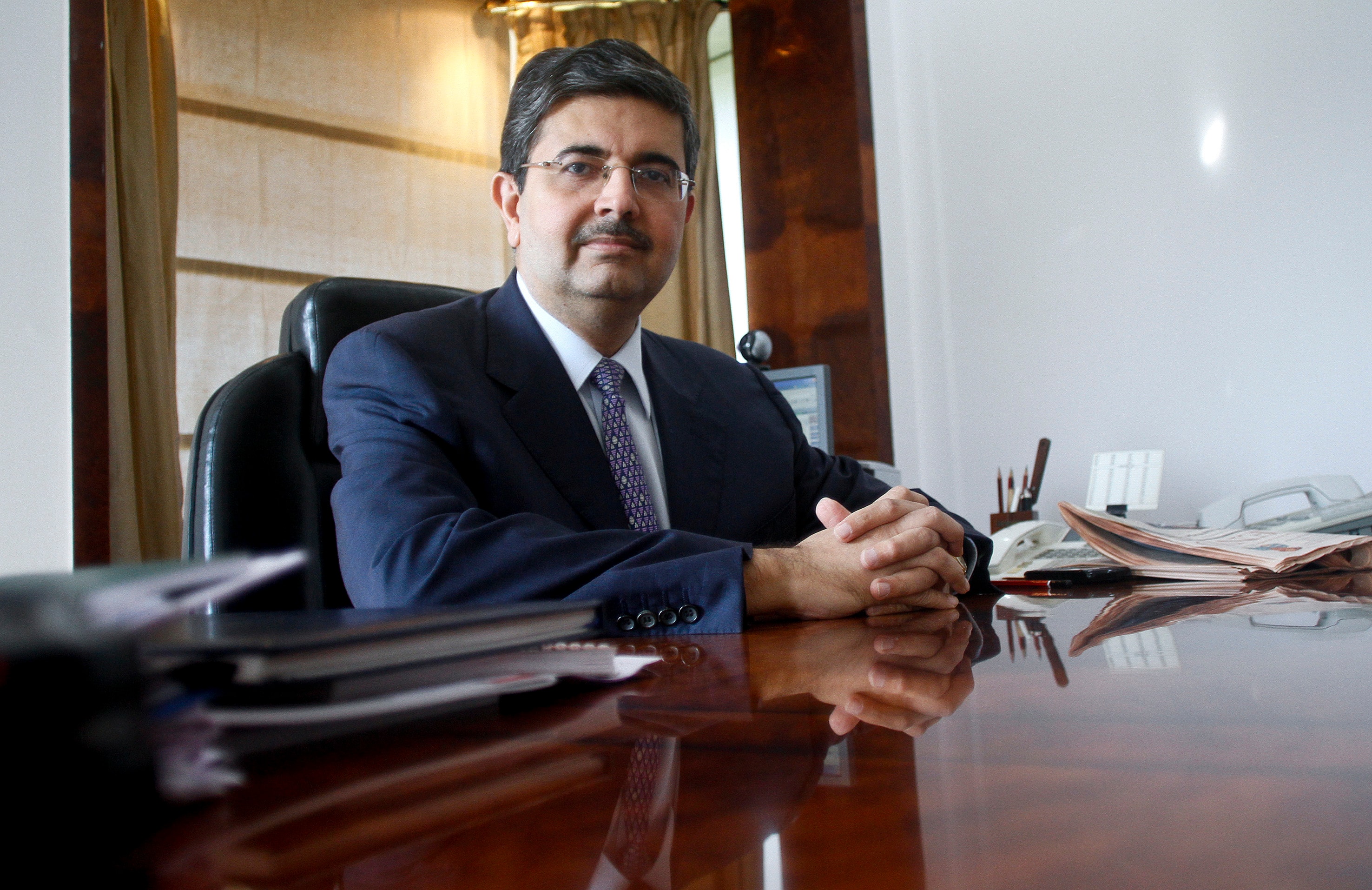
Banker Uday Kotak expects strong consolidation in the financial services sector and says eventually only five players will dominate the space, as is the case globally.
"Globally, in most countries, there are only three to five large banks which dominate. This is how the future will be in our country as well," Kotak, vice-chairman of Kotak Mahindra Bank, told PTI in an interview over the weekend.
India will be no exception to this global trend of having a few dominating players, he added.
Kotak declined to specify the names of the banks which will dominate the domestic banking space, but said State Bank of India will be one among them.
"The rest who knows? Can't say anything about ourselves but each of us will have to do our bit to get ourselves onto the high table. You just can't take it for granted," he said.
Also Read: A Few Healthy Banks Better Than Many Weak Ones, Says Vinod Rai
Kotak, whose bank is widely speculated to be interested in buyouts, acknowledged that consolidation is something his bank is interested in.
"We are open to change that is bold and that can be game-changing in the financial services industry," he said, but quickly added that there is nothing to announce now.
The board of the bank last week decided to raise over Rs 5,300 crore by diluting 3.3 per cent of the promoters holding, for pursuing a host of opportunities, including consolidation.
When asked if his bank which completed an integration with ING Vysya Bank, is ready for another such exercise, Kotak replied in the positive.
Do you think we are fatigued? We are alive and kicking, and have learnt a lot from the merger. That does not mean we are rushing into a merger but we are always open and keep our eyes and ears open for consolidation.Uday Kotak, Executive Vice Chairman and Managing Director, Kotak Mahindra Bank
Also Read: No Acquisitions On The Anvil, Says Uday Kotak
He said the share of private sector lenders should eventually grow beyond the present 25 per cent or thereabout.
"Competition may be from government banks, new players. You have to be alert, agile and paranoid," he said.
Kotak also made a strong pitch for having norms on "bank mortality", underlining that not all the players who enter due to liberal rules can't make it commercially, and should thus be given exit options.
"That is a big issue. Who is thinking about mortality in banking? We have to see in the long-term how it happens. As you make entry easier, mortality always have to be thought about," Kotak said.
When asked about if e-wallets will succeed, Kotak said, "to some of those models, you need to ask the question- how will you get stickiness and ultimately monetise?" Advocating a faster push on growth, Kotak said he is getting the vibes of an uptick in growth.
"Macroeconomic stability, now combined with political stability, is a very big plus for the country to embark faster on the growth side. This is our opportunity," he said.
When pointed to the continuing reluctance of private sector to invest since the past three years now, Kotak said, "we need to be bold and get the animal spirits back. We will get it back, people should feel excited to invest." He said a newer breed of entrepreneurs will emerge and the "historical Lalas" will change.
On whether government can meet divestment targets and if the markets will continue to rally, he said the present bullishness in the capital markets will help government achieve the aggressive divestment plans in fiscal 2018.
On his expectations from the forthcoming monetary policy review, Kotak said he expects the apex bank to go in for a status quo at the next week's review.
Also Read: SBI Merger Good First Step; Scope For More Consolidation, Says KV Kamath

-
Unhedged Position: Can India See An Indonesia-Style Time Correction?

The Nifty is trading below levels it first clocked in 2024. Is there, then, as I have suggested in the headline, potential that the current time correction drags on painfully for the next three-five, even ten years?
-
Navigating Friction And Energy Realities: An Analysis Of Marco Rubio's October Visit To India
Occurring at a critical juncture marked by stalled trade negotiations and escalating geopolitical pressures over global energy supplies, the visit offers a profound window into modern US-India relations.
-
India Exports Capital. Why Not Export Trusteeship?
The big question, then, is whether India can build an institution that global borrowers, investors, banks, and lawyers can trust, even without an Indian connection.
-
France's Economy & Politics Are In Crisis | The Reason Why
Let's look at how the French economy and politics evolved under Nicolas Sarkozy, Franois Hollande and Emmanuel Macron.
-
You May Inherit The Business. You Must Earn Its Credibility.
Succession tests the founder's ability to share authority as much as it tests the next generation's readiness to assume it.
-
Signing Deals Is One Thing; Making Them Work Is Another | The Week In Whys
Sometimes, things don't turn out as planned. Indian companies have lost some bids to rivals, some projects won't produce until 2030.
-
FOMC Wall, PERM Suspension, Hospital Stocks | Talking Points This Week
A PERM suspension would directly affect green-card sponsorship rather than H-1B visas, so the near-term earnings impact could remain relatively limited. The key question is whether this marks a new phase in US scrutiny of Indian IT.
-
Everything, Everywhere, All At Once: Dalal Street's Week To Forget | Joining The Dots
Visa curbs, a Starlink spat and cancer drug caps: what connects this week's shocks for Indian markets
-
India Is Going Abroad For Critical Minerals. But It May Take Years To Pay Off | The Reason Why
Although India's steps are in the right direction, they remain modest compared with India's growing dependence.
-
When Everyone Has AI, What Gives You An Edge?
India's young workforce is entering an uncertain world of work where powerful AI tools are becoming widely accessible. The advantage will belong to those who combine deep expertise with digital fluency, and the distinctly human capabilities that technology cannot manufacture.









