Oil Slides For Sixth Day, Longest Losing Run in 18 Months Post Fed Report
Oil fell for the sixth day in a row to the lowest level since May after the U.S. Federal Reserve on Wednesday signaled it was set to start tapering asset purchases within months. West Texas Intermediate futures ended the session down 2.7 per cent, dipping below $64 a barrel amid a broader commodity selloff as the prospect of reduced stimulus shook markets. The delta virus variant for air travel is denting demand, with enthusiasm for air travel waning in the both the U.S. and Japan. Asia's physical market is softening with muted buying from China and a move by India to sell oil from its strategic reserves.
"The dollar is seeing considerable strength as the Fed moves to cool the economy," said John Kilduff, a partner at Again Capital LLC. "Oil was already seeing downward pressure as the market reeled from softened demand coming out of China, and waning commodities appeal is encouraging the slump further."
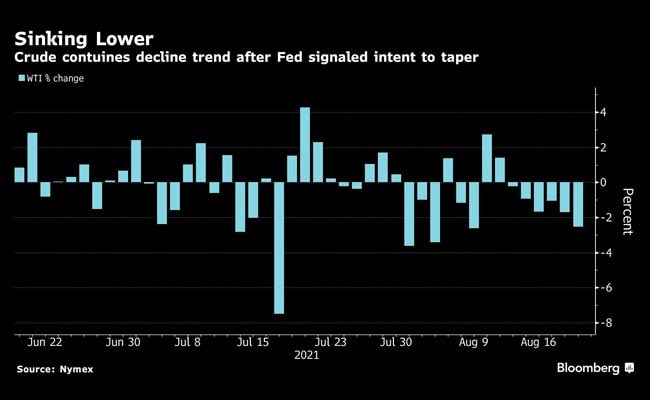
Oil's rally in the first half of the year has lost momentum since July amid the threat to demand posed by the spread of the delta variant. At the same time, OPEC+ pushed ahead with gradually restoring supplies. The combination of factors has led leading analysts to lower price forecasts for the last half of the year.
To cushion the U.S. economy from the blow inflicted by the pandemic, the Fed has been buying $120 billion of assets every month, buoying commodities. The minutes of the bank's July meeting showed a potential pullback in its monthly bond purchases, as most participants now judged it could be appropriate to start reducing the pace of stimulus.
"Economic growth concerns, stronger dollar and a risk-off environment are not helping oil," said Giovanni Staunovo, an analyst at UBS Group AG. "Demand will continue to recover in an uneven way over the coming weeks and the oil market remains under-supplied. So that should still support prices down the road."
Prices:
- WTI for September delivery fell $1.77 to settle at $63.69 a barrel in New York. It slipped as much as 4.3 per cent earlier.
- Brent for October settlement declined $1.78 to end session at $66.45 a barrel.
Road traffic remains depressed in various Southeast Asian countries as various levels of lockdowns are still in place. "Indicators for consumption coming out of the region have global influence," said Stewart Glickman, energy equity analyst at CFRA Research. "Where China goes, investors follow."
Related coverage:
- Asia's physical crude market softened this week as muted buying from China coincided with a surprise move by India to sell oil from its strategic reserves to state-run refiners.
- Barely a week after the White House called on OPEC+ to increase oil production faster, the group could be considering a very different route.
- Saudi Arabia is likely considering a pause in the next scheduled OPEC+ supply increase, according to Energy Aspects.
(Except for the headline, this story has not been edited by NDTV staff and is published from a syndicated feed.)

-
Unhedged Position: Can India See An Indonesia-Style Time Correction?

The Nifty is trading below levels it first clocked in 2024. Is there, then, as I have suggested in the headline, potential that the current time correction drags on painfully for the next three-five, even ten years?
-
Navigating Friction And Energy Realities: An Analysis Of Marco Rubio's October Visit To India
Occurring at a critical juncture marked by stalled trade negotiations and escalating geopolitical pressures over global energy supplies, the visit offers a profound window into modern US-India relations.
-
India Exports Capital. Why Not Export Trusteeship?
The big question, then, is whether India can build an institution that global borrowers, investors, banks, and lawyers can trust, even without an Indian connection.
-
France's Economy & Politics Are In Crisis | The Reason Why
Let's look at how the French economy and politics evolved under Nicolas Sarkozy, Franois Hollande and Emmanuel Macron.
-
You May Inherit The Business. You Must Earn Its Credibility.
Succession tests the founder's ability to share authority as much as it tests the next generation's readiness to assume it.
-
Signing Deals Is One Thing; Making Them Work Is Another | The Week In Whys
Sometimes, things don't turn out as planned. Indian companies have lost some bids to rivals, some projects won't produce until 2030.
-
FOMC Wall, PERM Suspension, Hospital Stocks | Talking Points This Week
A PERM suspension would directly affect green-card sponsorship rather than H-1B visas, so the near-term earnings impact could remain relatively limited. The key question is whether this marks a new phase in US scrutiny of Indian IT.
-
Everything, Everywhere, All At Once: Dalal Street's Week To Forget | Joining The Dots
Visa curbs, a Starlink spat and cancer drug caps: what connects this week's shocks for Indian markets
-
India Is Going Abroad For Critical Minerals. But It May Take Years To Pay Off | The Reason Why
Although India's steps are in the right direction, they remain modest compared with India's growing dependence.
-
When Everyone Has AI, What Gives You An Edge?
India's young workforce is entering an uncertain world of work where powerful AI tools are becoming widely accessible. The advantage will belong to those who combine deep expertise with digital fluency, and the distinctly human capabilities that technology cannot manufacture.









