Oil Refiners Set To Curb Spot Buying To Make Room For Iranian Oil

Oil refiners, anticipating a lifting of U.S. sanctions, plan to make space for the resumption of Iranian imports by reducing spot crude oil purchases in the second half of the year, company officials told Reuters. The world's third-largest oil consumer and importer halted imports from Tehran in 2019 after former U.S. President Donald Trump withdrew from a 2015 accord and re-imposed sanctions on the OPEC producer over its disputed nuclear programme. U.S. President Joe Biden's administration and Iran have been involved in indirect talks to revive the pact for Tehran to curb its nuclear activities in exchange for a lifting of sanctions.
Analysts expect Iran to ramp up crude exports to 1.5 million barrels per day in the fourth quarter when sanctions are lifted. India, used to be Iran's second-biggest oil client after China, buying as much as 480,000 bpd in the fiscal year beginning April 2018.
Several Indian state refiners, whose refineries are suited to the crude, have committed to buy Iranian oil once sanctions are lifted. State-run Bharat Petroleum Corp, which plans to tap the spot market for 45 per cent of its overall imports, will buy Iranian oil if sanctions are lifted, a company spokesman said.
High sulphur distillate-rich Iranian crude suits BPCL's Kochi refinery and costs $2-$2.5/barrel less than similar grades, he said, adding that Iran's proximity means India also has lower freight costs. Hindustan Petroleum Corporation (HPCL) also said it would buy Iranian crude if the price is right and it is suitable.
"HPCL will consider buying Iranian oil depending on techno economic suitability as and when sanctions are lifted and situations are conducive for commercial transactions," chairman M. K. Surana told Reuters. Top refiner Indian Oil Corp is also expecting to reduce spot purchases and can easily process about 2 million tonnes (14.6 million barrels) of Iranian oil this fiscal year, said a company source, who declined to be named as he is not authorised to speak to media.
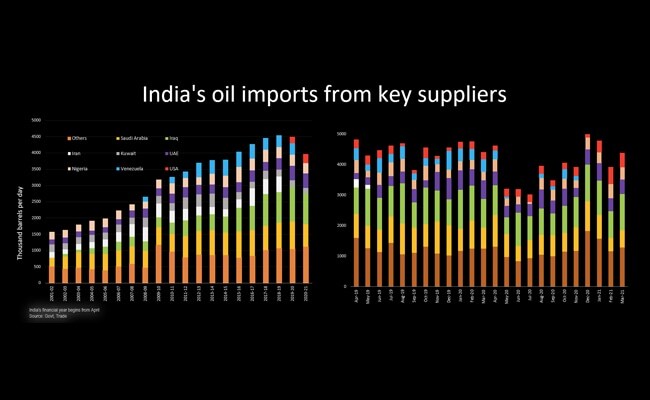
India's oil imports from key suppliers
Photo Credit: Reuters
The IOC plans to buy 56 per cent of its imports through term contracts this fiscal year. Indian refiners have raised the share of spot purchases versus term contracts to gain from cheaper barrels available in a surplus market. After the halt in Iranian oil, Indian had diversified its imports and raised its share of U.S. oil.
An official at Mangalore Refinery and Petrochemicals Ltd said his company would also cut spot purchases and buy Iranian oil.
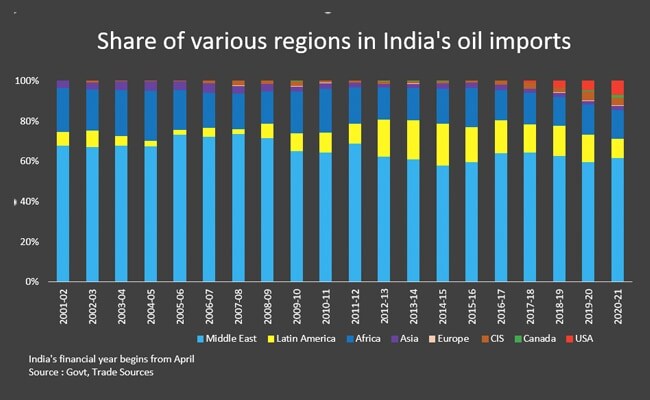
Share of various regions in India's oil imports
Photo Credit: Reuters
The resumption of Iranian oil supplies will help India replace lower supplies from Iraq and Kuwait, also members of the Organization of the Petroleum Exporting Countries, which has lowered output to support oil prices.
India's relations with OPEC's biggest member Saudi Arabia came under strain after it said the producer group's output curbs were damaging to consumers. Tensions eased this month after Saudi Arabia provided India with oxygen to help it deal with a surge in COVID-19.

-
It's Time To Take The GST Council's Bet On Trust Global

Payment records can prove India's services exports, and clear, proportionate rules can bring foreign digital sellers into the tax net.
-
Opinion | India at 38: From Innovation Overperformer to Innovation Powerhouse
India now has 453 VC-backed deep science startups, 18 of them late-stage, after 117 percent growth since 2020. Laurus Labs, at USD 9.3 billion, is the most valuable deep science company in any middle-income economy outside China.
-
Navigating Energy Crossroads: S Jaishankar's Call For Diversified Supply Chains At G20 Ministerial Meeting
As geopolitical fault lines continue to test maritime trade routes and commodity flows, Jaishankar's message remains pertinent: true economic resilience requires open markets, protected transit lines, and a genuine commitment to multilateral cooperation rather than coercion.
-
Indians Are Travelling, But Not Every Journey Is A Holiday | The Week In Whys
Pilgrims, patients and working women are the real travellers, and the system hasn't quite caught up with them.
-
Getting To Work Costs Women More | The Reason Why
It is not just about women paying more than men. It is about women paying much more in cities than in villages.
-
AI Bias In Investing Cannot Be Eliminated, But It Can Be Governed
Framing is a particularly important example as identical financial information presented in terms of gains rather than losses can lead an LLM to reach a different assessment.
-
Joining The Dots | Dark Skies, Steady Diya: Why Hope Holds This Diwali
With war, a weak rupee and foreign outflows weighing on sentiment, policymakers at the NDTV World Summit and market veterans at NDTV Profit Ignite: Diwali Edition offered the same advice: stay invested and filter out the noise.
-
The Curious Case of Equitas Small Finance Bank And A CEO Who Quit For Stock
PN Vasudevan believes persistent investor concerns over a perceived conflict of interest had become a governance overhang on Equitas Small Finance Bank's stock, even as the lender improved profitability and asset quality.
-
Talking Points This Week: AI Cash Burn, A Tiger Comeback And An India That Still Finds Its Own Path
India is not immune to higher oil or tighter global liquidity, yet its earnings base is broader, its domestic policy levers are still available.










