Nvidia Investors Balk at Beaten Down Valuation as Risks Mount
Nvidia Corp. shares are trading near their lowest valuation of the artificial intelligence era, but a growing list of perils has investors cautious about taking advantage of the dip.
The latest shock for the chipmaker came after saying last week US authorities have barred it from selling the H20 chip line in China, a move that will cost it billions of dollars. The news added to concerns that spending on AI could be poised to slow, especially as the escalating trade war further clouds overall prospects for economic growth.
“The outlook isn't as compelling as it was, and you really have to make a lot of assumptions here, about tariffs, China, hyperscalers, the macro,” said Krishna Chintalapalli, portfolio manager and tech sector head at Parnassus Investments. “Because all those things are compounding, the level of uncertainty is much higher than it has been.”
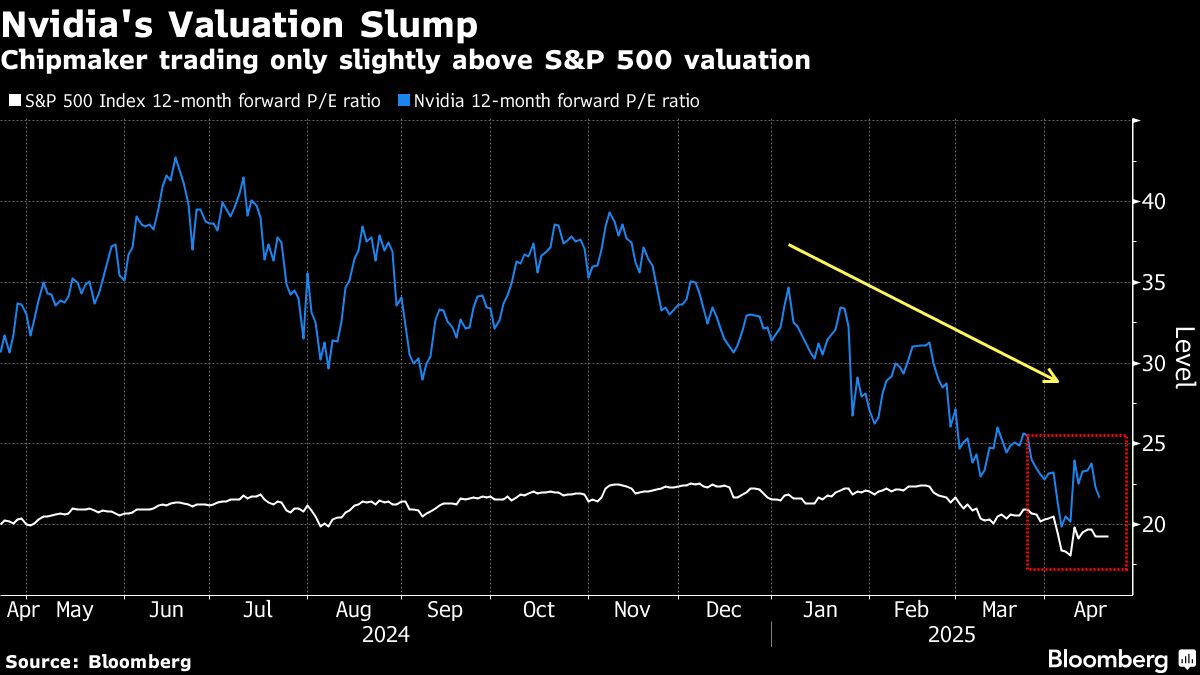
Shares of Nvidia have dropped 24% this year, roughly twice the decline of the Nasdaq 100 Index. Chintalapalli views the stock as fairly valued, even with shares trading at 22 times estimated earnings, and well below their long-term average. The valuation is not far from the S&P 500 Index's multiple of 19. The stock fell as much as 3.7% in premarket trading Monday.
(Image source: Bloomberg)
That Nvidia only trades at a slight premium to the market is notable given the company's growth is expected to be dramatically faster, with revenue seen rising 57% in the current year, compared with 4.7% for the S&P. The growth largely reflects how so-called hyperscalers — Microsoft Corp., Alphabet Inc., Amazon.com Inc., and Meta Platforms Inc., which are among Nvidia's biggest customers — have allocated tens of billions of dollars building out AI infrastructure.
“If you want to buy here, you're probably betting on hyperscaler demand for AI,” Chintalapalli said. While the intent to spend on AI is there, “they can always slow down on the margins” and “you can't make a call on the pace of investment, given the macro and tariff issues.”
Nvidia's share slump and resulting hit to valuation underline the perils the chipmaker faces from a potential slowdown in AI spending and the Trump administration's attempts to reset global trade relations. Should the trade tensions tip the economy into recession, all bets about future earnings are off, undermining the valuation case.
Downward Revisions
The analyst consensus for Nvidia's full-year earnings has dropped 1.1% over the past month, while the view for revenue is down 1%, according to data compiled by Bloomberg.
Microsoft has announced plans to pull back on data center projects, and while others such as Alphabet have maintained capital spending plans for the current year, the outlook for 2026 remains uncertain.
Investors had already been debating the outlook for AI spending, ever since China's DeepSeek emerged in January, claiming performance that is comparable to US models despite costing less and requiring fewer chips. Still, as tariff talks progress, investors are starting to see that demand for AI gear leaves Nvidia less exposed to trade risks than some of its mega cap peers.
Bloomberg Intelligence wrote earlier this month that “AI-focused players like Nvidia appear most insulated” from tariffs, while other chipmakers — especially those exposed to end markets like PCs, handsets, autos, and industrials — “will face indirect pressure via demand destruction.”
The tariff situation has been incredibly volatile. A recent reprieve on smartphones, computers and other electronics seemed to have removed an overhang from the shares, though Trump maintained the measure is temporary.
Last week, ASML Holding NV sold off after it reported first-quarter orders that were weaker than expected, and it warned it didn't know how to quantify the impact of tariffs. Separately, Taiwan Semiconductor Manufacturing Co. affirmed its outlook, suggesting demand for AI-related chips remains strong, although analysts said tariffs are a key question mark.
“Politics will remain part of the investment landscape for the foreseeable future, and the landscape will continue to evolve,” said Daniel Flax, a senior research analyst at Neuberger Berman. “This will impact many companies, including Nvidia, but I think it will continue to execute and innovate, and that will continue to drive growth. I think shares look pretty attractive if you have a 12- or 18-month time horizon.”
Long-Term Bulls
Analysts have stayed broadly positive, as nearly 90% of the firms tracked by Bloomberg recommend buying the stock. Furthermore, with shares trading more than 60% below the average analyst price target, implied returns for the stock are among the highest over the past few years.
Those who are still long-term bulls see the recent weakness as a buying opportunity.
In the short-term, “the news removes a major overhang — the stock H20 chipis more attractive today than yesterday,” Ivana Delevska, chief investment officer at SPEAR Invest said Wednesday, after Nvidia's initial dip on the H20 chip news, adding that in the long-run, Nvidia not having access to the Chinese market would be a negative.
Shana Sissel agrees that the current valuation marks a good time to buy, especially ahead of the company's late May earnings report, which she expects will show signs of Chinese customers front-loading purchases in anticipation of tariffs.
“I think it's attractive,” she said. “I'm obviously a bull on it. I've always liked Nvidia stock.”

-
Navigating Energy Crossroads: S Jaishankar's Call For Diversified Supply Chains At G20 Ministerial Meeting

As geopolitical fault lines continue to test maritime trade routes and commodity flows, Jaishankar's message remains pertinent: true economic resilience requires open markets, protected transit lines, and a genuine commitment to multilateral cooperation rather than coercion.
-
Indians Are Travelling, But Not Every Journey Is A Holiday | The Week In Whys
Pilgrims, patients and working women are the real travellers, and the system hasn't quite caught up with them.
-
Getting To Work Costs Women More | The Reason Why
It is not just about women paying more than men. It is about women paying much more in cities than in villages.
-
AI Bias In Investing Cannot Be Eliminated, But It Can Be Governed
Framing is a particularly important example as identical financial information presented in terms of gains rather than losses can lead an LLM to reach a different assessment.
-
Joining The Dots | Dark Skies, Steady Diya: Why Hope Holds This Diwali
With war, a weak rupee and foreign outflows weighing on sentiment, policymakers at the NDTV World Summit and market veterans at NDTV Profit Ignite: Diwali Edition offered the same advice: stay invested and filter out the noise.
-
The Curious Case of Equitas Small Finance Bank And A CEO Who Quit For Stock
PN Vasudevan believes persistent investor concerns over a perceived conflict of interest had become a governance overhang on Equitas Small Finance Bank's stock, even as the lender improved profitability and asset quality.
-
Talking Points This Week: AI Cash Burn, A Tiger Comeback And An India That Still Finds Its Own Path
India is not immune to higher oil or tighter global liquidity, yet its earnings base is broader, its domestic policy levers are still available.
-
Foreign Investors Own Half Of HDFC Bank and ICICI Bank. An LTCG Cut Could Matter Most Here
Foreign portfolio investors have US$115 billion parked in HDFC Bank, ICICI Bank. If the government cuts long-term capital gains tax, Jefferies says returning foreign money could land here first.
-
'Never Seen This Level Of Negativity': Sandeep Tandon Says The Next Rally May Be Closer Than You Think
Veteran investor Sandeep Tandon says foreign selling is easing, large-caps are due a comeback and mid-caps are crowded, while he turns positive on gold, power and pharma this Diwali.
-
Indians Stay With Family, Not In Hotels | The Reason Why
India still lacks enough clean, reliable and affordable hotels for budget-conscious travellers.










